HONDA

Honda Jazz e:HEV: The Japanese vehicle celebrates its 25th anniversary as one of the smartest utility vehicles on the market
Some cars succeed because they hit the market at the perfect moment, others because they benefit from an unstoppable marketing campaign, and some because—without fanfare—they end up forging their own unique identity. The Honda Jazz belongs to this latter group. It has never been the best-selling subcompact in Spain, nor the cheapest, nor the most popular—qualities that went to strong competitors like the Dacia Sandero, Toyota Yaris, Renault Clio, or Seat Ibiza.
These models achieved much more prominent positions on sales charts, whether due to price, tradition, sales networks, or simply a more established image among consumers. The Jazz, on the other hand, has always played a different game: one that seeks to convince not through volume, but through practicality.
Now, at 25 years old, it may be time to view it from a new perspective. Born in Japan in 2001 as the Fit and launched that same year in Europe as the Jazz, the small Honda arrived with a then-unusual concept: offering the space and practicality of a larger car within a compact body designed for urban use. It wasn't just about creating a spacious hatchback, but about completely rethinking how every centimeter, every inch of interior space, and every cargo configuration could be utilized. This approach explains why, a quarter of a century later, it remains one of the most distinctive options in the B-segment.
The Jazz’s silhouette has never tried to hide its design philosophy. Compared to other hatchbacks with more traditional styling, Honda has always prioritized a tall body, a large glass area, and a forward-positioned windshield. This silhouette shapes its aesthetic but also defines one of its greatest strengths: visibility. Behind the wheel, the Jazz conveys a sense of control rarely found in compact cars, featuring a wide field of vision, slim A-pillars, and a comfortable driving position from the very first meters. For this latest generation, the 2026 update is subtle. Details such as the 16-inch wheels, certain badges, exterior trim, and body colors have changed, but Honda hasn't altered the car's essence. The Jazz doesn't need to look like a mini-SUV (even though a crossover version now exists); its charm lies elsewhere—specifically, in the interior.
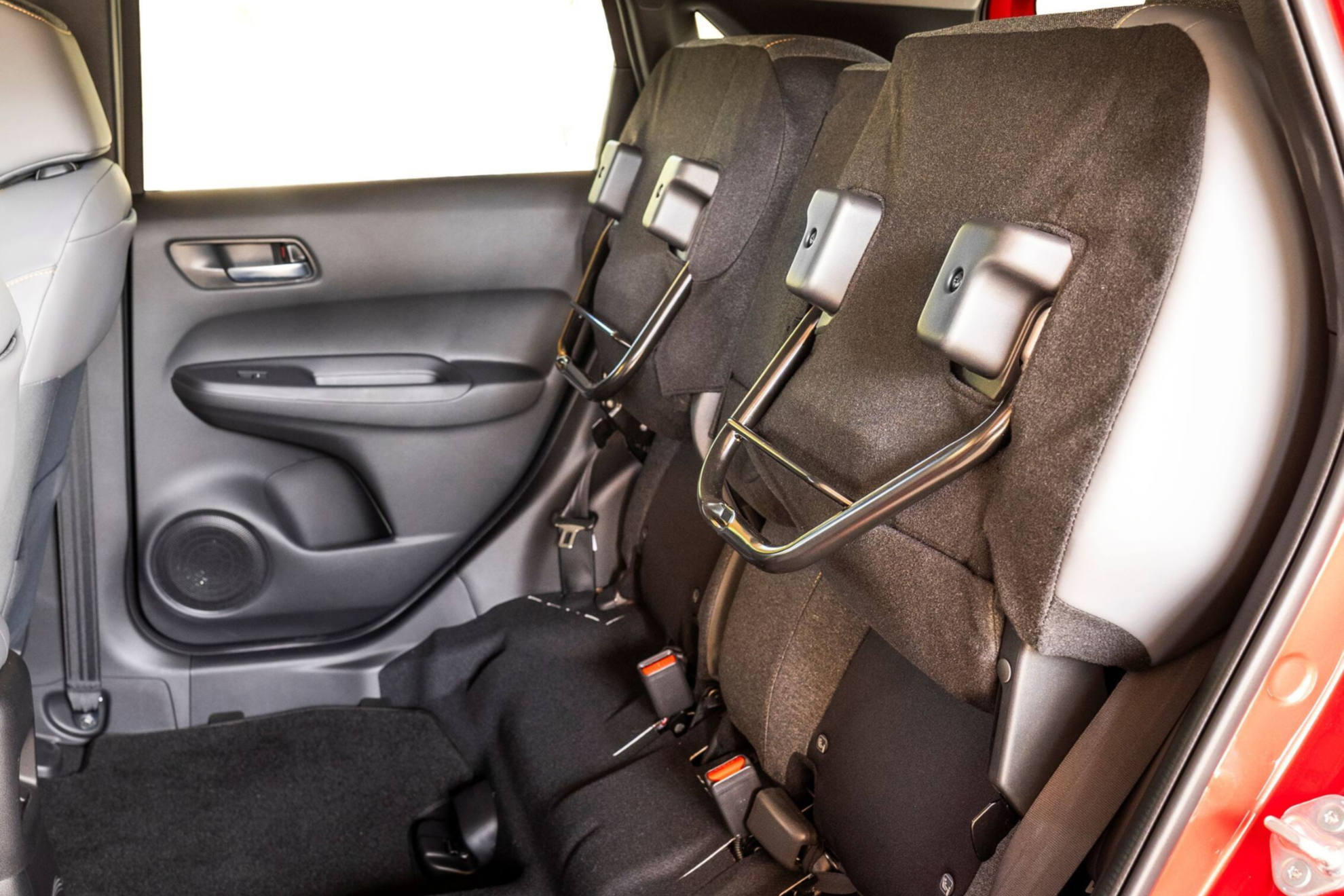
Magic Seats: the unique solution... The Jazz's interior remains a masterpiece of space optimization, as we discovered during the event (we had to fit as many cardboard boxes as possible inside, in true Grand Prix style). It doesn't boast the largest trunk in its class—its 304-liter capacity falls short of the Ibiza, Fabia, and even the Clio—but thanks to its regular shape and, above all, a low load lip, stowing your belongings is easy.
However, when it comes to versatility, the Jazz retains one of its signature features from the very beginning: Honda's Magic Seats. It is one of those solutions that seem obvious once you use them, yet very few manufacturers have managed to replicate them with the same effectiveness. Thanks to the central fuel tank position and a well-designed interior, the rear seats can flip up—like cinema seats—or fold down to create a virtually flat cargo area. In other words, the Jazz allows you to transport tall, bulky, or awkwardly shaped items without having to step up to a larger vehicle segment.
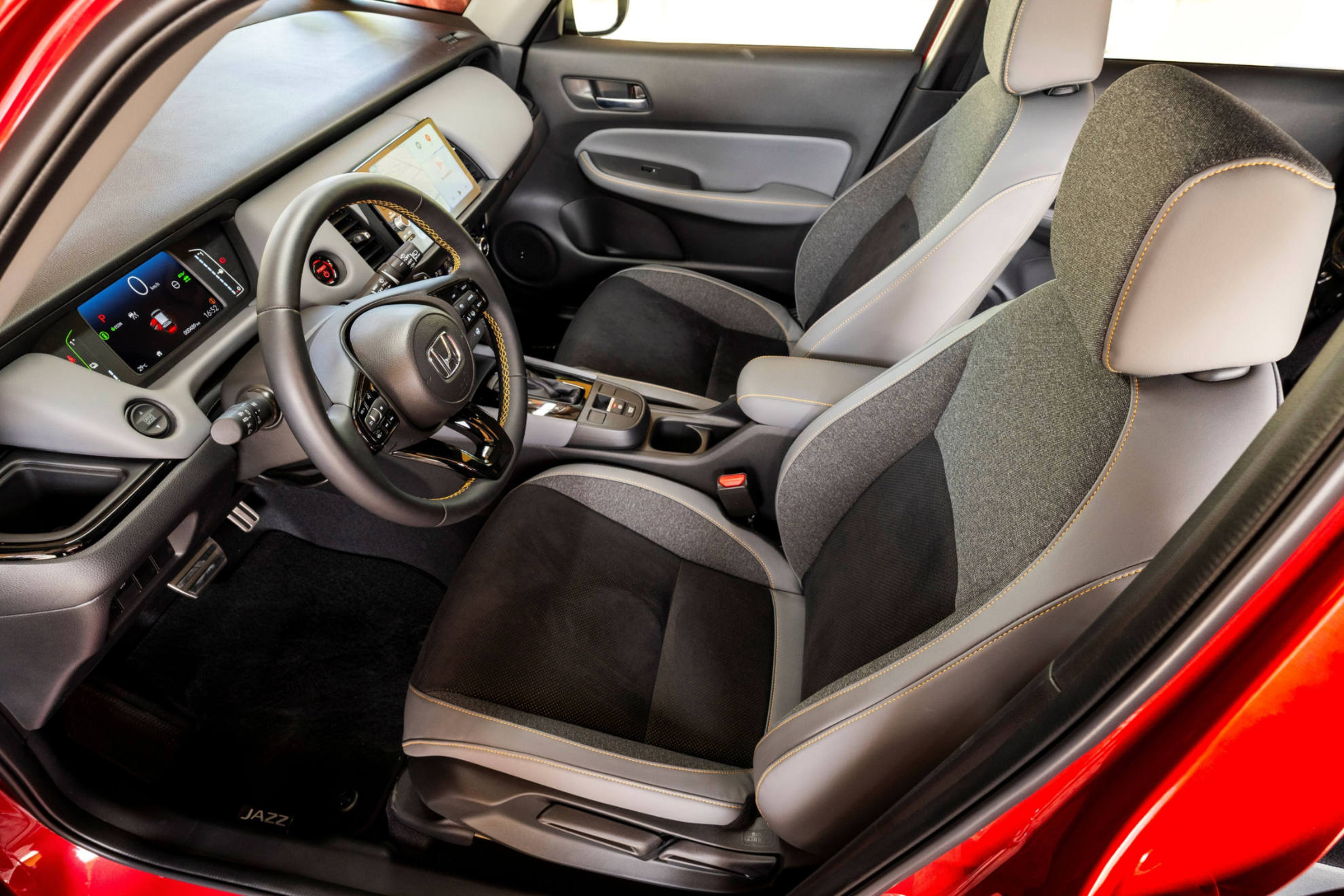
This is a key quality for understanding the model, as every centimeter counts in this category. With the Jazz, Honda manages to make the interior feel considerably more spacious than the exterior dimensions would suggest. The rear seats are spacious, access is easy thanks to a rear door that opens 90 degrees, and the overall feel is more akin to a compact minivan than a traditional B-segment car. Furthermore, the front cabin area also features various practical solutions, such as a dual glovebox on the passenger side, bottle holders at the ends of the dashboard, and a well-organized center console.
A hybrid, back when no one was thinking about it...Another aspect of the model's history is the efficiency of its powertrain. While talk of hybrid cars—including mild hybrids—is commonplace today, back in 2011, it was a rarity. That year saw the launch of the second generation, the main innovation of which was the incorporation of IMA technology. This solution wasn't as sophisticated as today's systems—in fact, it was a precursor to what we now know as mild hybrids—but it foreshadowed the direction Honda would reinforce years later with the fourth generation.
This latest version revives that concept with the e:HEV system, becoming the first European Honda to incorporate this two-motor hybrid technology. The current setup combines a 1.5 i-VTEC gasoline engine with two electric motors, a battery pack, and a fixed-gear transmission that allows for automatic switching between electric, hybrid, and combustion modes, depending on driving conditions. Total output is 122 hp, with 253 Nm of electric torque—more than enough to move the car with agility in the city and safety on the highway.
But the best part of the system is how it operates. The Jazz always starts and runs in electric mode for the first few meters, using the gasoline engine as a generator and driving the wheels when necessary for maximum efficiency. The driver doesn't need to choose anything; they simply drive while the car makes the decisions.
Where it really stands out is fuel consumption. Honda claims 4.6 l/100 km on the combined cycle for the Jazz e:HEV and 4.8 l/100 km for the Crosstar—figures that align with our real-world driving experience. It is relatively easy to achieve figures close to 5 l/100 km on the combined cycle and below 4 l/100 km in city driving. This level of efficiency is hard to match among most competitors and, once again, deserves recognition.

However, its limitations must also be acknowledged. The transmission can produce some noise during hard acceleration, and the car may exhibit some understeer on winding roads. On the other hand, the steering is light, the suspension prioritizes comfort, and the car moves very naturally in the city, where the electric motor's immediate response and ease of maneuvering are truly appreciated. On back roads, it behaves well—without sporting pretensions, but with enough composure to travel at a good pace without feeling unsafe. The Honda Jazz marks its 25th anniversary while remaining true to its roots—a remarkable achievement in a market that seems to change almost daily. It hasn't compromised on design or interior space; instead, it has evolved, proving that a small car can be exceptionally practical when designed from the inside out.
Perhaps that is why it has never been the top choice in Spain. It is a car that requires a certain sensibility to appreciate; the more you drive it, the more you understand its virtues—a rare quality in a segment where buyers are often swayed by habit, tradition, and, of course, price.
Although the current lineup remains straightforward—featuring the Advance, Sport, and Crosstar (the SUV-styled version) trims—Honda Spain is announcing special promotions to celebrate the model's 25th anniversary. The Jazz e:HEV Advance is available with monthly payments of €115 (based on a price of €28,800), while the Crosstar starts at €25,050 (MSRP €30,050). It may not be a cheap hatchback, but it is a car that boasts an ECO label, full hybrid technology, extensive equipment, and a warranty that can extend up to eight years, subject to the manufacturer's terms.
Autonews




Nenhum comentário:
Postar um comentário