AUTONEWS
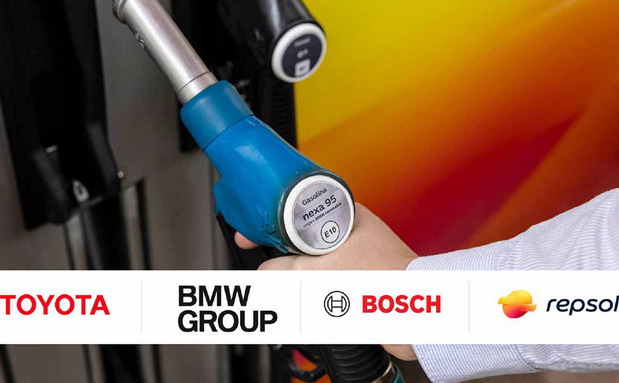
BMW, Toyota, Bosch and Repsol test vehicles on 100% renewable petrol
On Wednesday, a group comprised of Toyota, BMW, Repsol, and Bosch announced the launch of a new pilot program in Spain aimed at highlighting how existing vehicles can operate in the real world utilizing exclusively renewable fuel. The pilot program, which is slated to last for six months, will specifically target the collection of tangible data showing that these types of fuel can play a major role in the future decarbonization of Europe’s mobility sector.
The initiative itself, which was launched in early July, will center around a fleet of 20 Toyota and BMW vehicles. These machines are not significantly modified from their standard production counterparts, and are slated to only use existing renewable fuel infrastructure for the test. Repsol brings its expertise there, as the brand is the only one in Spain to offer 100 percent renewable gasoline at its pumps by way of the Nexa 95 blend.
The fuel itself is made from RED-compliant feedstocks, such as used cooking oil and tallow, which result in greenhouse gas reductions compared to more traditional fossil fuels. This blend, the study's partners say, is compatible with the fuel systems in vehicles on the road already. Bosch’s slick digital fuel tracking system will be used to support the experiment by certifying the results of the renewable fuel.
“Technology openness is a key pillar of the BMW Group strategy – at the same time our goal is always to have more environmentally friendly and efficient vehicles on the road,” said Stefan Heller, head of development of the VEEF program for BMW. “Our BMW and Mini vehicles as a part of this future oriented pilot, will help to gain valuable data helping us to offer our global customer the best and most efficient powertrain also in the future.”
While we will have to wait for the specific results of the study, the idea is one that enthusiasts can surely get behind. Europe is largely still embracing a less-oil-dependent future when it comes to automobiles, and strict emissions regulations in many parts of the globe continue to push the limits of what automakers can do without the addition of electrification. If we want to continue to see gas-powered sports cars from the likes of Porsche, BMW, Ferrari, and Lamborghini, to name just a few, studies like this one from Repsol could be a game-changing development. That’s especially true if the fuel works in vehicles without a need to significantly retrofit the powertrain.
BMW Group, Toyota Motor Europe, Bosch and Repsol launched a six-month pilot project in Spain in July 2026. The aim is to demonstrate how existing vehicles can run exclusively on 100% renewable petrol. Around 20 BMW and Toyota vehicles are taking part in the test, using Repsol’s Nexa 95 petrol, while Bosch is providing a digital fuel tracking system.
Three key objectives...The project focuses on three areas:
* Availability of renewable petrol – Repsol is currently the only one offering 100% renewable petrol at public petrol stations in Spain.
* Digital fuel verification – Bosch is developing a Digital Fuel Twin system that tracks and verifies the use of renewable fuel throughout its entire life cycle.
* Operational deployment of the VEEF fleet – demonstrating that existing vehicles can already run on renewable fuels without additional infrastructure investment.
Bosch’s system collects data from vehicles, pumps and card transactions, ensuring transparent tracking and verification.
Scalable solution without new technologies...Unlike electrification, this project uses existing cars and infrastructure. Toyota and BMW vehicles show that renewable fuels can be implemented immediately as a drop-in solution. Nexa 95 is made from feedstocks that meet the EU Renewable Energy Directive (RED) and delivers significant greenhouse gas reductions compared to fossil fuels.
Spain was chosen because of the availability of the fuel and the support of local partners. Repsol emphasizes that renewable fuels expand consumer choice and allow emissions to be reduced without the need to buy new vehicles.
Technology neutrality in European policy...The European Union is currently emphasizing electrification, but this project shows that renewable fuels can play a complementary role. Data from the pilot program will be shared with European decision-makers to consider the possibility of including renewable fuel vehicles in future regulations.
Toyota warns that the goal of 100% zero-emission vehicles by 2035 may not be fully achieved. In this case, renewable fuels can fill the gap and accelerate the path to carbon neutrality, especially in combination with hybrid technologies.
Gasoline or electricity? This project shows that renewable fuels are not just a theory but a real and fast option for reducing emissions. While electrification requires huge investments and time, renewable gasoline offers an immediate solution that uses existing infrastructure and vehicles. If the results prove successful, Europe will gain a strong argument for a technology-neutral approach in the transition to sustainable mobility.


Nenhum comentário:
Postar um comentário