DOSSIER
TESLA
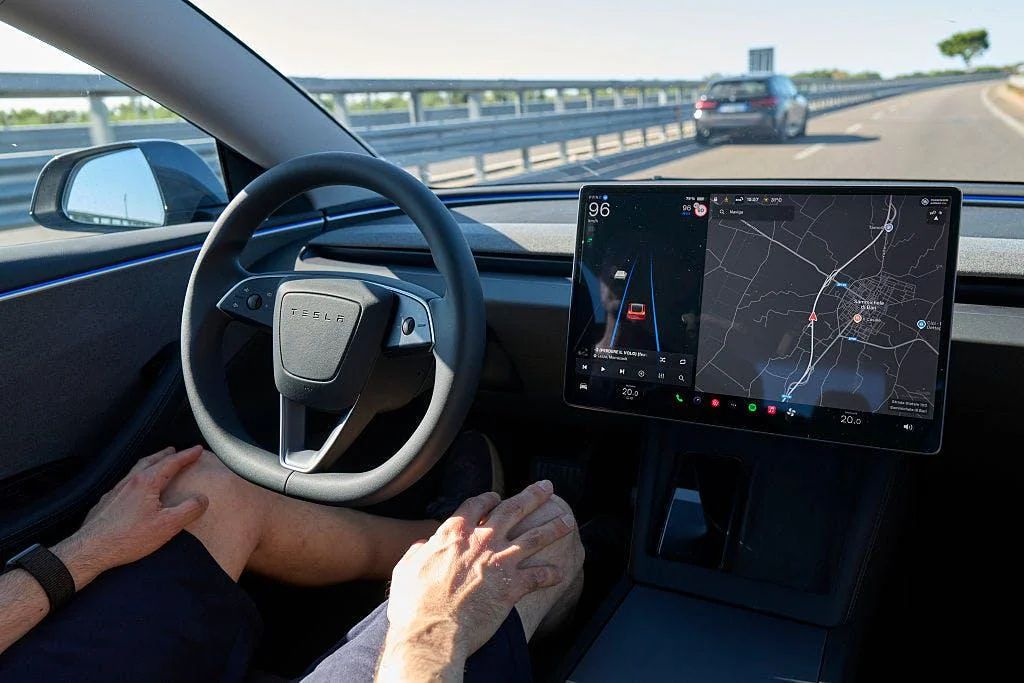
Tesla's Full Self-Driving: Learn what works and what's...less good
It was with surprise that the Dutch National Road Traffic Service (RWD) approved the latest version of Tesla's Full Self-Driving (FSD) to circulate on all public roads in the country, without the driver being required to put their hands on the steering wheel. The driver only needs to remain minimally attentive—not taking their eyes off the road for periods longer than a few seconds—and as long as they keep at least one hand capable of taking control of the steering wheel, if necessary. This is why this Full Self-Driving system is called Supervised, since it is the driver who is responsible for supervising the vehicle.
Tesla Netherlands FSD system...The Netherlands is the first country in Europe to approve Tesla's Full Self-Driving system. FSD could be translated as fully autonomous driving, but the system is just a more advanced driver assistance system and still requires the driver's full attention.
Tesla and the Dutch RDW (official traffic organization) confirmed the news. Tesla has been fighting for a year and a half to get the technology approved on European roads.
The system allows for autonomous vehicle movement in many scenarios, but it is necessary for the driver to be active and to be able to take control at any time. Also, FSD is only legal in the Netherlands and cannot be used in the rest of Europe. Tesla points out that the risk of an accident can be up to seven times lower per kilometer than if the car was driven by a driver. That, of course, is what Tesla claims. Now, the FSD system will be installed (over the air) in all Dutch Teslas that meet the requirements.
The announcement was made on April 10th, so since then all Tesla models equipped with this driver assistance system can now circulate everywhere, without the driver needing to put their hands on the steering wheel. From roads and highways to large cities like Amsterdam — where traffic is particularly complex due to the presence of pedestrians and, above all, many cyclists, which is expected in a country with 17 million inhabitants and more than 22.5 million bicycles — the authorities in the Netherlands decided that it was safe to entrust the driving of Teslas to a machine, albeit supervised, this being the first and, for the moment, the only system authorized to operate in all types of situations and on all types of roads, without human intervention. There are competitors that offer similar systems, but only capable (and authorized) to take over driving the vehicle in specific areas and always on highways.
The homologation of the FSD Supervised was far from being done lightly by the RWD, an entity that needed 18 months of testing and the consequent analysis of data before allowing the models of the American automaker to share the public road with other vehicles, with humans at the wheel. But the authorization for Tesla's autonomous driving system to continue operating freely on Dutch roads will remain subject to mandatory supervision until the manufacturer can prove that FSD is reliable in all types of situations. Even the most unpredictable ones.
Five days after the homologation of FSD Supervised in the country we have known as the Netherlands for decades, Tesla invited Observador to travel to Amsterdam and, exclusively, verify the effectiveness of the new autonomous driving system. Simply leaving the hotel parking lot sitting behind the wheel and activating only FSD Supervised, without touching the pedals or the steering wheel, allowed us to see the evolution compared to the already known Autopilot, because, despite the tight space and the little room to perform the maneuver, FSD proceeded with surprising ease, which led me to crane my neck to make sure we wouldn't "rub" against the car next to us, or hit the one parked in the second row in front of us.
Accompanied by one of Tesla/Europe's technicians, the company responsible for adapting the system to Dutch legislation, the same as that in force in the Old Continent, we continued on a route mostly through the capital — which made sense since this is traditionally the area that presents the most difficulties for autonomous driving systems. But the hands-free experience also included some road and highway routes, introduced by our companion who, sitting in the seat next to us, seemed quite confident.
To avoid the chosen route being pre-mapped specifically for the event, facilitating the work of the FSD, we requested the introduction of new waypoints in the navigation system. One that would take us to the Red Light District area, Amsterdam's nightlife center full of narrow streets along the canals, crowded with people and where even bicycles have difficulty circulating, and from there to the Johan Cruijff Arena, Ajax's football stadium, with conditions closer to those of large traditional urban centers. The first difficulty came at a T-junction, where we were going straight and a bus entered the main lane, turning 90º to the left. It was obvious that, given the width of the street we were on, the front of the bus would have to encroach on our lane and, curiously, this was also the "perception" of the FSD (presumably a vehicle or vehicle), which began to swerve to the right even before the heavy vehicle posed a threat. This without ever reducing speed, which was always at the level of the more "aggressive" vehicles with whom we shared the streets of the capital.
The FSD easily detected all the traffic lights we encountered. But, unlike flesh-and-blood drivers, it brakes on yellow lights, which led us to question "our" technician about the humans who had taught the system to drive. The answer came quickly: "The FSD has the ability to learn, like humans, with the contribution of all vehicles in circulation, but also with the experience collected by Tesla technicians, like myself, but always prioritizing safety."
One of the most difficult situations we encountered was in the Red Light District, when we were driving on one of the one-way streets near the canal, where the driver has to swerve a little to accommodate the pedestrians and cyclists they encounter, when the navigation system told us to turn right, into an even narrower alley. There we came face to face with a truck that seemed to be carrying out its morning deliveries to the cafes, bars and restaurants in the area. We hadn't yet recovered from the surprise when the FSD was already reversing and turning left onto a street that, because it was uphill, limited visibility, always respecting pedestrians and cyclists, but without wasting much time. I (a human), under those conditions — with the visibility problems, the number of people around the car and a total lack of knowledge of the intersection in question, especially with other cars behind, one of which didn't want to wait and forced its way through — would have performed the maneuver more slowly and carefully.
There were several situations in which the FSD impressed, for its agility and efficiency, but none like the one that happened on a street in Amsterdam, with the necessary width for two traffic lanes, one in each direction, but which the city decided to complicate — and even make dangerous — by allowing parking right up against the sidewalk on both sides. In practical terms, this means that whenever two vehicles cross paths, the drivers need to negotiate and reach an agreement between the interests (and priorities) of one driver and the other, which I thought would be complicated if one were human and the other controlled by a chip. Sitting behind the wheel, I felt for the first time like I was in the dead man's place, because as the supervisor of the FSD I wanted (and needed) to see how far it was capable of going. But, on the other hand, I was already imagining myself engaging in a conversation with one of the Dutch police officers who, besides seeming to have (even) less of a sense of humor than ours, speak the language of someone who, apparently, has a huge thorn stuck in their throat. But "our" FSD, with me supervising but without moving hands or feet, found a way to dare to advance when it understood that the traffic rules gave it that right, only to then "shrink" to let the other vehicle pass when it concluded that the other had the right. The truth is that we drove down the long street without problems and at a good pace, without hesitation. I felt a bit like those proud parents with the ease shown by their child taking their first (successful) steps behind the wheel of the family car.
What surprised us negatively and what still needs to evolve...Despite the frankly positive outcome during our test, with the FSD Supervised revealing great ease on the streets of Amsterdam, the experience also served to detect the system's difficulties in dealing with less frequent situations, but which an experienced driver can still solve better than the machine. This is why this Tesla FSD, now adapted to European standards, embraced by the Netherlands, still needs supervision, although it is expected to continue evolving into an autonomous driving system, as soon as everything is perfect.
We have already stated here that, during the route we took to test the FSD Supervised, under real-world conditions, we never felt the need to grab the steering wheel to replace the "machine" when faced with more complex situations. But the same did not happen with the pedals, namely the accelerator, which occurred on two occasions. One was when the system, after identifying the red light and stopping, as expected, completely failed to identify the green light, which would have allowed it to start moving. We were then forced to briefly tap the accelerator to get the FSD moving again. The explanation given by “our” technician was that the system was not sure if the green light was directed to the lane it was in. “This is something that is already receiving our attention,” he assured us.
Another situation where FSD revealed weaknesses occurred in the Red Light District area, just after an intersection where we turned right onto a narrow street near the canal, when we encountered a tour guide leaning against the left and a group of about 15 tourists drinking in the words the guide was shouting from across the street. Even we, who already knew about Tesla's (very) careful approach to the system, were surprised that FSD was torn between moving forward, since everyone was perfectly fine where they were and the street was clear, or stopping to yield to the pedestrians, as if the tourists wanted to cross to the other side. Again, it shouldn't be difficult to "explain" to the system that, in a case where there are pedestrians with no crosswalk in sight and without expressing an obvious desire to cross, the car can proceed. Something our technician agreed with, assuring us that "it's just a small problem to overcome."
Will FSD arrive in Europe and Portugal? And when will it be autonomous? Approved by the Netherlands after 18 months of analysis and testing, there won't be much that the Dutch don't know about the potential of FSD Supervised. In addition to approving the system to circulate on the country's public roads as what it is, an autonomous driving system as long as it is supervised by the driver, the local authorities have made it known that they will propose to the European Union that the system be approved in all member states.
This widespread approval may not happen, at least not immediately, since many European automakers, with emphasis on the German ones, will not fail to fear that FSD, even if supervised, will give Tesla too great an advantage. The most likely path may be for each country to approve FSD separately, if it is convinced of the system's advantages, which is equally valid for Portugal.
As for the evolution of the FSD Supervised approval to just FSD, that is, capable of guaranteeing autonomous driving, everything depends on the performance it manages to demonstrate in the Netherlands. The number of incidents or accidents you are involved in with FSD (even if the driver is always at fault) will determine the future.
by Autonews



Nenhum comentário:
Postar um comentário