AUTONEWS
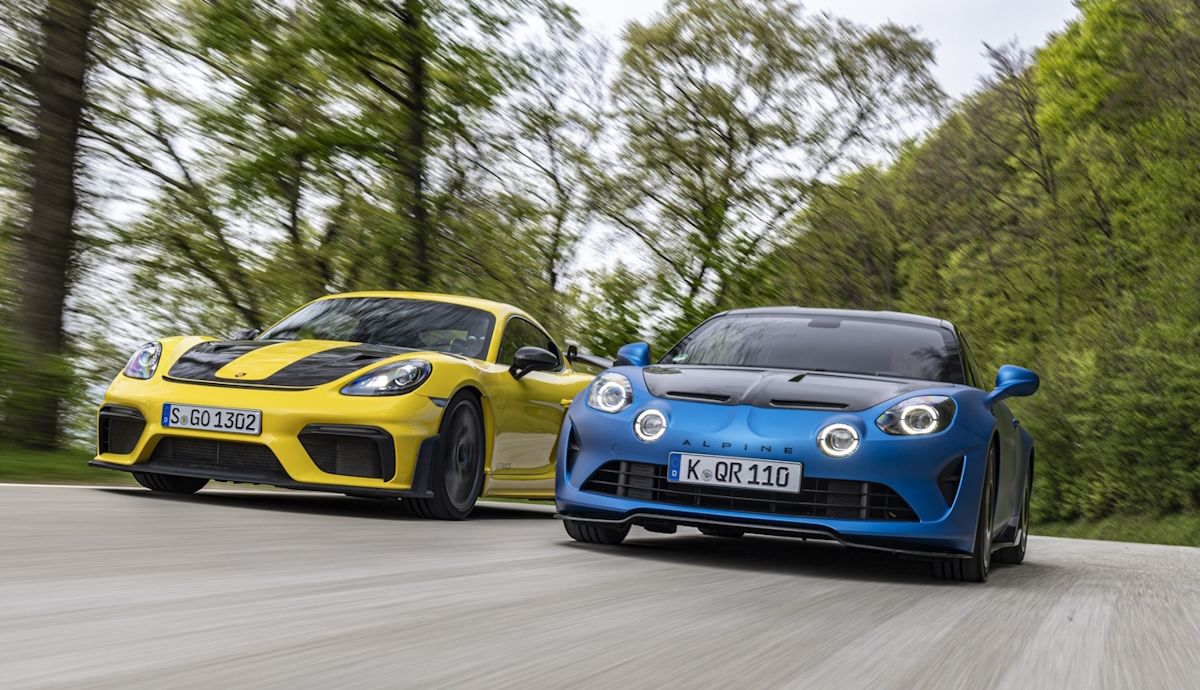
Supertest--Alpine A110 R vs. Porsche 718 Cayman GT4 RS: Which is the best pure sports car right now?
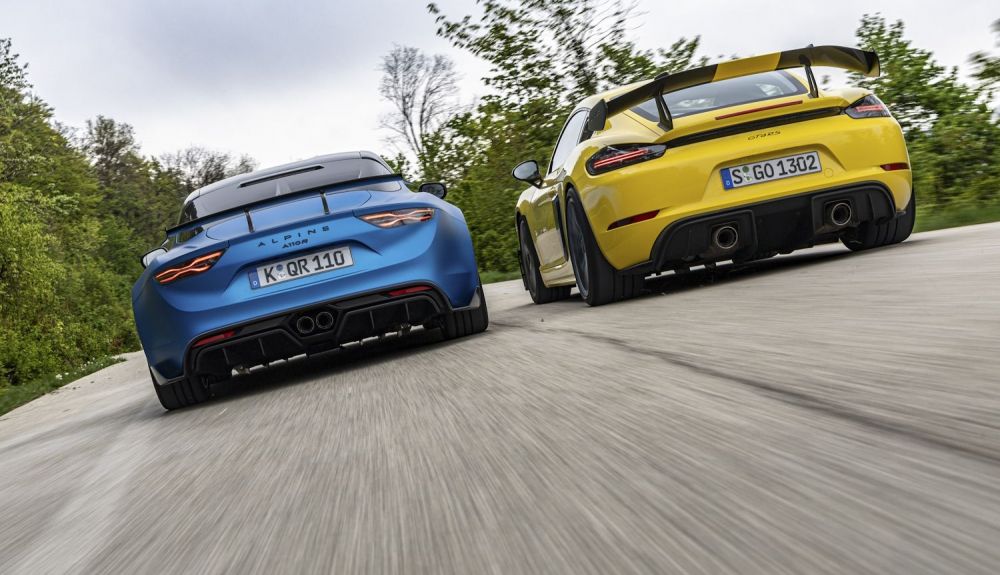
Arguably the best sports cars of the last two years, or at least the ones I liked the most, are these two models we're comparing today. And, interestingly, both share a common destiny: to be the last of their kind for their respective brands and eventually become electric cars. Or at least, that was the intention of the medium-term industrial plans outlined with the electrification phenomenon that Europe imposed five years ago. But as this process is proving to be a failure and brands seem to be backing away a bit, perhaps some models like the ones we're discussing here will be saved.
The original intention was for Alpine to be an exclusively electric brand and for the 718 to also be an exclusively battery-powered model.
I won't go into too much detail about the cars, as we've already done in our individual tests. Both the Alpine A110 R and the Porsche 718 Cayman GT4 RS are top-of-the-line models and, why not say, the best. And not because they're the most expensive or exclusive, but because they offer what buyers of a car like this seek: thrills and sensations. Speaking of price, since we tested these cars individually, their cost has increased by approximately 10%.
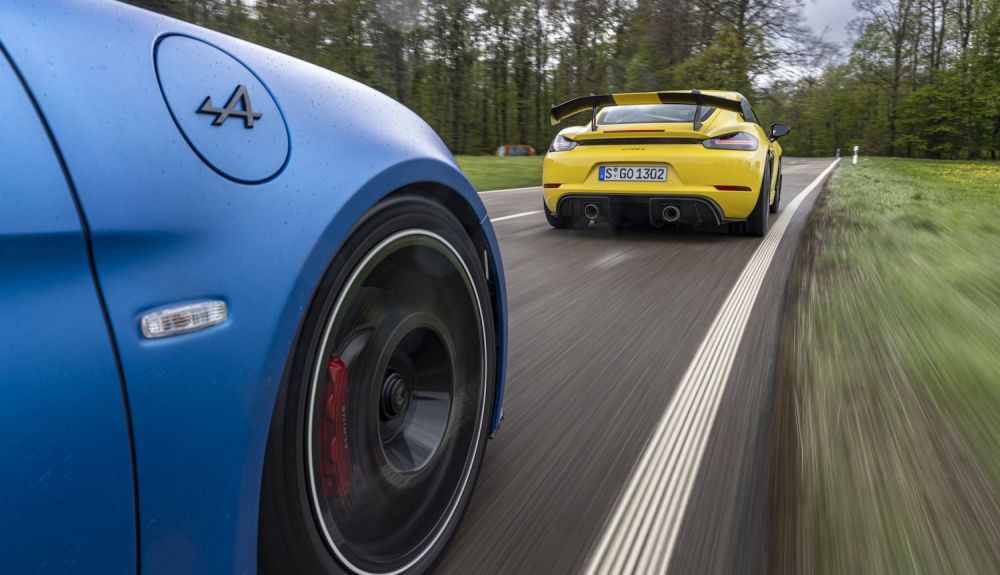
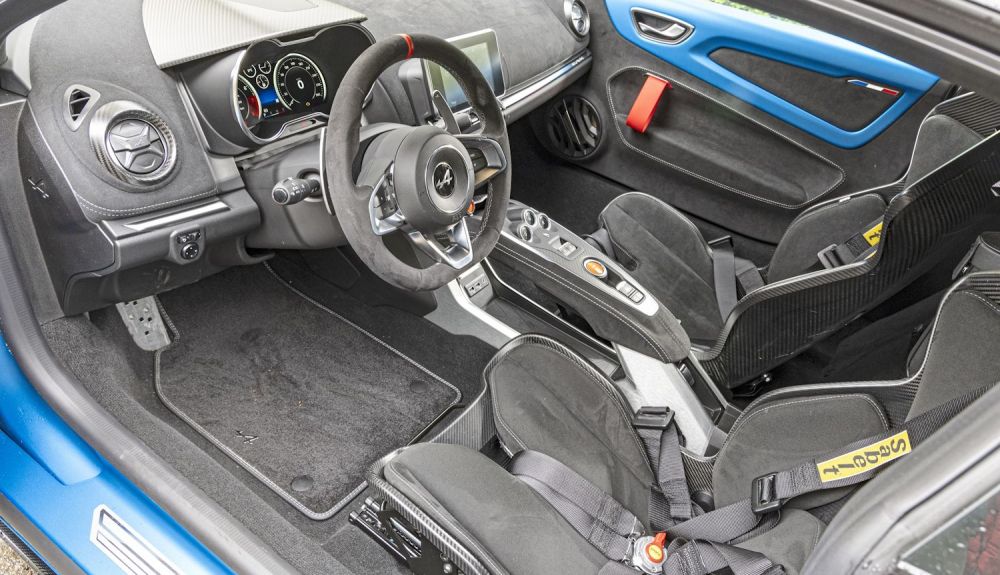
The secret lies in the weight...But where does the secret lie in this balance of power? Well, in the weight. According to our scales, there's a difference of 344 kilos in favor of the French model. If the Alpine was already light at birth, in this R version, they've worked hard to make it even lighter. And this despite the fact that the interior isn't as austere as its intentions and weight might suggest. The suede interior, good equipment, and even a central digital screen (in addition to the instrumentation behind the steering wheel, which is also digital). In short, it's not as austere as it might seem when you see the doors with a red canvas handle and no storage spaces. Its bucket seats are simply spectacular and padded enough to avoid discomfort, but you truly feel like you're in a race car.
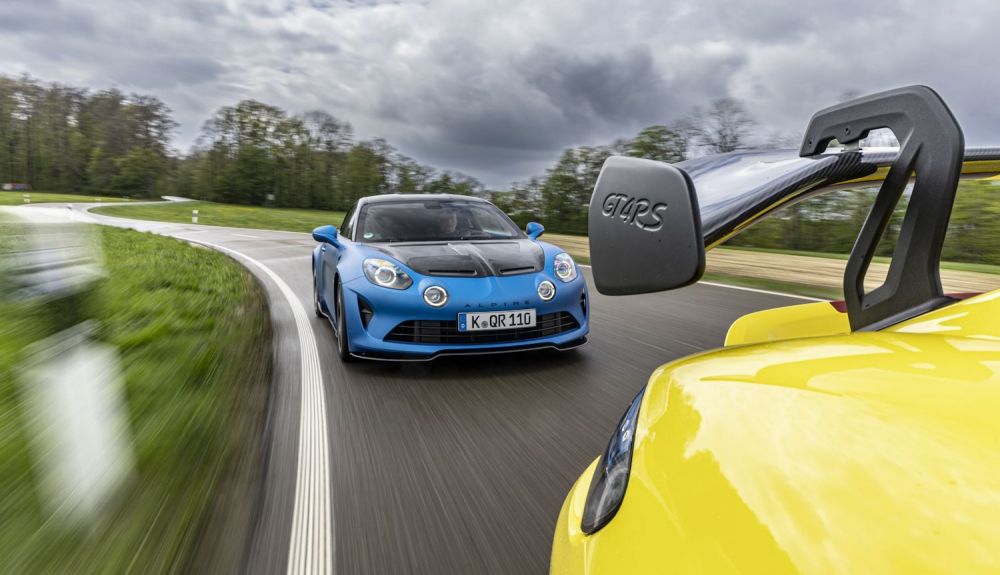
This is the Porsche 718 Cayman GT4 RS...The Porsche 718 Cayman GT4 RS retains the McPherson strut system, but has been tuned like never before in a Cayman. The two axles have been so well balanced that they resemble the stability of a 911. To support the front axle, they use the same fender vents we first saw on the 991 GT3 RS. These vents are called "louvers" and originate from motorsport. They aren't for ventilation, but rather for stability, especially at high speeds, as they reduce the excess pressure that occurs when the tire rotates in the wheel arch. This effectively reduces upforce on the front axle.
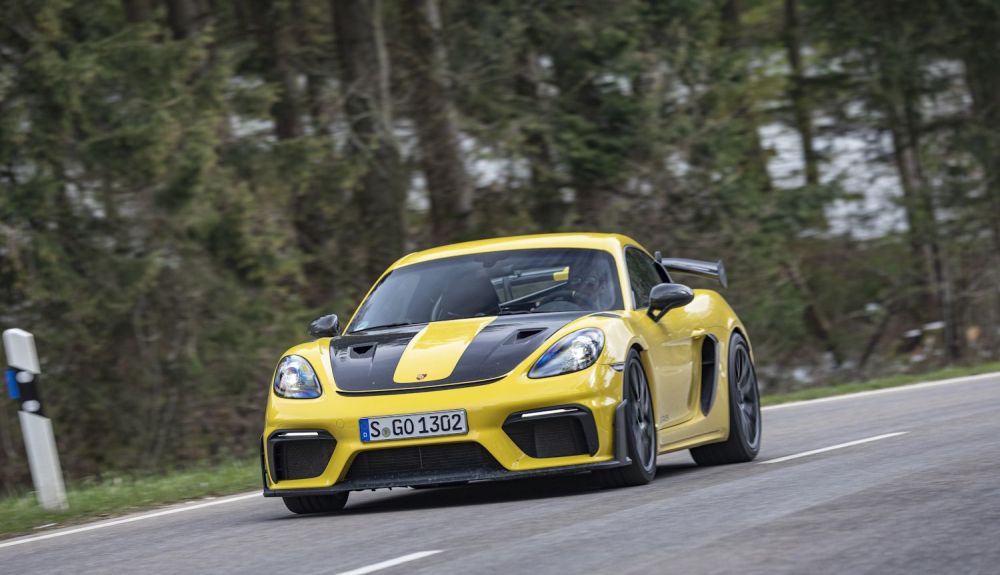
Axle balance is now near-perfect, and you don't get the feeling that the rear axle is trying to escape when you turn the wheel quickly with the quickest available steering (it's variable with a ratio of 16.9:1 to 12.25:1), or that the front axle feels unreliable when you're accelerating hard, hoping it will support you without understeering and forcing you into lift. Spring rates have been increased from 45 N/mm to 100 N/mm at the front axle and from 80 N/mm to 140 N/mm at the rear axle in the GT4 RS. Additionally, the front axle track is six millimeters wider and the rear axle track is eight millimeters wider than in the 718 Cayman GT4.
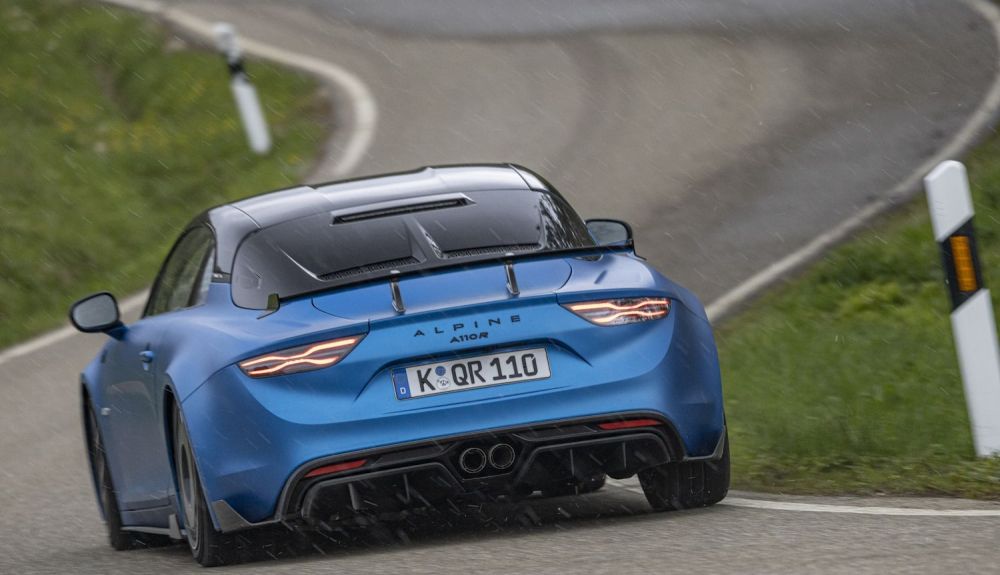
In the Porsche, aerodynamics come into play in such a way that it completely changes the model's appearance. First, there's the massive rear spoiler, anchored by swan-neck struts and capable of carrying a load of 100 kg at 200 km/h. The NACA intakes on the carbon fiber front hood also provide high-tech sealing, as they are used to cool the brakes without compromising aerodynamic efficiency. Other NACA intakes are located at the bottom of the car to cool the gasoline particulate filter and avoid affecting the airflow exiting the rear diffuser.
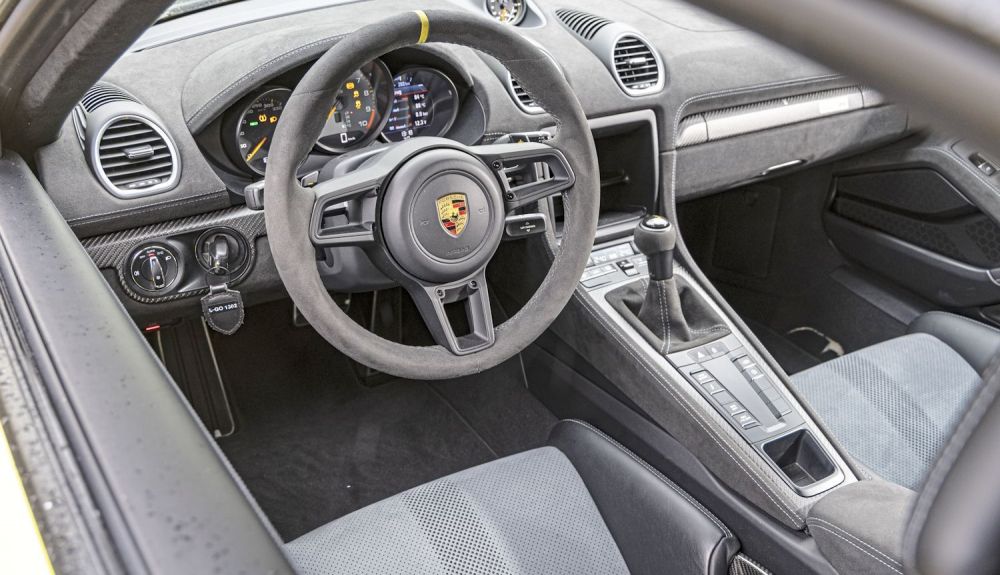
While the main difference is the side air intakes in the rear window area, which have been replaced by vents that channel air to the engine, they are not only necessary for air volume but also aesthetically stunning, as can be seen under the rear window. The engine is a work of art, and unlike the 911, in the 718 Cayman, you can see it. And hear it, because, being centrally located, the driver has it literally right next to their ear. Although the main difference is the side air intakes in the rear window area, which have been replaced by vents that channel air to the engine, they are not only necessary for air volume, but also aesthetically spectacular, as can be seen under the rear window. The engine is a work of art, and unlike the 911, in the 718 Cayman you can see it. And hear it, because, being centrally located, the driver has it literally next to his ear.
The engines of both sports cars, two jewels...And the engine is one of the stars of this version. Of course, it remains naturally aspirated, a hallmark of its design from the beginning. But for the RS, it goes from the 4.0-liter flat engine, codenamed MA223 and producing 420 hp, to the MA275 used in the 911 GT3, but with 10 hp less, as this RS "only" has 500 hp. During the development of the 992 GT3, the dry sump tank for the oil supply system was designed for installation in the mid-engine sports car. The air intakes in the side windows were also considered. From left to right, the intake air flows unobstructed into a centrally located airbox behind the passengers. This allows us to enjoy a fully amplified wind concert from privileged seats. Therefore, while the sound is beautiful and exciting, the noise inside the cabin is extremely loud. You can barely hear the radio or talk to your passenger. But what a difference it makes!
The fact is that we're looking at a car that, thanks to its lightness, achieves a power-to-weight ratio of 3.76 kg/hp, while the Porsche's ratio is 2.87 kg/hp. Obviously, the GT4 RS has no rival in the Dieppe model, but it had to work hard to beat it in certain tests. On our circuit, for example, the time difference isn't as great as one might assume, given the power difference between the two. There's a real difference of 209 hp between the Porsche's naturally aspirated engine and the Alpine's supercharged engine. This time, we were able to measure them on our dynamometer, and both yielded good results, although in the case of the A110 R, it fell slightly short of the declared value. It's only 10 hp, but when you need all of them to push and be able to compete with a rival the size of the GT4 RS, you'll miss them.
Better sensations in the Alpine...From a feel standpoint, I'd almost say you're better off with the Alpine, because the lightness is appreciated when you're at the limit of the track. Inertia is lower and braking is more controlled. This translates into agility when entering a corner. It gains speed quickly, aided by the car's roll. Since it's a mid-engine car, the inertia when braking and turning is noticeable, disengaging the car, but not radically; it does so progressively. And when you do accelerate, since it's not a tremendously powerful car or with huge torque, you can accelerate without the car spinning. Traction is excellent, aided by the semi-slick tires.
The Porsche is less agile than the Alpine, but it's obviously more efficient because it has more ammunition. Of course, it also runs on semi-slick tires, which are essential to get the most out of these machines. We always compare it to a 911 GT3, but it can't be equipped with the rear-wheel steering its bigger brother has. This would give it the extra agility needed to be unbeatable on all terrains, but it would likely make the car undriveable. With this steering system, the cars become much more unstable, and a high level of driving experience is essential, especially with short-wheelbase cars like this Cayman. This is already very well achieved in 911s, and it's impossible to imagine a supercar in this Porsche lineup without rear-wheel steering assistance.
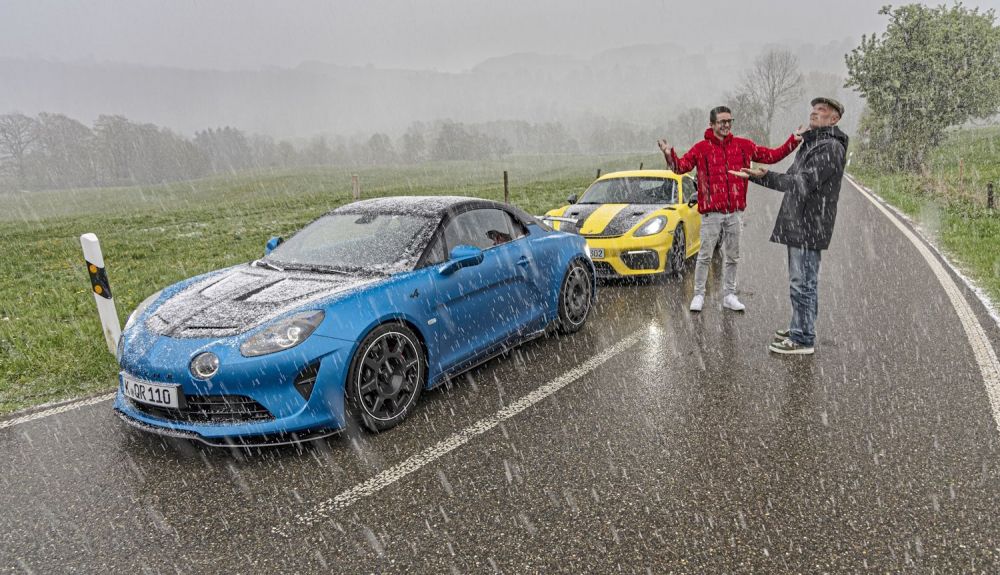
The Porsche, in turn, is the best of the best. The 718 Cayman has always been the younger, marginalized sibling of the 911 family. But the GT4 RS can hold its own against any 911. It has nothing to envy the vast majority of 911s and, above all, delivers spectacular sensations. It's not as extreme as the original 2015 GT4 (981 generation), so it's more civilized for everyday use, although it should be clear that it's still a true sports car, without compromise. Exactly how we like it. And perhaps they'll reconsider their electrification plans, as with the A110. We'll see.
Reporter: Juan Ignacio Eguiara, Spain

:strip_icc()/i.s3.glbimg.com/v1/AUTH_cf9d035bf26b4646b105bd958f32089d/internal_photos/bs/2021/e/R/gSPPBXTC6dO3lVwwNT7g/catsvaii.jpg)


Nenhum comentário:
Postar um comentário