AUTONEWS
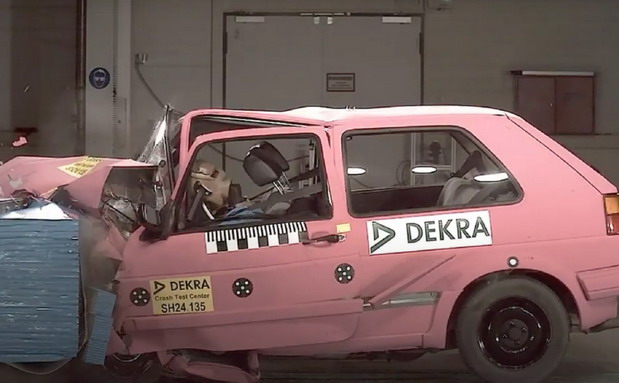
How did the Volkswagen Golf II fare in a modern crash test?
Enthusiasts and journalists often point out that cars are getting bigger and heavier than they were a few decades ago, and much of that weight is dictated by safety regulations. Still, you're much more likely to survive a crash in a modern car than in an equivalent model from 20 to 30 years ago. A new crash test of Volkswagen's old second-generation Golf has served as a reminder of just how far car safety has come.
Dekra, an independent car safety organization founded in 1925, has now subjected the second-generation Golf to the strict standards of a modern crash test. The aim was to show how far car safety has advanced by comparing the hatchback from 1989 with its current successor, the eighth-generation Golf from 2024. Dekra secured a 36-year-old car for this unusual test.
At its crash test center in Neumünster, Dekra "launched" a Golf II into a barrier at a speed of around 60 km/h, simulating the frontal collision procedure that Euro NCAP will use until 2020. The barrier was equipped with a deformation element to imitate the energy absorption of an oncoming vehicle. Under these conditions, the test reproduced a frontal collision between two identical cars, traveling at a speed of 50 to 55 km/h.
Although the terrifying photos of the aftermath were convincing enough, a Dekra expert commented on the results.
"In the Golf II, the passengers would have had little chance of surviving this frontal collision due to the collapse of the passenger compartment, the deep penetration of vehicle components into the passenger compartment, the deceleration and the impact on the steering wheel," he said.
The outcome was much different for the Golf VIII tested under exactly the same conditions. Its passengers would probably have escaped with only minor injuries.
"The entire passenger compartment remained completely intact, and the passengers were very well protected by front and side airbags in combination with seat belts, belt tensioners and belt force limiters," added the Dekra expert.
Dekra did not stop at destroying a 1989 Golf for the purpose of demonstrating safety. Braking tests showed that the eighth-generation car needed about 30 percent less distance to come to a complete stop. Cornering stability was also tested in a maneuvering test, with the modern Golf safely completing the test at a speed of 75 km/h compared to just 65 km/h for its predecessor.
The differences also apply to visibility. The new car's standard LED headlights are "in a completely different league" than its predecessor's halogen bulbs. At the rear, LED lights have improved visibility for drivers behind, and are further enhanced by a third brake light, which was not available on the 1989 model. It should be noted that the additional brake light was not mandatory in Europe until the late 1990s, although some cars adopted it earlier.
-----------------------------------------------------------------------------------------------------------------------------
-OutIn Nano Portable Electric Coffee Maker, Capsule & Ground Coffee Maker, Self-Heating Car Coffee Maker with USB-C, with Ground Coffee and NS Capsule for RVs, Hiking, Office. (https://amzn.to/4fAOVRu)
-Nespresso Combo Essenza Mini Red + Aeroccino 220V(https://amzn.to/3UrFiuI)



Nenhum comentário:
Postar um comentário