AUTONEWS
How safe are old cars?
Size matters, but it's not the only thing. In any conversation about cars, there's bound to be at least one person who will conclude that "cars don't work like they used to." And most people would agree. And when it comes to safety, that's a good thing.
The phrase "making cars work like they used to" would mean omitting many of the basic safety features we take for granted today. Probably the most important of these are airbags and crumple zones. Despite this, the claim that old cars are safer is still heard, so engineering firm Munro & Associates has made a video to debunk the myth.
Chief engineer Carl Crittenden explains that he's not against old cars. He loves them, owns a few, and restores them in his spare time. But even from a classic car enthusiast's perspective, the idea that a decades-old sedan, with a classic body-on-frame chassis, is better built than a modern car full of plastic simply doesn't hold water.
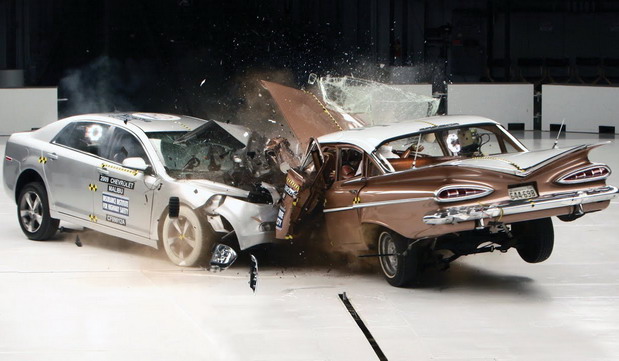
He points to a video released in 2009 by the Insurance Institute for Highway Safety (IIHS) comparing a 1959 Chevrolet Bel Air to a 2009 Chevrolet Malibu in a crash.
While the Malibu was no masterpiece of automotive engineering, it literally destroyed the Bel Air in a crash. Still, the video is a topic of debate today, 16 years later. Crittenden notes that there are frequent allegations that the Bel Air’s engine and transmission were removed before the test. He refutes this with photographs that clearly show the engine remained in the vehicle.
He also rejects the claim that one fender had its brackets removed to make it easier to remove. On the Bel Air, the fenders are attached only to the radiator support and the body. In contrast, most newer cars have fenders attached to a metal structure that also serves as a crumple zone.
The sheet metal used in automobiles used to be thicker than today, but the body panels were weaker because they weren’t reinforced. Crittenden demonstrates this by comparing the doors of an obscure 1961 model to the doors of a new Kia EV9. The old doors are a millimeter thicker, but they’re completely hollow. The new ones, although made of thinner sheet metal, are reinforced in several key places.
If safety is your top priority, buying an old cruiser isn’t the best choice. Of course, owning a vintage car has its charms, and even its advantages, but safety isn’t.
Autonews


Nenhum comentário:
Postar um comentário