AUTONEWS
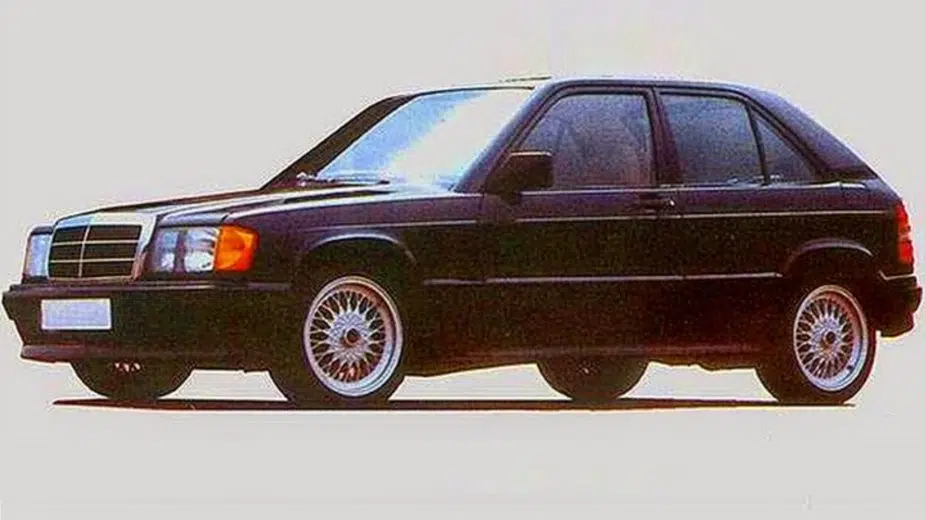
Mercedes-Benz 190E City: the curious hatchback, rival to the Golf that Mercedes-Benz never produced
It may not seem like it, but the first Mercedes-Benz hatchback only appeared in 1997 with the launch of the A-Class. Until then, the closest thing to a hatchback from the Stuttgart brand was called the 190E City and... it was not created by Mercedes-Benz!
So it is. While marking the definitive rise of hatchbacks, the 1980s also saw Mercedes-Benz launch a revolutionary model in its history: the 190 (W201).
Nicknamed the “baby-Mercedes”, this was a revolutionary car for its time and for the star brand, representing a complete paradigm shift for Mercedes-Benz. It dispensed with XXL dimensions, did not make intensive use of chrome throughout the bodywork and inaugurated a new stylistic language.
Despite all this, the Mercedes-Benz 190 (W201) was still far from the dimensions of the hatchbacks that were all the rage in that decade and perhaps for this reason (or inspired by the 190E Stadtwagen whose story we will tell you) Schulz Tuning decided to create the 190E City.
Founded by Eberhard Schulz, a former Mercedes-Benz designer whose most celebrated work was the CW311 project, Schulz Tuning was responsible for the birth of the 190E City (a.k.a 190E Compakt).
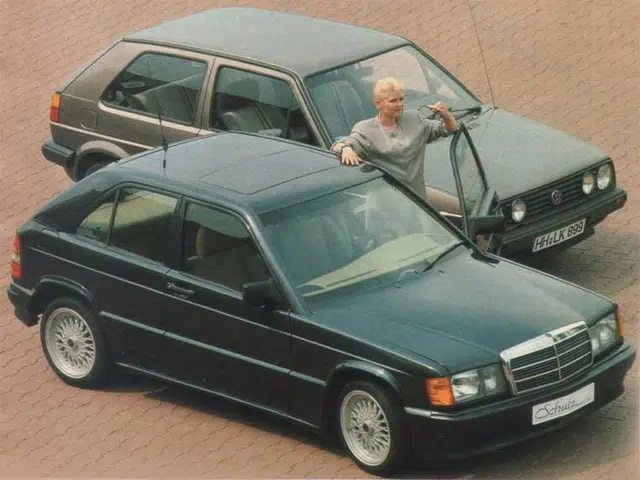
Based on the 190E chassis, the 190E City saw the rear end cut just behind the doors, thus losing the third volume that made it a sedan.
To make it a hatchback, Schulz Tuning equipped it with the trunk door from the station wagon variant of the Mercedes-Benz W124. Also inherited from this were the taillights.
Available with three and five doors, the 190E City from Schulz Tuning pointed directly to what was, at the time, one of the references among hot hatches: the Volkswagen Golf GTI. To do this, he used a Mercedes-Benz inline six-cylinder with a capacity of 2.5 l or 2.6 l that delivered between 160 hp and 204 hp.
Promising but didn't go far Produced in an artisanal manner, it goes without saying that the 190E City was considerably more expensive than the models it was intended to compete with, reflecting not only the greater level of luxury it presented but also the higher production costs.
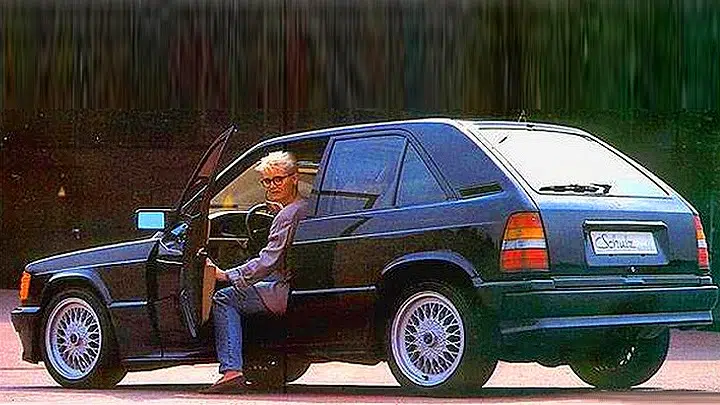
In addition, there was another factor “playing against” the 190E City. Mercedes-Benz did not want to be associated with the model and for that reason it could not have the brand symbol (this does not mean that they did not receive it later from the owners), thus losing even more potential customers.
The end result of all this was a virtually residual production that, according to rumors, was between four and six units.
Mundoquatrorodas


Nenhum comentário:
Postar um comentário