AUTONEWS
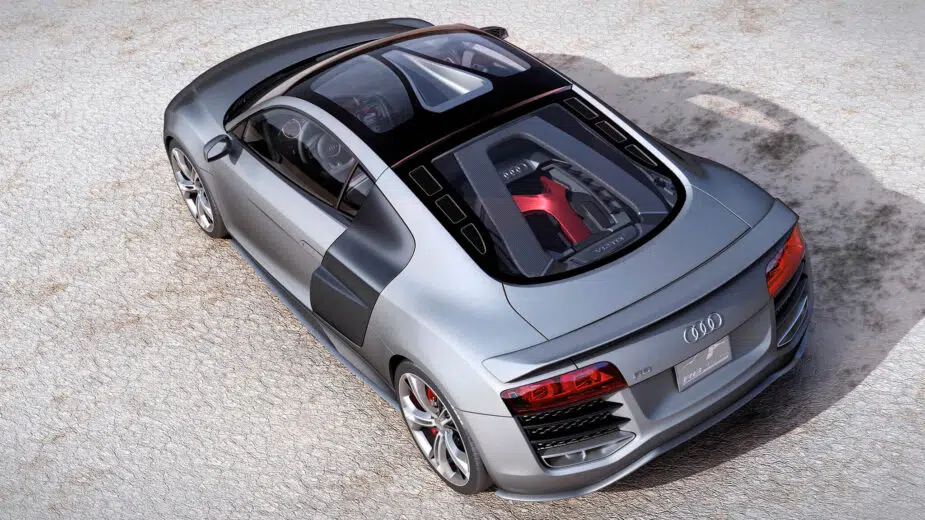
Audi R8 V12 TDI Concept: the diesel-powered super sports car
The year 2008 could not have started, in the automotive world, with a bigger bang. Audi took to the Detroit Motor Show — which always takes place in the first few days of the year — a prototype of the R8 that would shake the foundations of all beliefs about pure sports cars and super sports cars. The Audi R8 on display came equipped with a huge V12 block… Diesel!
Can you imagine the waves of shock and amazement? A Diesel supercar?!
Dissenting voices claimed that a Diesel supercar was an absurd idea. Contextualizing the presentation of this model, it was not at all… It was 2008 and not 2018 (NDR: at the time of the original publication of this article).
The diesel engine was the car's best friend. More and more diesel engines were sold, accounting for almost half of sales in the European market, and Audi, in particular, had already scored two victories in the 24 Hours of Le Mans with the Audi R10, a diesel prototype — an unprecedented feat. And it wouldn't stop there, totaling eight victories at Le Mans with diesel-powered prototypes.
It was this push, in the market and in competition, that allowed Diesels to be seen as something more than just low-consumption engines — at Audi, the Le Mans prototypes were technological showcases that were reflected in their street cars. A remarkable evolution, which extended to all car brands.
Despite the “demonization” they are subjected to today, it is important not to forget the importance and meaning that Diesel engines once had.
The rumors...In 2006 Audi dared to launch a mid-rear engine sports car, the R8 — a junior supercar, as some of the press called it. Its unique appearance, dynamic balance and the excellence of its naturally aspirated 4.2-liter V8 — 420 hp at an intoxicating 7,800 rpm — quickly made it one of the most desirable Audi sports cars of the moment.
Developed in half with the Lamborghini Gallardo, it was an unprecedented proposal from the ring brand. It represented the pinnacle of the brand on several levels, which quickly gave rise to rumors: with the victories at Le Mans, would Audi capitalize on its success in the competition by launching a diesel supercar?
This would never happen, many claimed. A diesel engine powering a super sports car? It didn't make sense.
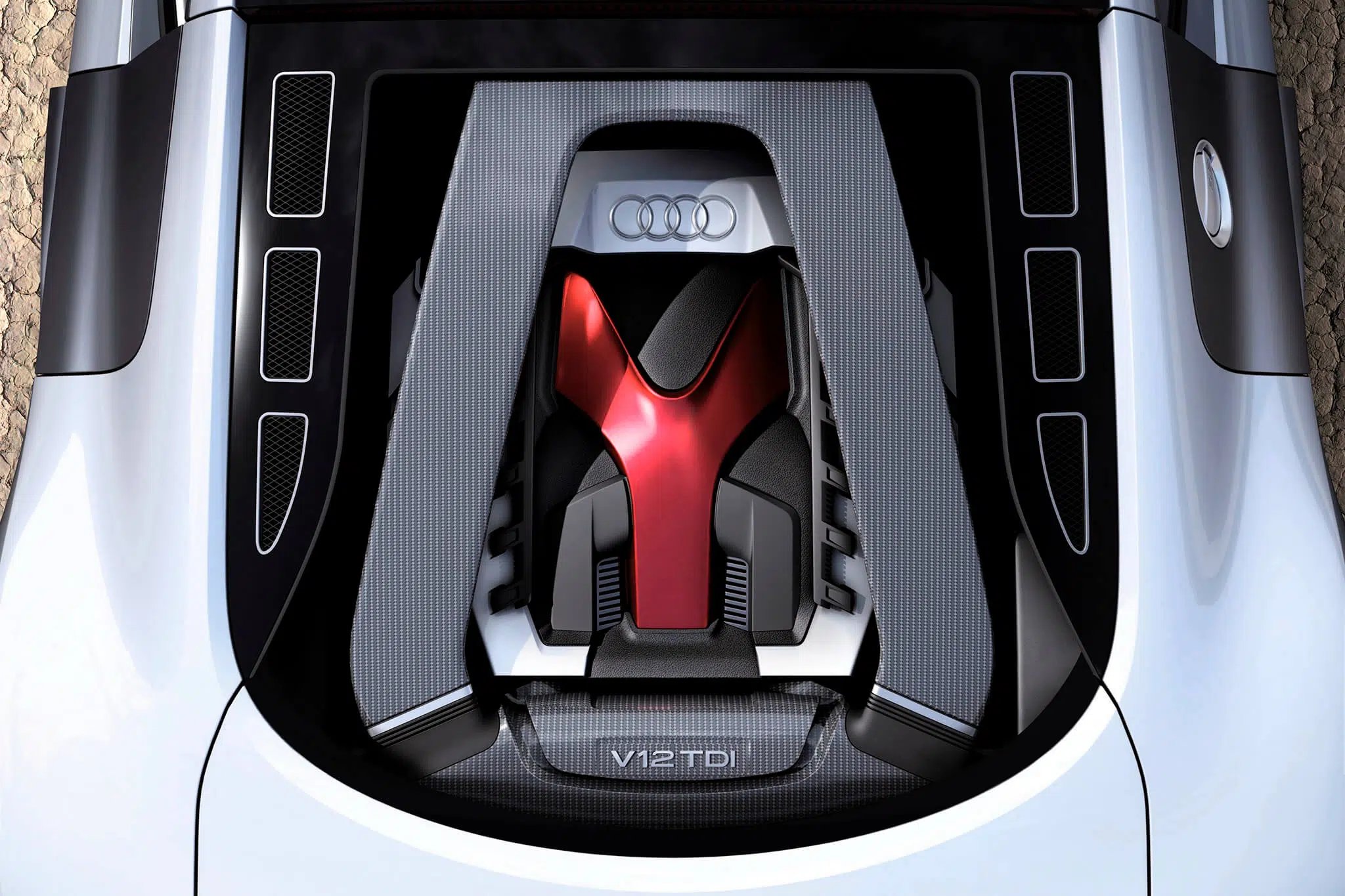
The shock...And we return to Detroit, in early 2008. Amidst a curtain of smoke (not from the engine) appeared the Audi R8 V12 TDI Concept — later renamed the R8 Le Mans Concept.
It was clearly an R8, despite distinctive bumpers, flared side intakes and a NACA intake (so named because it was developed by the National Advisory Committee for Aeronautics) on top for engine cooling. And the name didn't fool you, Audi was presenting a Diesel super sports car.
Instead of the V8 Otto behind the occupants there was a «monster» V12 Diesel, the largest ever placed in a light car: 12 cylinders in V, like in the noblest of super sports cars, 6.0 l capacity, two turbos, 500 hp and a thundering 1000 Nm… at 1750 rpm(!). And, just imagine, coupled to a manual transmission.
With numbers like that, it's no wonder the engine has larger air intakes.
Contrary to rumors, the engine was not a derivative of the 5.5 l V12 of the R10 competition, but shared much of the architecture and technology employed.
According to the brand's figures, the Audi R8 V12 TDI, with four-wheel drive, would be able to accelerate to 100 km/h in 4.2s and reach a top speed of 300 km/h — not bad... Technical complexity... The Audi R8 V12 TDI Concept would appear again, a couple of months later, at the Geneva Motor Show, swapping the original gray color for a much more vibrant red. More importantly, it was a working prototype, closer to production — some journalists were even able to drive it.
But it was quickly realized that this “laboratory experiment” would yield little and that the culprit was actually the engine, or rather, its size. The V12 block was longer than the V8, so it "invaded" part of the cabin to fit.
And it left no room to install any of the Audi R8's transmissions — what's more, none of them were prepared to handle the colossal block's 1000 Nm of torque.
They had to resort to a more compact Audi A4 transmission to allow the Audi R8 V12 TDI prototype to run, but like the other transmissions, it was incapable of handling the torque of the V12, so the torque was artificially limited to 542 Nm, just over half.
The beginning of the end... As you can see, the task of fitting a V12 engine into a body that was not designed to accommodate it proved to be complex and expensive. The final step towards production would force the reconfiguration of the R8's rear section and the creation of a drivetrain from scratch that would not only fit into the limited space available, but also handle the 1000Nm.
The math simply didn't add up — the production figures predicted for this wheeled "heresy" didn't justify the investment required. What's more, some markets essential to its success, such as the USA, where Audi sold a third of all R8s, were not at all receptive to diesel engines, let alone a supercar with that type of engine.
Audi ended the project definitively — the diesel supercar would be confined to the realm of probabilities. It was the end of the diesel supercar, but not the end of the powerful engine.
It wasn't the end of the colossal V12 TDI... and thank goodness for that... Rejected in the R8, the V12 TDI engine found space in a more suitable body. The Audi Q7 V12 TDI, which also went on sale in 2008, became the only production car equipped with this engine. It is still the only light vehicle to have had a V12 Diesel under the bonnet — with the same power and torque figures as the Audi R8 V12 TDI — and a six-speed automatic transmission from ZF, reinforced to ensure its durability in the task of handling 1000 Nm.
After all these years it continues to impress…
Mundoquatrorodas


Nenhum comentário:
Postar um comentário