DUCATI
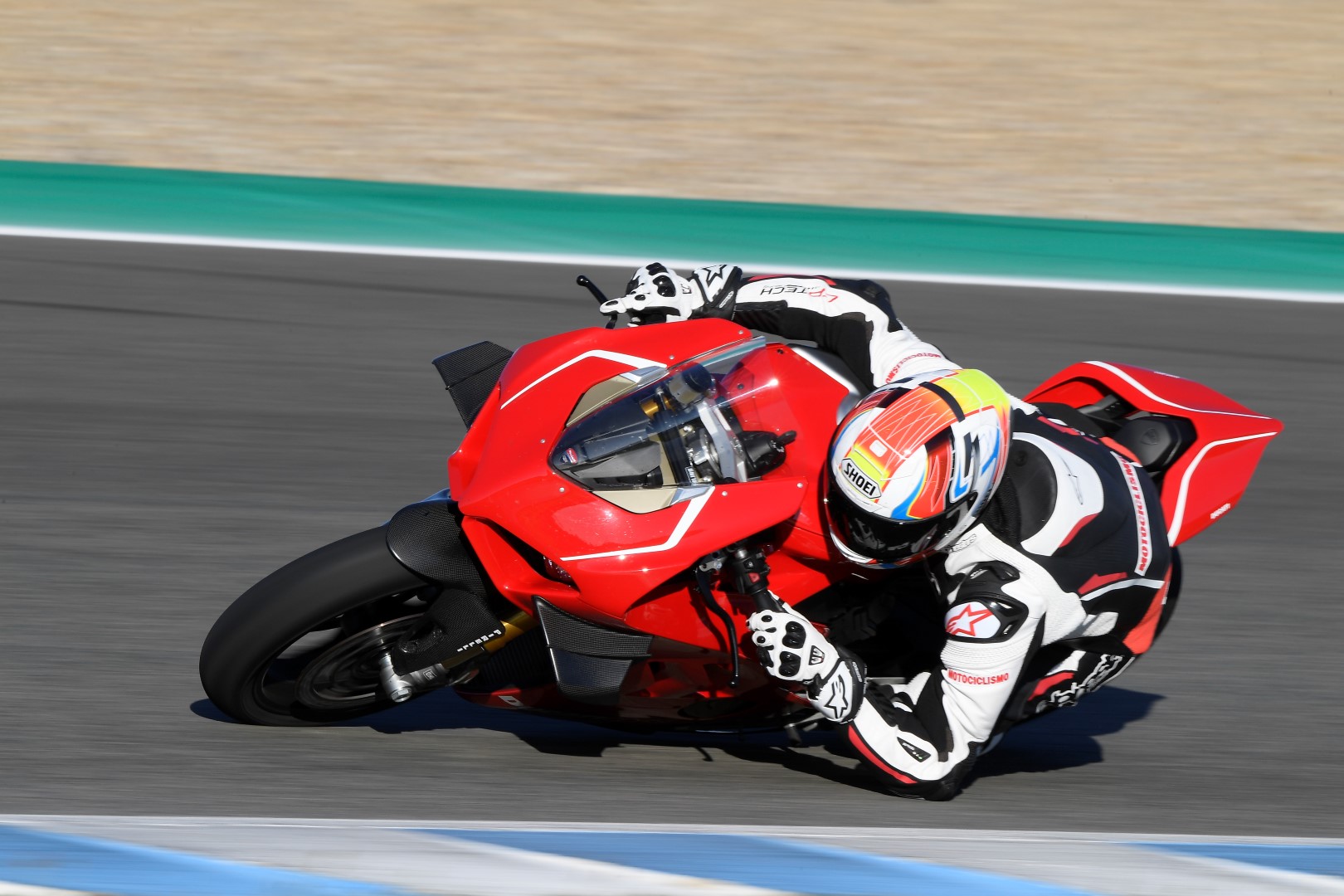
Panigale V4 R-The passion Italian with 234cv
Ducati has once again demonstrated its technological power with the staging of the Panigale V4 R, a motorcycle that has aroused enormous expectations since it was unveiled less than a month ago at the Milan Motor Show. The Italian brand presented last year the Panigale V4 S, a revolution for them, and in parallel has been developing this version with Ducati Corse R to serve as a base in the World Superbike, where they will pilot Álvaro Bautista and Chaz Davies. We were lucky enough to be able to go to this small and exclusive presentation that was made in Jerez, just after the MotoGP test and coinciding with some tests of the official team in WSBK and the BSB, so in addition to testing it we have also been able to Chat with the pilots of the brand and share track with them.
 The figures and the technology of the Panigale V4 R make it a unique motorcycle and the most powerful of the category, since the series declares 221 hp for 193 kg, but with the complete Akrapovic exhaust as we have tested it the power arrives up to 234 CV for 186.5 kg in full, which translates into a weight / power ratio of 1.25 HP / kg. Data of a motorcycle racing, in fact is more powerful than the first Desmosedici of MotoGP of the Italian brand. To these spectacular figures we must add that it has the latest technology in terms of electronic aids, managed by the IMU 6D Bosch, and that in the R version the strategy with which the traction control DTC EVO works goes a step further there with the experience of MotoGP and SBK.
 Taking into account these figures and the impressive aesthetics of the Panigale V4 R, marked by the ailerons derived from the Desmoseici GP16, you have the feeling before getting on it that it is going to be a radical bike and that only the best riders can tame. And that added to Jerez is a "small" track for a motorcycle of these characteristics. But it is not like that, as we could see the ten journalists who were lucky enough to try it. This time we went on track with the bike configured in the Race mode (it offers three modes: Race, Sport and Street) and with quite low electronic aids, with the settings with which Alessandro Valia has left it configured for this track. The surprise comes when making the first laps on a track still a little wet by a morning storm.
 The Desmosedici Stradale engine, the now 998 cc V4, which has been designed to have everything needed to win in Superbike, is very progressive and "docile" in the media. So it does not cost you much work, if you already have experience in circuit with a sport of 1,000 cc, go exploring your possibilities. Each lap you feel more confident and you reduce time to the chrono, because you can open the accelerator very soon and the delivery is linear. It also helps that the cycle part works perfectly. Once you have the clear references and you start to throw the thing it gets a bit more difficult, although it is mainly because the few straight stretches of the Jerez Circuit Angel Nieto are finished in a sigh.
 The bike runs a lot, but a lot, but never gives you more power than you can admit at that time, thanks to an incredibly advanced electronics. Now the DTC "interprets" what you are doing, so that if you make the rear wheel slide very quickly the system anticipates its action so that there is less variation in speed and therefore less oscillation of the rear axle in acceleration. In addition, when it detects that you are looking to skid to the exit to finish the curve, it lets you do it in a very progressive way.

 The horses are not as abrupt as you expect and the bike stays at a safe distance from the ground for a few tens of meters. Once you've gone through all that you have only two gear changes to see how far the engine stretches, the climb to fourth and fifth, before having to brake to stop the bike in Dry Sack. Busy. The V4 rises without rest up to 15,000 rpm, almost without you noticing, and at 15,500 you start warning that you are approaching the limit and reduces its momentum. According to the short gear to a slightly different regime and in sixth it does nothing more and nothing less than 16,500 rpm.

 The ailerons were another point that raised a lot of expectation and is that they are as eye-catching as they are interesting when you're riding with them. A key point is the aerodynamic pressure on the front end (down force), which is very effective in the accelerations, since it avoids the lifting of the front wheel, but it is not easy to notice its action because it is mixed with the effect of the antiwheelie DWC. But its effect is remarkable in supports in fast corners, such as the 8, where despite going at high speed you can support the elbow on the ground with the maximum aplomb of the front end, or in the last two fast before entering the finish line . They also give extra stability in braking and it is true that the bike is precise and stable in almost all phases of driving.

 This Panigale is the best and most evolved of the whole saga, in addition to the best street superbike to date. Ducati has brought the experience and technology of MotoGP to the street to fulfill the dreams of some lucky people. It will begin its production in January and will have a price of 39,900 euros.
Motociclismo.es
This Panigale is the best and most evolved of the whole saga, in addition to the best street superbike to date. Ducati has brought the experience and technology of MotoGP to the street to fulfill the dreams of some lucky people. It will begin its production in January and will have a price of 39,900 euros.
Motociclismo.es


Nenhum comentário:
Postar um comentário