AUTONEWS
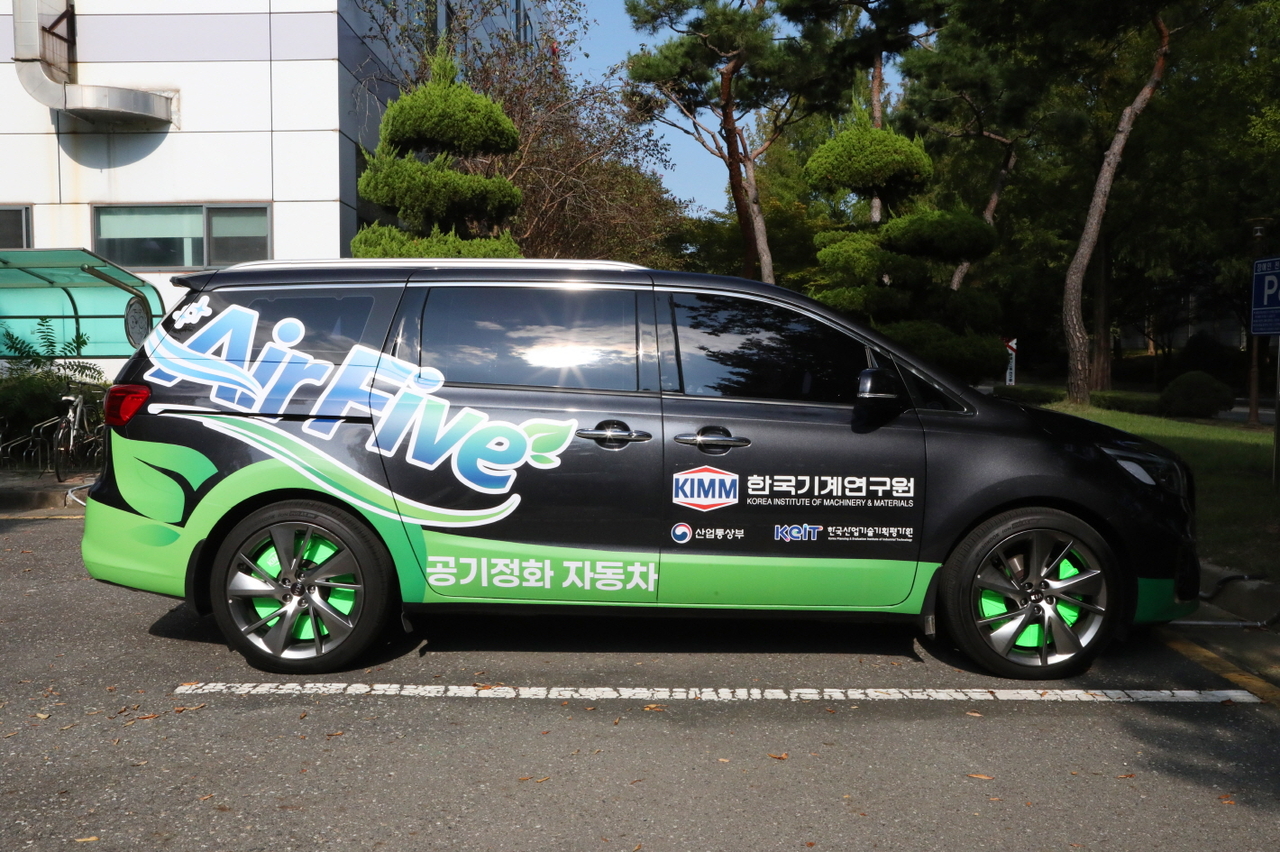
'The cleaner it drives, the cleaner the air': Korean researchers develop car that filters fine dust
Cars on the road could soon transform from sources of air pollution into moving air purifiers. Korean researchers have developed technology that filters more than 95% of ultrafine particles entering a vehicle from the front while driving and captures brake wear dust before it can be released into the air.
The Korea Institute of Machinery and Materials announced Monday that a research team led by Han Bang-woo, director of the Urban Environment Research Laboratory under the institute's Eco-Friendly Energy Research Division, has developed an "air-purifying vehicle" technology capable of simultaneously reducing roadside fine dust and brake wear particles while a vehicle is in motion.
The system consists of a grille-mounted dust collector installed at the front of the vehicle, a caliper-type dust collector that captures brake particles, and a wireless power transmission technology that allows air purification even while the vehicle is parked. The research team verified the system's performance by fitting it to actual vehicles, including the Kia Carnival and Hyundai Sonata.
The key to the system is its use of airflow generated naturally as the vehicle moves. Fine dust entering through the grille is electrically charged and then drawn onto collection plates by electrostatic force. Carbon fiber — far thinner than a human hair — processes the dust with minimal current, keeping ozone generation to a minimum.
Because no separate high-powered blower is required, energy consumption is also reduced. In parking spaces equipped with wireless power supply infrastructure, the vehicle's existing radiator fan can be activated to purify surrounding air even when the car is stationary.
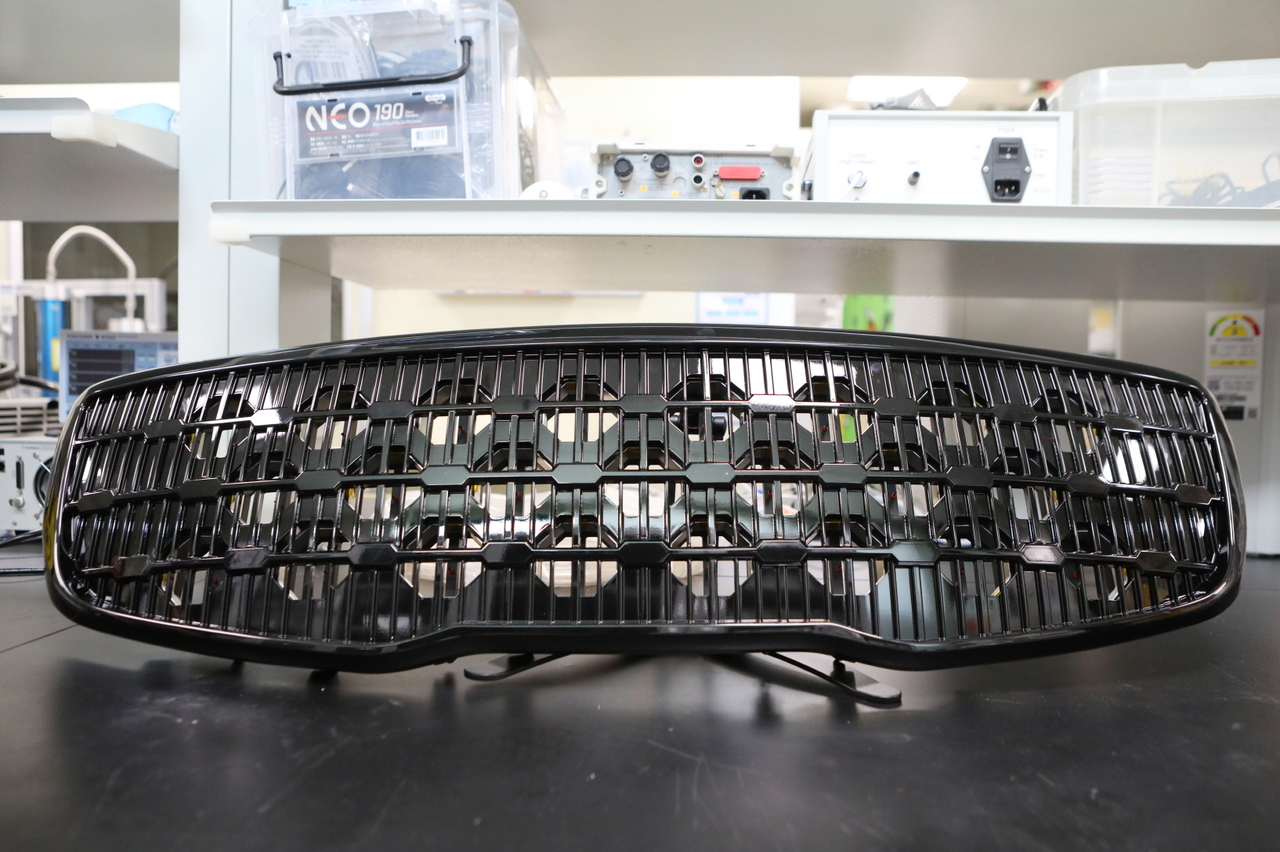
A grille-mounted dust collection device installed at the front of a vehicle to remove fine dust in urban areas. [Korea Institute of Machinery and Materials]
Performance tests confirmed strong results. At 30 km/h, the system removed more than 95% of ultrafine particles (PM2.5) and more than 99% of fine dust (PM2.5–10). The same collection performance was maintained at 50 km/h. A single vehicle can purify approximately 1,800 cubic meters of air per hour.
Adding the air purification system had little impact on fuel efficiency. Both the Carnival and the Sonata showed fuel economy changes of less than 1 percent before and after installation.
The system also captures brake-generated fine dust at the point of origin. It exploits the natural tendency of particles to become electrically charged when brake pads and discs rub together. Without any separate charging device or suction fan, a collector mounted behind the caliper gathers the dust using electrostatic force alone.
Under the internationally standardized WLTC driving cycle, a single vehicle collected 22.2 milligrams of brake wear dust per kilometer. Over approximately 450 kilometers of driving, that amounts to roughly 10 grams of brake dust captured before it can disperse into the atmosphere.
The technology's potential is drawing attention particularly as the expansion of electric vehicles has pushed "non-exhaust fine dust" — particles generated by brakes, tires and similar sources — to the forefront of environmental concern. Europe's EURO 7 automotive emissions regulation already includes brake-generated fine dust among its regulated pollutants.
"The distinguishing feature is that a vehicle can purify roadside fine dust as it moves and also reduce brake dust at the point where it is generated," Han said. "We will continue expanding the application of air purification technology so that it can contribute to improving urban air quality."
The research findings have been published in the international academic journals Tribology International and Atmosphere, and multiple patents have been filed in South Korea, the United States, Germany and other countries.
South Korean researchers at KIMM (Korea Institute of Machinery and Materials) have developed an automotive system that filters road-level air and captures brake dust. The technology uses electrical charges to trap fine particles at the front grille and near the brake calipers, all without negatively affecting fuel consumption.
Key features of the system:
• Front-grille filter: Removes over 95% of PM2.5 particles and more than 99% of PM10–2.5 particles by using carbon fibers that ionize the air as the vehicle moves. Each car can purify approximately 1,800 m³ of air per hour.
• Brake dust collector (caliper-type): Installed behind the brake caliper, it leverages the electrical charge naturally generated by the friction between the brake pad and the disc to attract metallic dust before it can spread onto the road.
• Minimal impact on the vehicle: Tests on models such as the Hyundai Sonata and Kia Carnival showed that changes to fuel efficiency or engine resistance remained below 1%.
• Air purification while stationary: When parked in locations equipped with wireless power/charging support, the radiator fan continues to draw in and clean the air.
• Parallel project in Europe: A similar proposal (called VENTRA) was also developed by students at the Eindhoven University of Technology to capture tire and brake debris from electric vehicles.


Nenhum comentário:
Postar um comentário