DODGE
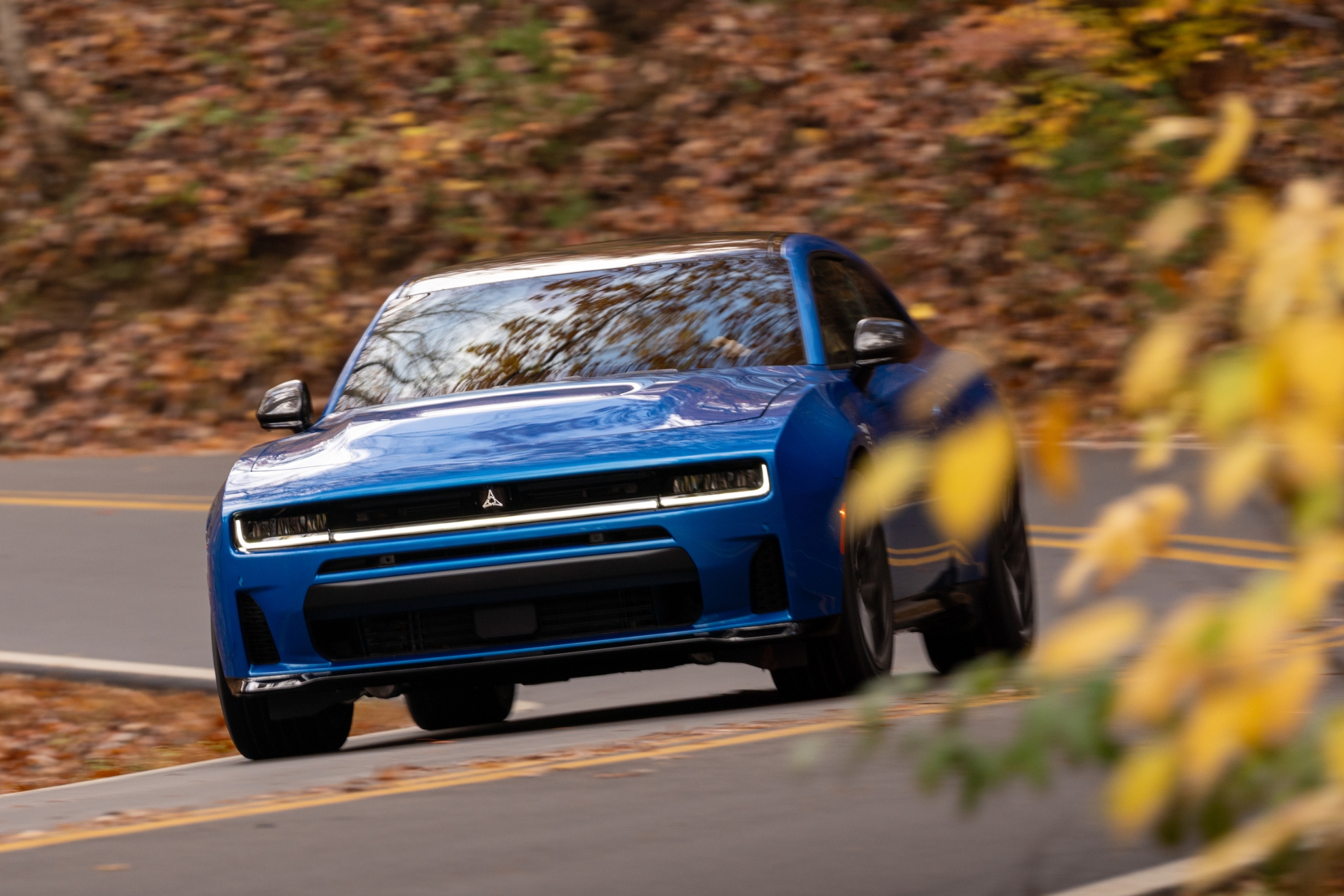
Dodge Charger Scat Pack Arrives in Europe
In the era of electric propulsion, an output exceeding 500 horsepower is commonplace, even in cars that aren't sports cars by definition. Yet, in the case of the Dodge Charger Scat Pack—which we had the chance to test in the US—that horsepower is truly thoroughbred.
Like any major automotive group today, Stellantis seeks rationality in defining its model lineup and aims to share as many components as possible without compromising (or, at worst, destroying) the DNA of its constituent brands. Cars rolling out of Rüsselsheim, Turin, Paris, or Sochaux are often so predictable that even their sporty versions struggle to spark much interest among their target audience.
Models like the Opel Corsa GSE, Peugeot 208 GTI, or Alfa Romeo Junior Speciale offer more power, aggressive styling, and—at most—some electronic aids for better road grip, yet they always retain a distinct air of conservatism.

To truly let a car's personality shine, you have to go further. That’s where Dodge—an American distant relative within the Stellantis family—steps in with the Charger, now arriving in Europe in its eighth generation (having been available in North America since 2024). Even with its own distribution network (managed by KW Automotive, which oversees 200 Dodge and RAM dealerships in Europe), the brand is perfectly suited to handle this "troublesome cousin": a figure viewed with suspicion and one no one dares cross, yet whom every other family member secretly envies.
Historically, the Charger was the dream car for generations of Americans (and public enemy number one to the Ford Mustang—the original muscle car, not the electric SUV—and the Chevrolet Camaro), though it remains less well-known in Europe. Although it retains some of its most important characteristics (such as its design), it has changed significantly.
It is available with a three- or five-door body style—though Dodge refers to them as two- or four-door models, the trunk actually features a fastback-style liftgate with an integrated rear window rather than a standard sedan trunk lid—and comes with either an inline-six gasoline engine (the 420 hp and 550 hp "Sixpack" variants) or a fully electric, eco-friendly, and politically correct variant (the Charger Daytona, the lineup's most powerful model at 680 hp), always with all-wheel drive.

Measuring over five meters in length (5.25 m, to be exact) and two meters in width (2.02 m), with a substantial weight of 2.2 tonnes, the Charger is built on Stellantis Group’s STLA Large platform. These proportions and mass define the entire driving experience, making it clear that the Stellantis brand designed the Charger to prioritize imposing road presence, straight-line stability, and a thrilling drive, rather than the precision associated with European sports sedans—particularly those of the German school.
Two cylinders fewer...but it certainly doesn't lack power! While this inline-six engine from the Hurricane family may lack the evocative charm of the old Hemi V8, it certainly sounds great—at least from outside the car. Inside, the situation changes slightly, as the active exhaust system is complemented by a sound amplifier that projects low-frequency notes through the cabin speakers—a questionable solution: the natural sound was already pleasing to the ear, and the acoustic experience feels quite artificial in its futile attempt to mimic the sound of a V8 engine (production of which ended in late 2023).
A direct comparison with the previous V8-equipped Charger shows that losing two cylinders does not translate to inferior performance. In the case of the new R/T, power increases by 50 hp compared to the 5.7-liter HEMI V8, and 0–100 km/h acceleration is half a second quicker (4.9 s vs. 5.4 s). A similar trend applies to the Scat Pack when compared directly to the 6.4-liter HEMI V8; it boasts 65 hp more and is 0.3 seconds faster in the 0–100 km/h sprint (4.1 s vs. 4.4 s). Yet, as with so many things in life—even sports cars—much of the experience is defined more by the *how* than the *how much*. And the truth is, the organic vibration of a V8 remains unique.

For this test, we opted for the gasoline-powered Scat Pack version, which features a twin-turbo inline-six engine capable of producing 550 hp and 720 Nm of torque. The engine block is made of aluminum and features direct fuel injection and variable valve timing. At the driver's discretion, the all-wheel-drive system can be disengaged, sending all power to the rear wheels.
Speaking of exceptional dynamic features, the Line Lock system (optional on the R/T and standard on this Scat Pack) locks the front brakes, allowing the rear wheels to spin freely without the car moving forward (the official justification is that this tire friction helps clean and warm them up before a launch, though we all know the real purpose is bringing that irrational teenage fun into adulthood...). Had I driven on a track, I might have given it a try, but on California roads, such a maneuver is enough to risk a stint with free room and board—staring at the sun through barred windows in the company of the county sheriff...
All Chargers feature five driving modes (selectable via a steering wheel button): Auto, Eco, Wet/Snow, Sport, and Custom. Eco mode prioritizes efficiency, emphasizing rear-wheel drive. Wet/Snow mode maximizes traction on low-grip surfaces, distributing torque equally between the front and rear axles. Sport mode firms up the steering (2.5 turns lock-to-lock—acceptable for a sports car also used for daily driving), sharpens transmission behavior (delaying upshifts and hastening downshifts), amplifies the engine note, and quickens throttle response, giving the Charger a sportier overall feel.
In this mode, traction control is deactivated, though the driver can re-engage it via a button located below the climate controls. In Custom mode, the driver can select Street or Sport settings for the drivetrain, traction control, and steering, as well as enable or disable the steering-wheel-mounted paddle shifters.

How does it behave on the road? Regarding performance, the acceleration figures have already covered most of the story, and the top speed (285 km/h) confirms there is no shortage of power. Any extra pressure on the throttle pins the driver and passengers against their leather seats—delivering power with remarkable linearity when all four wheels are engaged, or allowing the rear end to come alive—in a manner that feels almost sensually wild—when power is sent solely to the rear wheels. This is precisely where you understand why it’s called a "muscle car."
The Americans equipped the Dodge with independent multi-link suspension at both the front and rear, adaptive dampers, and—in this more powerful version—Brembo brakes. The ride is quite firm, especially in the unit I drove, which sported imposing (and visually stunning) 305/40 ZR20 wheels and tires, with impressive (and capable) Brembo brake calipers gleaming behind them. Unless the asphalt is as smooth as a billiard table, you’re better off avoiding Sport mode. The eight-speed torque-converter transmission handles normal driving demands well in automatic mode but is slower in manual mode, especially compared to a dual-clutch transmission.
Spacious and solid, but the price...The overall impression of the interior is positive. Build quality is solid, though some trim details fall short of what a European buyer would expect from a car costing over €70,000 (specifically, the plastics in the door bins, the lack of soft-touch lining in the glovebox, the dashboard materials in lower, out-of-the-way areas where front occupants have less contact, the rear air vents, etc.).
Both rows of seats are spacious; the second row is suitable for two people and can accommodate a third, provided they aren't too tall and don't mind sharing foot space with the bulky central tunnel housing the driveshaft and exhaust pipes. A rear passenger around 1.80 meters tall will have about ten fingers' width of clearance in front of their knees before touching the front seatbacks, but very little headroom.
The large rear hatch adds a level of practicality its predecessor lacked, making this Dodge a more functional vehicle than many sports cars capable of carrying the whole family. Its cargo capacity—exceeding 600 liters—is more typical of an SUV trunk and can be expanded to over 1,000 liters by folding down the rear seatbacks to create a flat load floor.
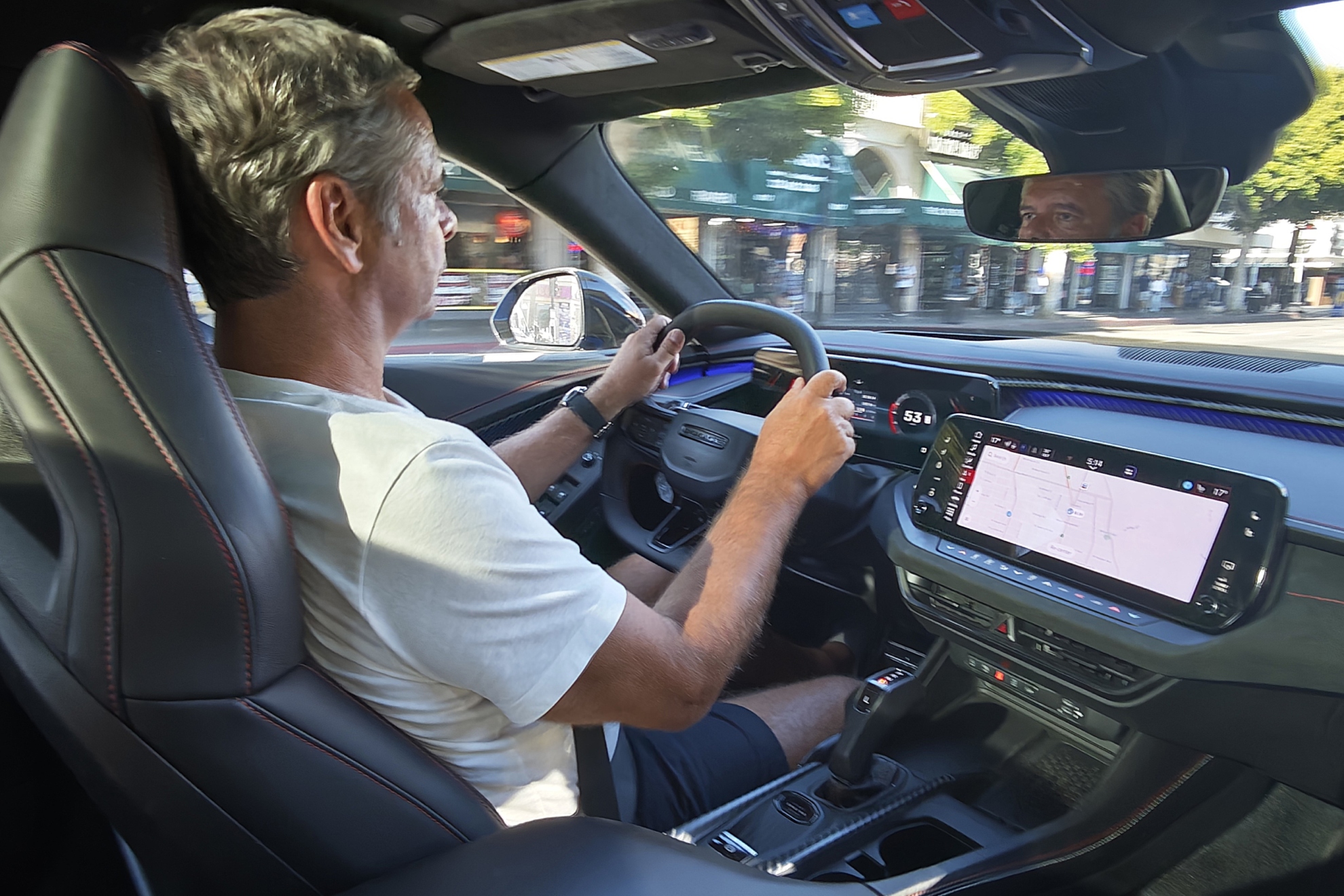
The dashboard features two screens: a 16-inch digital instrument cluster and a 12.3-inch touchscreen for the infotainment system. It also includes a head-up display. There are enough physical buttons to make driving and simultaneously controlling key vehicle functions easy.
Performance pages on the central display provide real-time data on vehicle parameters—such as acceleration times, gauges, G-forces, and powertrain behavior—while the driving experience recorder can capture synchronized video, audio, and vehicle data for post-drive analysis.
After covering more than 1,000 kilometers between Los Angeles, Palm Springs, and San Diego, the Dodge Charger Sixpack Scat Pack’s average fuel consumption was 12.6 L/100 km—slightly (0.2 L/100 km) higher than the official figure. Given current gasoline prices, this results in a hefty monthly bill, but considering the Charger's power and performance, it is understandable. It is not something that greatly bothers American drivers, in a country where gasoline is still cheaper than water...

When paying over 75,000 euros for a car, one generally expects the highest level of fit, finish, and material quality—something the Charger does not offer. Yet, there is no doubt that it stands out on the road thanks to its commanding presence. The new Charger is captivating and lacks no personality, both visually and in terms of its on-road performance. This is true despite certain flaws—such as being too large for many European roads and too heavy to be truly agile or efficient—and the void left by the absence of the defunct V8 engine's naturally impressive sound.
Joaquim Oliveira, reporting from Los Angeles



Nenhum comentário:
Postar um comentário