AUDI
Audi RS5: Full test of the V6 hyper-wagon that beats physics
Preconceptions can be awfully sticky. Think ‘fast Audi’ and you might still think of understeer and numb steering, but a quick dive into the Autocar archive reveals that all the way back in 2006, we reported that “the [new RS4] even changes direction properly now”, and we’ve heaped plenty of praise on the handling of subsequent generations.
Nevertheless, Audi Sport’s engineers are still on a mission to prove they can produce super-saloons that are on the same level as products from BMW M and Mercedes-AMG as driver’s cars. At the launch of the new Audi RS5, its head of technical development, Steffen Bamberger, told us that “we wanted it to be an oversteering car”, to which end the newly hybridised RS5 has gained a very clever, very complicated rear differential that can send power this way and that.
On previous encounters, we’ve already found out that the new RS5 does indeed oversteer. Now to see what it’s like to live with and how it fares against the road test timing gear.
The headline feature of the new RS5 is the new torque-vectoring rear axle. If you thought we’d seen every possible way of distributing power between the left and right wheel at this point, think again, because Audi has come up with something new.
What it has effectively done is to harness the same powers of the planetary gearset as Toyota’s hybrid transmission but for the purposes of fun rather than economy. Planetary gearsets have the useful property that if you drive the sun gear with a small electric motor, you change the ratio of the whole system. A Toyota e-CVT uses this to create a variable ratio between the engine and the wheels. In Audi’s Dynamic Torque Control system, a 5bhp, 30lb ft electric motor fed by the high-voltage battery does much the same but to create a variable ratio between the left and the right rear wheel, so that one side can receive more torque than the other.
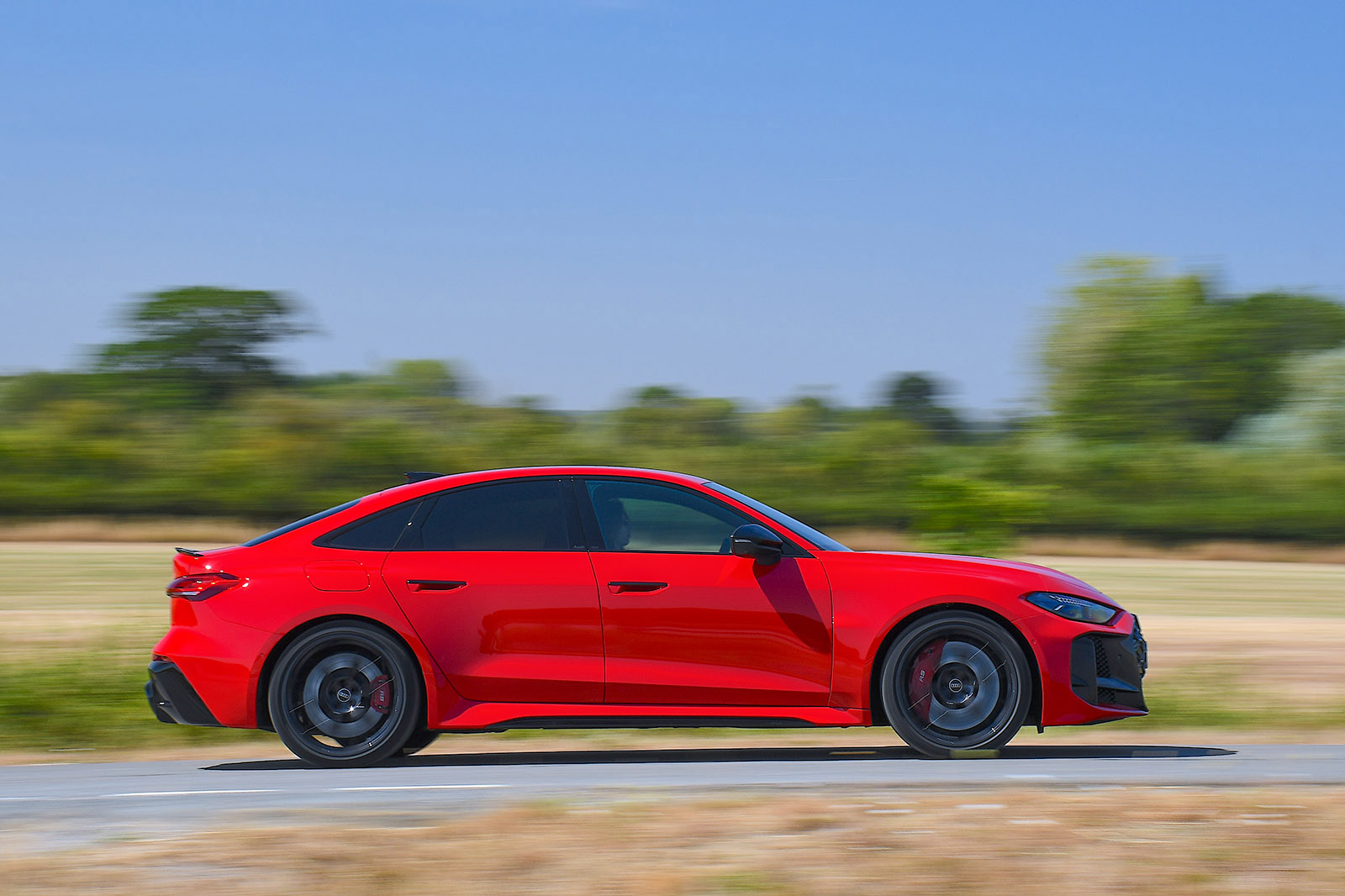
Whereas the BMW M3’s wide rear wheel arches only start behind the doors, the RS5’s flaring runs into them. Note also the shaped fuel filler flap. That’s a lot of bespoke parts and panels – times two for the estate. A production engineer’s nightmare, but it looks great...Illya Verpraet-Road Tester
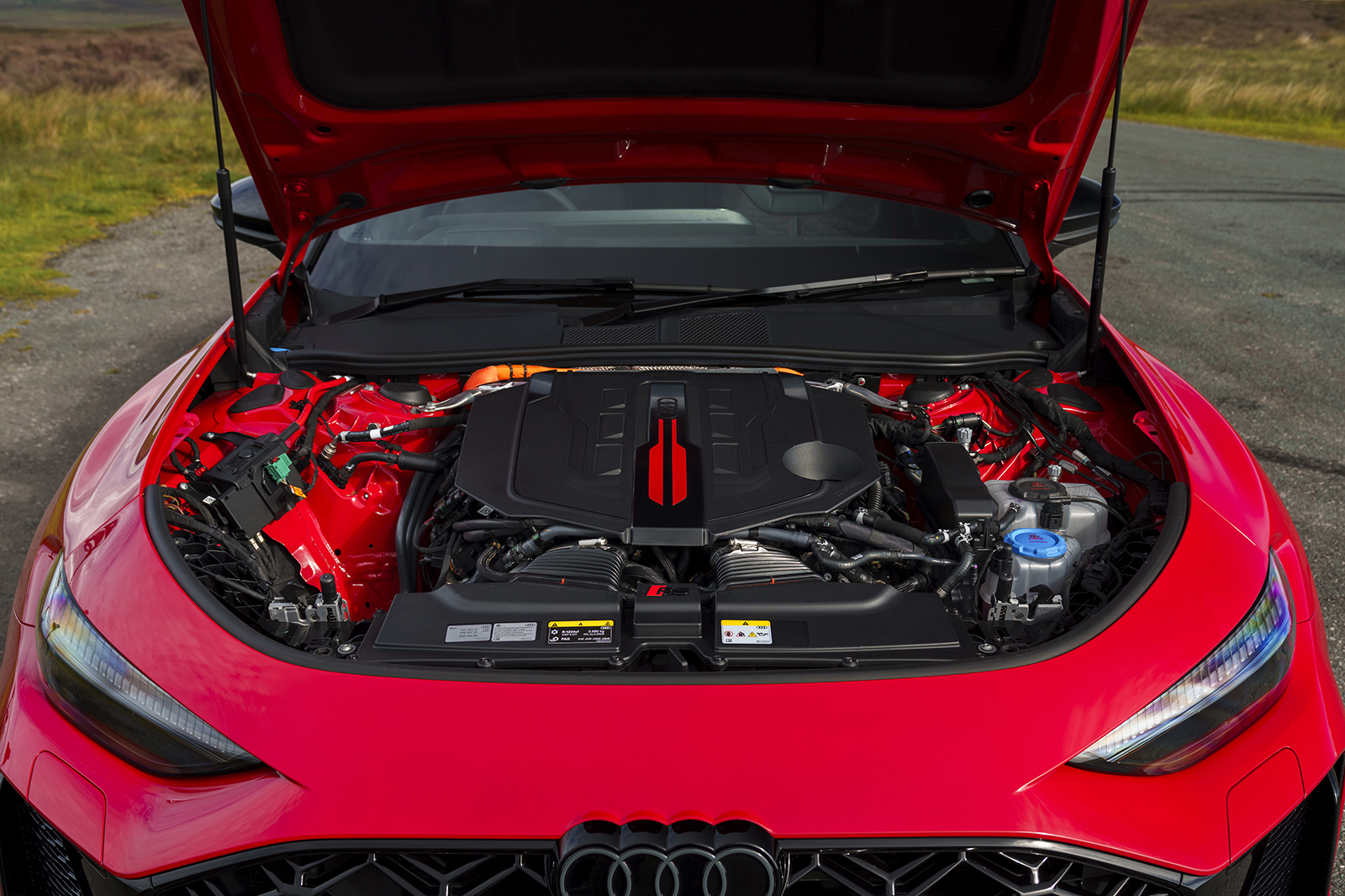
The rest of the drivetrain is relatively conventional for a fast Audi. The twin-turbocharged 2.9L petrol V6 is largely the same as in the previous generation, although it’s now assisted by a 174bhp electric motor upstream of the automatic gearbox, which is the trusty ZF eight-speed torque converter. All other A5s have switched to a dual-clutch gearbox, but presumably it can’t handle the violence of the RS-spec engine. Power then goes to all four wheels via a Torsen centre differential. This is pre-loaded, so that the RS5 is never purely two-wheel drive. The hybrid battery lives under the boot floor and is largely the same as in a normal A5 E-Hybrid, although it has a bit more usable capacity.
The suspension is relatively standard fare, sticking with coil springs, albeit with twin-valve adaptive dampers, while the bushings are RS-specific. The steering is variable-ratio as standard. One unusual detail is that while the tyres are the same size front and rear, the rear alloy wheels are half an inch wider than the fronts to give a bit more sidewall stiffness at the rear.
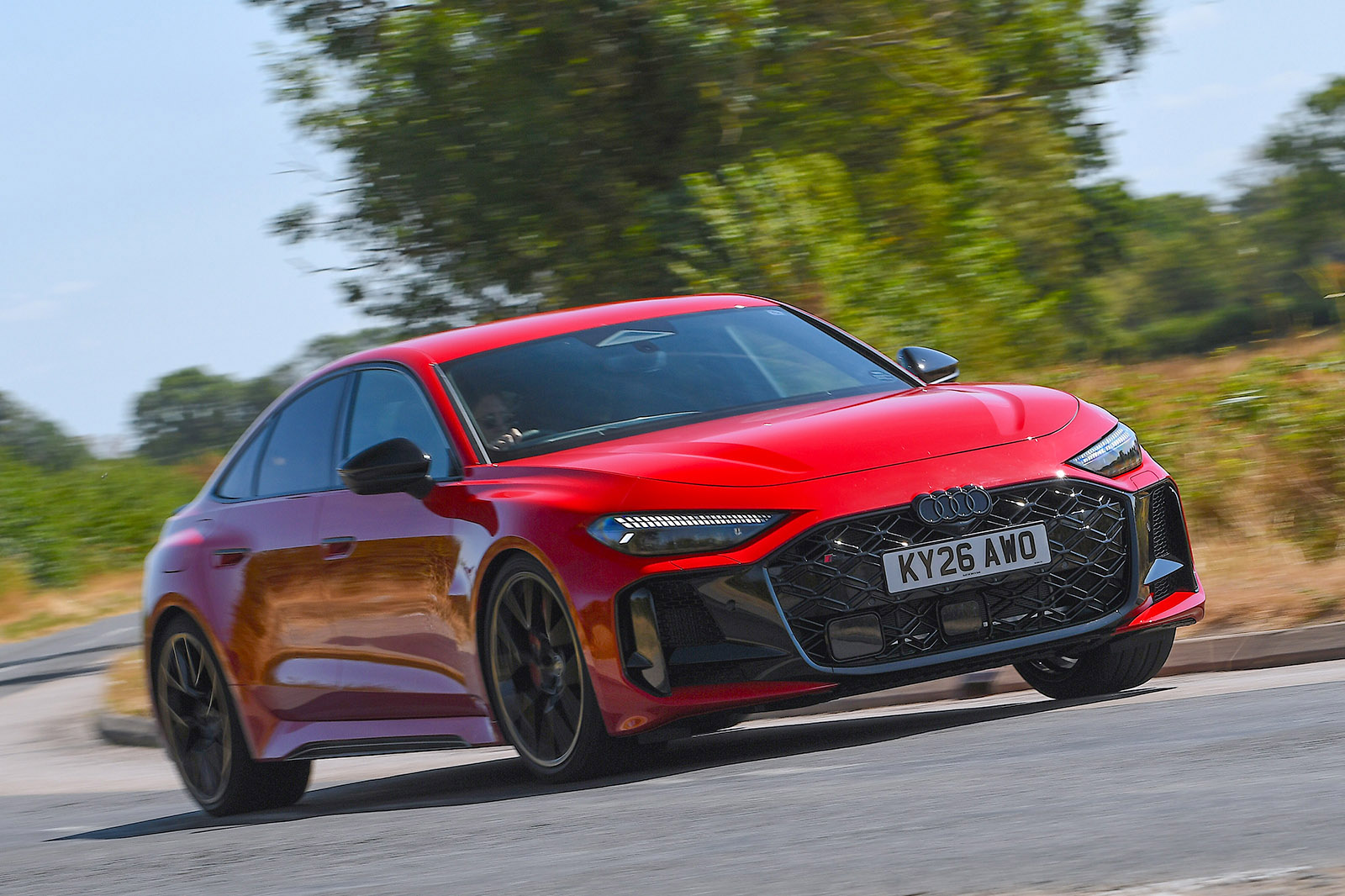
A proper super-saloon needs a purposeful stance, and the new RS5 certainly has one, thanks to deeply dished wheels and remarkably involved flared arches. Some may lament that fast Audis aren’t as subtle as they once were, but the RS5 has plenty of presence.
Unlike the previous generation, it’s now available in both Avant estate and Saloon (which is actually a liftback) variants. The estate is expected to take the majority of sales, but we think there is a certain elegance to the saloon. It’s good to have the choice.
The RS5’s cabin disappoints on two counts. We already know that the base A5 has taken a big step backwards from its predecessor in terms of visual and tactile appeal, as well as usability, but it’s a shame that Audi Sport hasn’t done more to inject some quality and sense of occasion into the RS5.
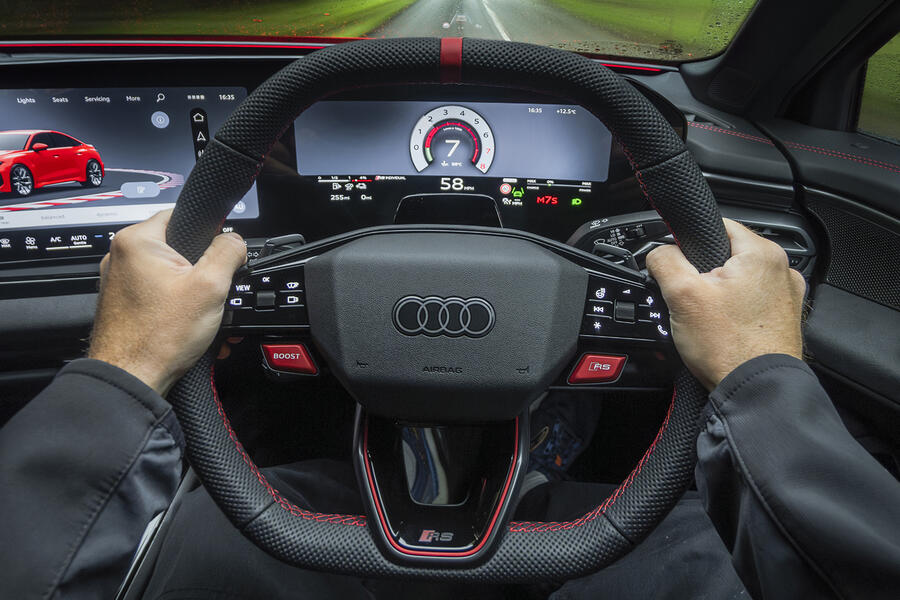
We hoped Audi Sport might have added some performance flavour to the regular A5 recipe, but that hasn’t occurred. In fact, if you were to materialise into the driver’s seat of the RS5, your only clue that you weren’t in an S5 or a high-spec A5 would be the RS and Boost buttons on the steering wheel.
For 2026, Audis have ditched the touch-sensitive steering wheel controls in favour of scroll wheels. Much better, but the gloss black button panel still looks and feels a bit cheap...Matt Saunders-Road test editor
The seat itself is also the same as in the S5. It’s relatively comfortable and supportive but leaves plenty of room for a more aggressive bucket seat option, which currently doesn’t exist. We’d recommend Audi take some inspiration from its Spanish colleagues and pinch a few Sabelt seats from Cupra’s parts warehouse.
Even then, some drivers might run into the issue of the instrument cluster being partly obscured by the oddly shaped steering wheel, which some testers experienced.
Whereas the old A4 and RS4 had a class-leading interior that combined beautifully wrought switchgear with classy materials, the new car has screens and fingerprint-attracting gloss black plastic everywhere. What few physical controls remain don’t feel particularly solid and some of them don’t operate consistently either.
The infotainment, which has recently been updated with Google Android-based software, largely works well. The touchscreen responds quickly, the built-in navigation is clear and well informed of traffic conditions and there are shortcuts permanently displayed on-screen.
Even then there are frustrations. Although there is a physical drive mode button, it’s more involved than it should be to switch modes or adjust the parameters of the custom mode. The driver display also lacks configurability and doesn’t always show the most relevant information.
Rear-seat space is typical for the class, although the saloon’s sloping roofline limits head room slightly. The upside is that it has a hatchback rather than a traditional bootlid, which gives it some added versatility. That’s just as well, since the hybrid battery pushes up the boot floor to an unhelpful degree. We measured 10cm less height than in the S5, which already has a fairly high floor. A BMW M3 saloon’s boot swallows 149 litres more.
Because the RS5 is now a plug-in hybrid, when you press the start button there isn’t a flare of revs but simply a message on the screen to say that the car is ready to drive.
You can then proceed to drive your 630bhp super-saloon as a 174bhp EV if you wish. For some people, being able to keep the engine for best will add an extra dimension, because the RS5 functions well enough as an EV. It will still hit 60mph in 10.5sec and the shift paddles will adjust the level of regen. Because the motor is upstream of the transmission, it goes through the gears as you drive and you can hear the whine of the motor rise and fall, sounding a bit like a supercharger without an engine. In the standard drive modes, the engine will come in smoothly as and when it’s needed, taking into account navigation data, much like any other A5 E-Hybrid.
If you needed any more evidence of the ZF 8HP transmission’s ubiquity: not only is it used by the RS5, M5, M4, M3, M2 and Giulia Quadrifoglio, but all of those cars have the same ratios as well. Clearly, if you want to buy in a gearbox that will withstand the violence of a modern super-saloon, you have one option, and you don’t even get to specify the gearset...Illya Verpraet-Road Tester
But to drive the RS5 in electric mode does feel like denying yourself something. Switch to one of the RS modes, or to S on the gear selector, and the V6 will fire up. Contrary to what the drainpipe exhausts promise, its voice is actually fairly muted. At low revs, it’s quite gravelly and rather similar to the turbo sixes in the BMW M3 and Alfa Romeo Giulia Quadrifoglio. It feels quite free-revving, and in the higher registers it clears its throat and gains more of a V6 bellow without ever becoming truly loud or especially distinctive. Lift off at the right moment and you might even hear some pops from the exhaust.
With petrol and electric power joining forces, you have a monstrous 630bhp at your disposal – but also 2.4 tonnes of weight to deal with. As a result, the RS5 is clearly very fast but, much as we found with the BMW M5, outright performance is perhaps not as much of a leap forward as you might hope. The RS5 hit 60mph from rest 0.6sec quicker than the RS4 Avant of 2018, but that was tested in the damp. In fourth gear, the RS5’s 30-70mph time was only 0.2sec quicker. The mighty BMW M4 CS, 87bhp down but also 661kg lighter, out-accelerates it in all metrics.
Where you do notice the electric punch is in the accelerator response. The 2.9L V6 was never a particularly laggy engine, but the RS5 seems to delight in flinging you back in your seat when you floor the throttle, no matter which gear it’s in.
Like most of its rivals, the RS5 uses ZF’s eight-speed automatic gearbox, which manages to combine smoothness at low speeds with super-saloon-appropriate shift speeds when you put the hammer down. Most of the time it responds well enough to the paddles, but if you try to shift within 500rpm or so of the redline it will get flustered and the engine will bang into the limiter.
Under braking, you can again see the work Audi has done to make sure the 2.4 tonnes bother you as little as possible. While the old RS4 had ‘mere’ 375mm front discs and 330mm rears, the RS5 gets an upgrade to 420mm at the front and 400mm at the back. Our test car had the standard iron discs, but carbon-ceramics are an option – one that we would recommend if you plan to take your RS5 on track frequently. We recorded good stopping distances in both the dry and the wet and no notable change in retardation during our fade test. However, we noticed a puff of smoke after slowing down from 160mph in our acceleration test runs and the discs had a blue tinge afterwards, so they were clearly working hard. The RS5 has brake-by-wire technology, which produces a nicely solid pedal feel that’s very easy to modulate at all speeds.
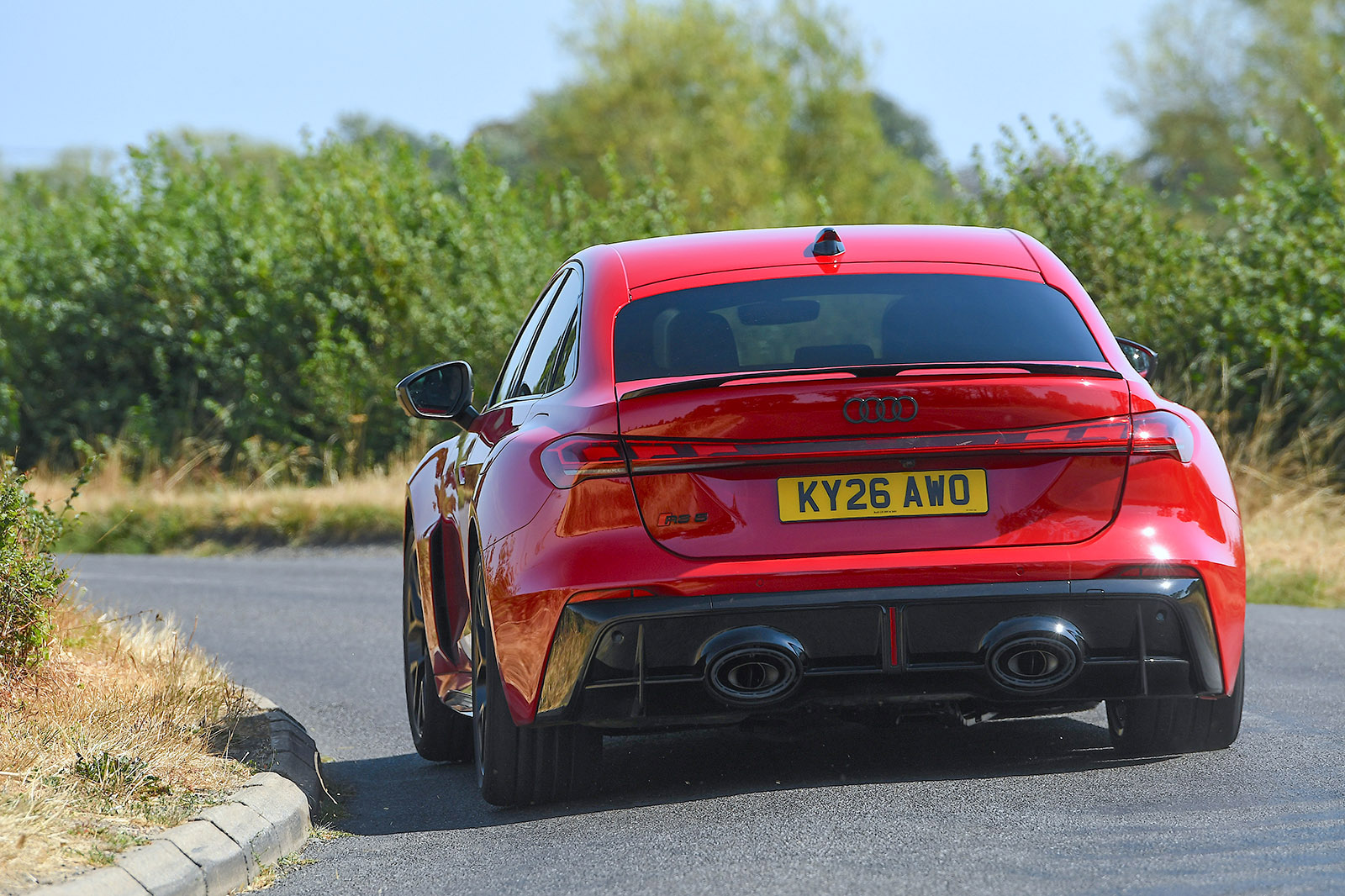
The technology enabled by the electrification aims to elevate the handling, rather than just negate the ill effects of the added weight. Early media coverage was dominated by pictures of RS5s in clouds of their own tyre smoke. Thanks to the new rear torque-vectoring unit, it will do all of that, but the drifting capability is a bit of a red herring.
You don’t need to torture the tyres on a track to feel the effects of the torque-vectoring tech. It suffices to engage one of the RS modes, dive into a tight corner at a speed that feels like it ought to be a bit too quick and feel the nose bite and the car zip round with not a hint of understeer or even tyre squeal. It feels slightly unreal, as if there is downforce at work or the car is wearing hardcore track tyres. Neither of those things is the case. The standard Bridgestone Potenza Sports are a high-quality performance tyre but certainly not a semi-slick and, while there is the usual gamut of lift-reducing diffusers and spoiler lips, this obviously isn’t an aero car.
Audis can drift now, but nobody told the seatbelt pre-tensioners. Get the RS5 sideways and there’s a good chance you’ll get choked by the belts...Richard Lane--Deputy road test editor
When you attempt the same corner again, this time with more confidence, and add more throttle on the exit, you’re rewarded with a manageable hint of oversteer, as the differentials and electronics telepathically know where to send power. On a good road, the RS5 can be a very exciting driver’s car that doesn’t feel like anything else.
Reporter: Illya Verpraet


Nenhum comentário:
Postar um comentário