AUDI

Audi RS 3 Competition Limited: driving pleasure and the adrenaline of speed and performance still exist
They are becoming increasingly rare...but cars that reignite the passion for driving pleasure and the adrenaline of speed and performance still exist. Yet, they are rarities—like the Audi RS 3 Competition Limited—that transport us back a few years in time.
Back to a time when gasoline, noise, and internal combustion power stirred admiration in drivers and fans alike; when there was no guilt in burning fuel, in forcing downshifts just to hear the engine roar (aided by the sports exhaust), or in accelerating hard just to feel the thrust of this special RS 3’s fabulous five-cylinder engine.
It is an engine without frills—no hybridization to mask its explosive character, and no efficiency strategies designed merely to boast unrealistic fuel economy figures. It offers raw power (and torque), yet retains enough refinement to keep the driving experience composed, true to Audi tradition.
The dampers feature three-way adjustability: two settings for compression and one for rebound. The car sits 10 mm lower than a standard RS3 and leaves the factory with a preset road-focused setup. For those wishing to explore the extensive adjustment possibilities, the car comes with a tool kit and instructions.
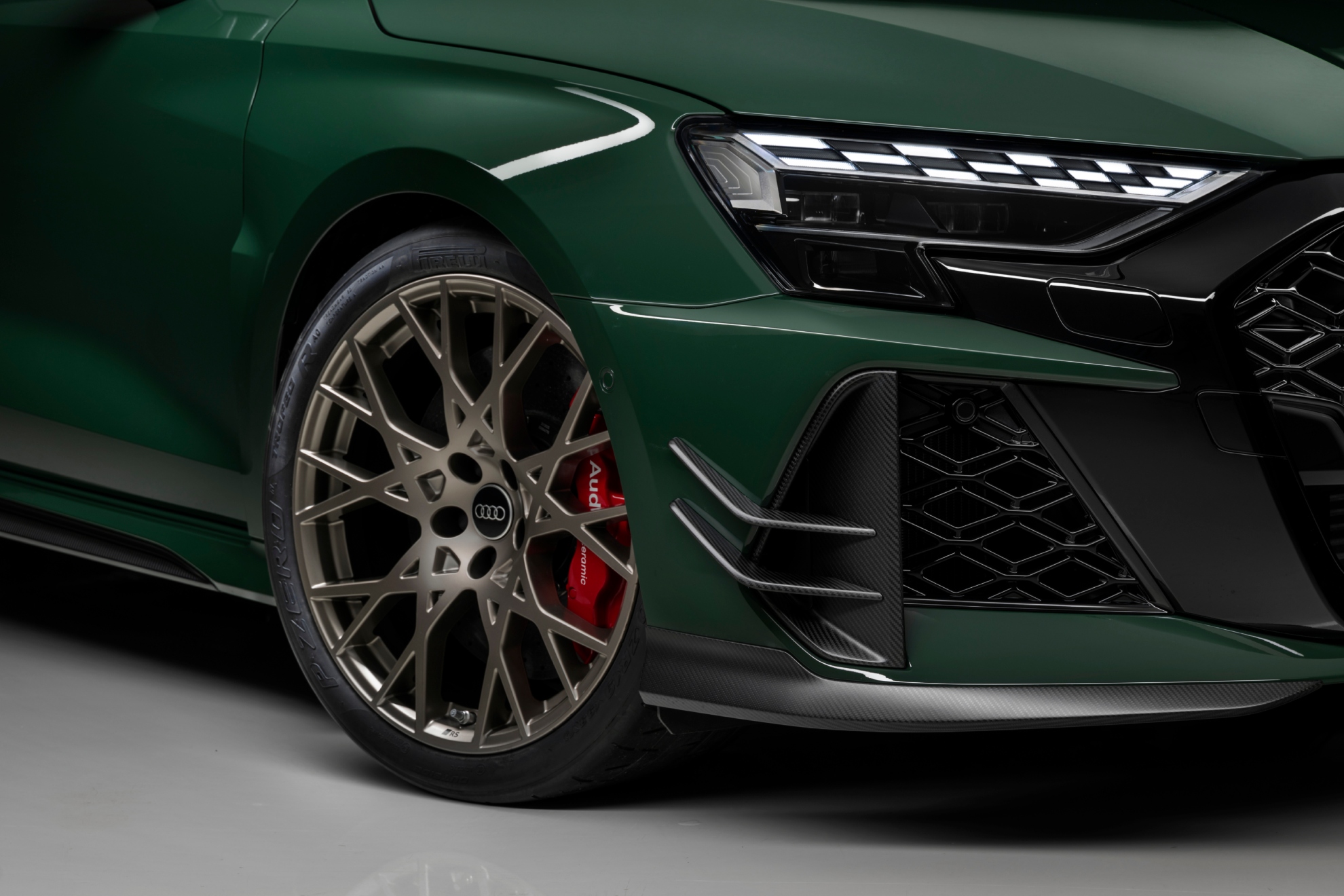
To further enhance agility, Audi installs a thicker, stiffer tubular anti-roll bar on the rear axle. Up front, carbon-ceramic brake discs with red calipers come as standard. Pirelli P Zero Trofeo R semi-slick tires are also available as an option.
That is the concept behind the RS 3 Competition Limited, a special run of 750 units worldwide (ours was number 55, as certified by an engraving—not a plaque—on the center console). It allows you to put Audi’s entire dynamic arsenal to the test: from the engine and the rear Torque Splitter (which facilitates controlled drifts) to the specialized suspension and standard ceramic brakes.
It all makes sense the moment you press the start button and the five-cylinder engine’s pistons resonate—a sound that deepens as you cycle through the driving modes (Efficiency, Comfort, Auto, and Dynamic) and reach the three modes that feel most natural for this RS 3: RS Individual, RS Performance, and RS Torque Rear.
Essentially, these are modes where the driver can customize key vehicle parameters; in the first one, virtually all of them (steering, engine, stability control, and rear differential) offer three adjustment options...in the second, we can modify only the steering and stability control; and the last one is the drift program.
An engine that outshines everything...or almost everything... The familiarity of the RS 3 Competition Limited’s 400-horsepower, five-cylinder 2.5 TFSI engine hasn't diminished its impact. And that is likely for the best, because its lifecycle may be coming to an end: Euro 7 emissions standards, mandatory starting mid-next year, could make it unviable (the brand hasn't confirmed this, but things don't look good)...and we would have to say goodbye to it, probably forever. At least in Europe...
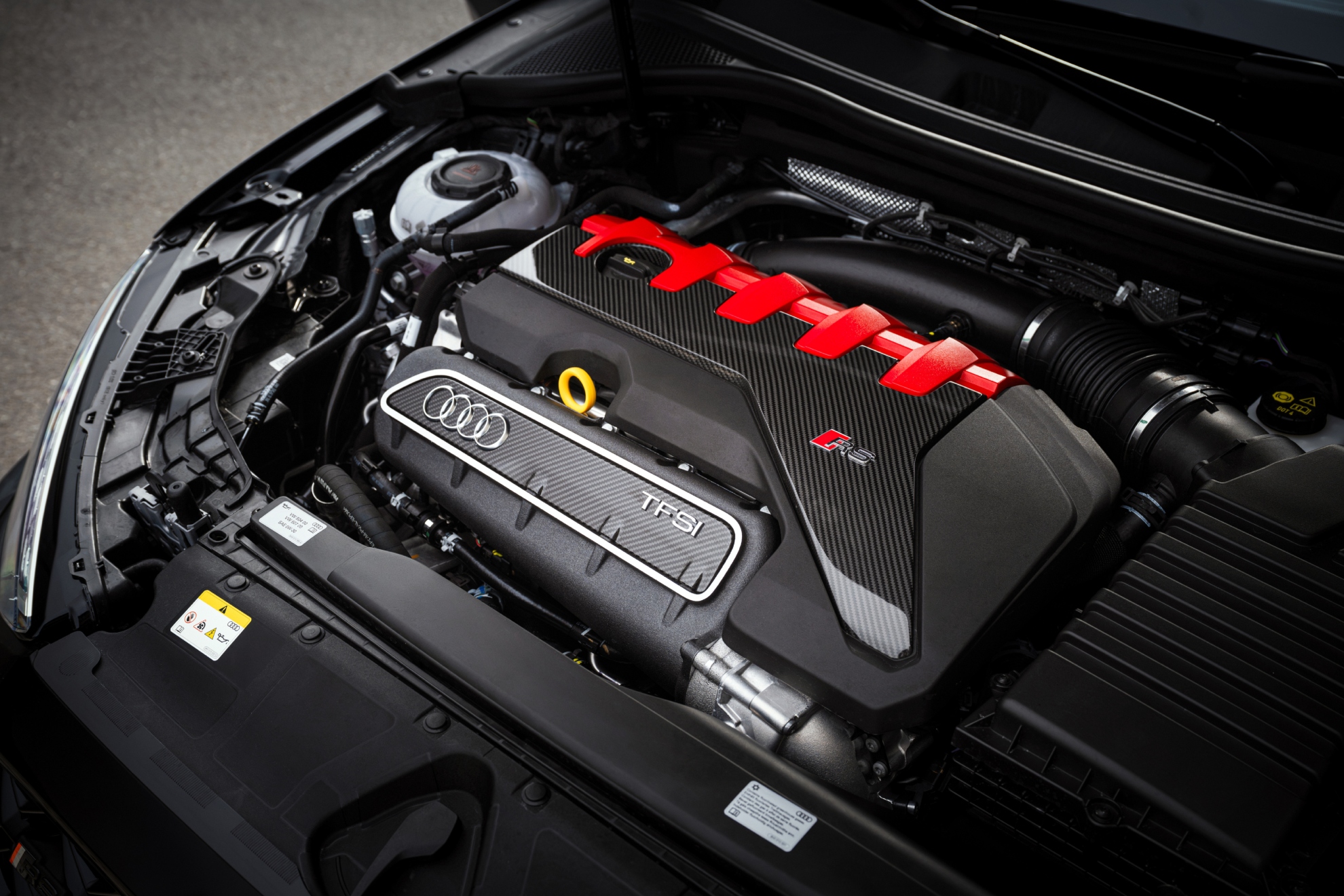
Back in 1983, the Audi Sport quattro developed 225 kW (306 PS) and 350 Nm from 2.1 liters of displacement. Today, the inline five-cylinder engine of the Audi RS 323 comes with 2.5 liters of displacement and boasts 294 kW (400 PS) and 500 Nm. Coming curtesy of an engine that is the only one of its kind in this segment, these figures lend the RS 3 competition limited extraordinary performance. The model accelerates from 0 to 100 km/h in 3.8 seconds and reaches a top speed of 290 km/h. Along the way, the unmistakable sound of the five-cylinder turbo engine provides extra emotion. It stems from the firing order 1-2-4-5-3. This means that the engine’s cylinders ignite in an alternating pattern — some that are next to each other and some that are further apart.
To understand what lies behind this "supercharged" RS3, one must look back 50 years. The first five-cylinder engine debuted in 1976 in the second-generation Audi 100. The engine gained true fame in the 1980s with the Ur-Quattro and Sport Quattro. In 1994, the RS2 Avant—developed with Porsche's involvement—brought this powertrain into the high-performance wagon league.
In 2011, Audi fitted the new 2.5 TFSI engine into the compact segment, giving birth to the first RS3 (the 8P generation). Today, we are in the final stretch of the third-generation RS3's lifecycle, and the five-cylinder engine remains revered for its punchy power delivery and an inimitable exhaust note. Another reason for driving enthusiasts to take notice lies hidden beneath the fenders: for the first time, Audi equips the RS3 as standard with a specially calibrated coilover suspension.
With its fully variable flap control, the RS sports exhaust system broaden the spectrum of the exhaust note while reduced insulation around the firewall means the engine sound reaches the occupants even more directly. The flaps open earlier in the Audi drive select modes dynamic, RS Performance, and RS Torque Rear, meaning that the car’s throaty sound is even more pronounced than in other modes.
Perhaps that’s why Audi added a special touch...to the headlights. The RS 3 Competition Limited’s headlights incorporate digital technology, allowing for the customization of the light signature (with four designs) and various welcome animations. One of them simulates the engine's firing sequence, activating the cylinders in this order: 1-2-4-5-3.
The figures it boasts are sensational for a compact car: 400 horsepower, 500 Nm of torque, a top speed of 290 km/h, and acceleration from 0 to 100 km/h in 3.8 seconds. These are numbers you can truly feel... when the car presses you hard against the seat during rapid acceleration—using Launch Control, for instance. Another figure you’ll certainly notice is fuel consumption... especially if you indulge in sportier driving (and believe me, you will). The figures displayed by the onboard computer during spirited driving are almost unspeakable... though for daily use—and if you’re careful—it is possible to keep consumption around eight liters per 100 km in Efficiency mode.

Clearly, all of this—translated into sensations—evokes the kind of emotions typical of sports cars that, in theory, possess greater substance. The engine's power makes you feel like the car could unleash its full potential at any moment... yet it never quite does. It remains manageable even for less experienced drivers, however, because its cornering response is simply breathtaking.
The quattro all-wheel-drive system makes everything easier. It is the same system found in the latest-generation RS models, featuring a rear differential capable of sending all the torque to a single rear wheel (which guarantees controlled slides). This is the "Torque Splitter," which—beyond the controlled drift function (recommended for track use only)—makes cornering much more efficient, as the electronic systems can intervene more actively, often without the driver even noticing.
For instance, in a right-hand turn, the Torque Splitter can increase torque to the left wheel, improving stability...and vice versa. The car becomes far more agile, exhibiting less understeer and allowing the rear end to track through the corner with greater precision. And the driver can definitely feel the difference.
The chassis makes no concessions to comfort (as becomes evident whenever driving over a speed bump), but in return, it corners like a rollercoaster—delivering precision transmitted to the driver's hands through firm, accurate steering that allows you to feel every millimeter of the curve. The new rear stabilizer bar also contributes to greater rear-end stability.
This is where we find one of the defining features of the RS 3 Competition Limited: the coilover suspension. By integrating the spring around the shock absorber into a single unit, it offers key advantages for an ultra-sporty car like this: a lower center of gravity and reduced body roll. In short: precision.
An Audi A3 for the price of a Porsche Taycan...Forget everything you’ve read so far. What will impress you most about the Audi RS 3 Competition Limited is... the price. The 750 buyers paid a staggering €135,000. In other words, we are talking about an A3 that costs the same as a Porsche Taycan, a BMW 7 Series, or a Mercedes S-Class.

Of course, everything comes standard—including, for instance, a premium Sonos sound system that attempts to compete with the orchestra under the hood. But perhaps more than the equipment, it is the aesthetics that make it special: the matte gold wheels that seem to cradle the ceramic brakes (which offer wonderful responsiveness) like a treasure; the matte carbon fiber aerodynamic elements, ranging from the DTM-style side winglets to the roof spoiler; and the massive oval exhaust tips (fortunately not quite as exaggerated as those on the RS 5). Inside, we find semi-bucket seats (offering the best of both worlds: as attractive as bucket seats, yet as comfortable as conventional ones) featuring the model name embossed below the headrest, carbon fiber trim, an Alcantara-wrapped steering wheel (a material also used on the seats, combined with synthetic leather), and floor mats bearing the model name...
The only downside (though through no fault of anyone's) is that the interior—featuring a digital cockpit and a 10.1-inch central screen that even includes a menu displaying the temperatures of key mechanical components—has become dated compared to the new generation of Audis.
Let’s be clear: while it is true that many of its core components (engine, transmission) are identical to those of the standard RS 3, the price is significantly higher (over a third more expensive). Whether or not it is worth it is a matter of personal opinion.
Autonews


Nenhum comentário:
Postar um comentário