TOYOTA

Toyota still produces an old and indestructible diesel
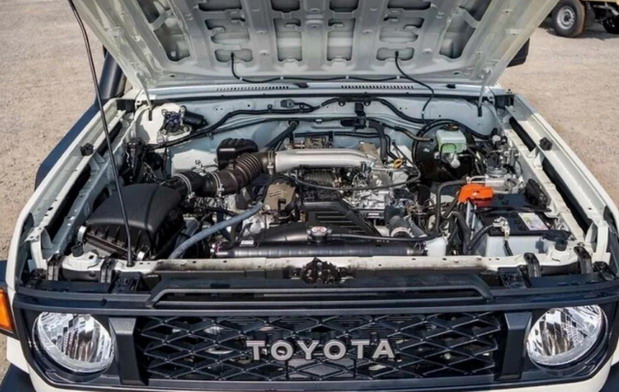
At a time when almost all manufacturers are switching to hybrids, electronic injection, turbines and complex gas treatment systems, Toyota still produces an extremely simple diesel engine codenamed 1HZ. The old-school diesel is installed in the Land Cruiser Series 70.
It is a 4.2L inline six-cylinder engine that is installed in the legendary Land Cruiser Series 70, primarily for markets where reliability and durability are more important than performance.
The Toyota 1HZ is an inline-six diesel engine developed and produced by Toyota starting in 1990. It remains available in the Toyota 70 Series and the Toyota Coaster—sold in countries with low or non-existent emissions regulations—and also powers Land Cruiser 70 models sold by Toyota Gibraltar Stockholdings to organizations such as the United Nations and other NGOs. Previously, the engine was used in the Land Cruiser 80 and Land Cruiser 100 series before being replaced.
The 1HZ engine generates more power and torque than the older 2H diesel engine. Despite being 35 years old, the 1HZ is still used in the production of the Land Cruiser J70 worldwide, with the exception of markets that exclusively use gasoline engines, Euro 4 compliant markets, and the Australian market, where the 1GR-FE and 1GD-FTV turbo-diesel engines are supplied, respectively. Popular in the Land Cruiser 80 Series, it replaced the 2H engine in the 80/85 series in 1990.
The Toyota Land Cruiser 1HZ engine—a 4.2-liter (4164 cc), inline-six, 12-valve SOHC (Single Overhead Cam) diesel—features indirect injection and delivers a maximum power output of 96 kW (129 hp; 131 PS) at 3800 rpm and a peak torque of 285 N⋅m (210 lbf⋅ft) at 2200 rpm.
The 1HD is the turbocharged, direct-injection version of this engine. It shares many of the same components, most notably the engine block and crankshaft.
The 5-cylinder variant of this engine is known as the 1PZ.
While Toyota does not install its 1HZ engine into any mainstream passenger car, it's not merely producing it for fun or through any sense of nostalgia, and it's certainly not keeping it alive through aftermarket support. Toyota South Africa lists the Land Cruiser 79 DoubleCab 4.2D on its website, complete with the 1HZ engine, as part of an official 2026 specification sheet. It goes on to list the coded engine with its power and torque outputs and notes that it pairs with a five-speed manual transmission for that particular market.
In parallel, Toyota Gibraltar Stock Holdings (TGS), which is the parent company's dedicated supply arm for humanitarian agencies, fleet operators, and NGOs, also offers multiple Land Cruiser 70 series variants with the HZJ model code. These vehicles have the 1HZ diesel engine, and this shows that the engine policy is not only a regional anomaly. Instead, it seems to be a deliberate product decision that sits within Toyota's global industrial ecosystem.
However, Toyota doesn’t sell the Land Cruiser 70 Series everywhere with the 1HZ in place. For example, when it reintroduced the vehicle to the Japanese market in late 2023, it came with the newer 2.8-liter 1GD-FTV turbodiesel.
If you go down to New Zealand or Australia, you'll find that Toyota has transitioned away from the 1HZ as well, due to both evolving customer expectations and emissions regulations, showing that the engine’s survival is certainly not universal.
Instead, that survival does seem to be strategic, as Toyota confidently builds it and sells it in places where durability, serviceability, and regulatory allowances permit, and where the engine fully aligns with its original design intent.
Fundamentally, the 1HZ is still going because it explicitly delivers what some customers require, and it's not simply a case of survival through accident or neglect.
The engine codenamed 1HZ is almost a textbook example of a simple design. The engine is atmospheric, without a turbine, has a design with only two valves per cylinder and a single camshaft. It does not have common-rail injection, electronic injection control or a computer that controls its operation. The injection is completely mechanical, and the pump is driven by the engine itself. Therefore, it can also work with lower quality fuel.
The performance is modest by today's standards: from 4.2 liters it develops 131 hp and 285 Nm. It is this conservative design that allows the engine to operate far below its maximum load and therefore lasts an exceptionally long time. The crankshaft has seven bearings, the cylinder diameter is 94 mm, the piston stroke is 100 mm, and the compression ratio is 22.4:1.
The immortal Toyota diesel has neither a DPF filter nor an EGR system, and in some markets it does not even have a catalytic converter. Its environmental standard is Euro 2, which is why it would practically not be able to be registered as a new vehicle in the European Union.
However, in countries such as Tanzania, South Africa, Botswana, Namibia, Zambia and Australia, the Land Cruiser 70 with this engine still has its purpose. In remote and demanding areas, a simple engine is often worth more than modern technology.

In some markets, the 1HZ is offered in parallel with the newer 2.8-liter turbo diesel, but Toyota still retains it, even though it has been in production for 36 years. For certain international customers, including humanitarian and security organizations, vehicles can be customized and delivered through Toyota's Gibraltar dealer.
While most of the world is preparing for increasingly strict standards such as Euro 7, Toyota is still preserving this almost "fossil" diesel. Because where there is no service, diagnostics and quality fuel - simplicity is sometimes worth more than the most modern technology.
by: Autonews



Nenhum comentário:
Postar um comentário