BMW

BMW Neue Klasse introduces technology that prevents doors from opening in front of cyclists
You know that moment when you’re about to open your door, but a cyclist suddenly appears, and you breathe a sigh of relief that you saw them just in time? BMW’s Neue Klasse cars have you covered even if you don’t. They won’t just beep at you if they spot a hazard. If they think you’re about to cause a dooring accident, they can temporarily refuse to let you out.
The enhanced Exit Warning system debuts with BMW’s Neue Klasse technology in the new 2027 iX3. Side radars monitor approaching vehicles, bikes and other road users, and if opening the door could cause a collision, the electronic lock delays release until the danger has passed.
BMW isn’t first here, to be fair. Lexus introduced its e-Latch Safe Exit Assist on the NX several years ago, preventing the door from unlatching when its blind-spot sensors detect approaching traffic. Audi also offers exit-warning systems that briefly delay or prevent door opening when they spot cyclists or vehicles approaching from behind.
But BMW says another Neue Klasse trick is currently unique among rivals. Its emergency steering intervention can steer the car around an obstacle while remaining within its lane. BMW gives examples including somebody unexpectedly stepping into the road and an unseen cyclist appearing in poor light.
BMW's Neue Klasse vehicles are introducing technology that should prevent common accidents, such as opening a door in front of a cyclist. The system not only warns of danger with an audible warning, but can also temporarily block the opening of the door if it determines that it would cause a collision.
A new, further improved exit warning function debuts in the new iX3 for 2027, and uses side radars to monitor traffic. If the system detects a vehicle or bicycle in a dangerous vicinity, the electronic lock will delay unlocking until the danger has passed.
It should be noted that BMW is not the first manufacturer to use this technology. Lexus introduced its e-Latch system on the NX a few years ago, which prevents the doors from opening when blind spot sensors detect traffic. Audi also offers similar solutions, whose systems can briefly delay or prevent the doors from opening if they detect vehicles or cyclists approaching from behind.
BMW, however, points out that another function of the Neue Klasse platform is currently unique on the market. It is an emergency steering intervention system that can bypass an obstacle without leaving the traffic lane. Examples include situations in which a pedestrian unexpectedly steps onto the road or an unlit cyclist suddenly appears in poor visibility.
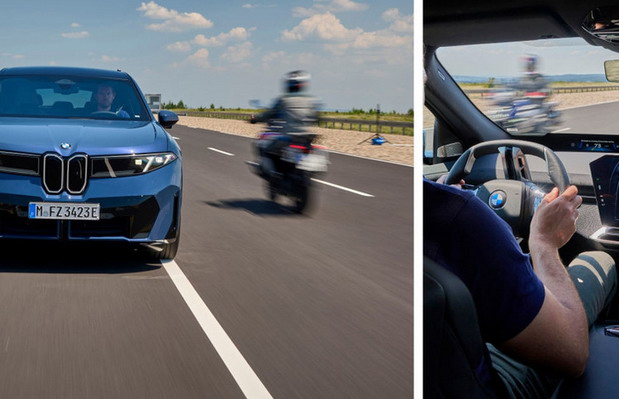
The list of electronic aids does not end there. The car can turn the steering wheel independently to avoid a potential side collision, while the emergency braking system now also recognizes animals. In the event that the driver becomes unable to drive, the Attentiveness Assistant system takes over.
It stops the car independently, activates all direction indicators and automatically calls the emergency services. The problem of accidentally pressing the accelerator pedal instead of the brake in a parking lot has also been solved. At speeds of up to 2 km/h, if an obstacle is within one meter and the driver suddenly and forcefully presses the accelerator, the car will ignore the command and stop on its own.
BMW announces that these systems will be gradually introduced in other models. After the premiere in the iX3 model, the technology also arrives in the i3, X5 and 7 Series models.
BMW is rolling out an expanded set of active safety features as standard equipment with the Neue Klasse, and the iX3 is the first production model to carry them. The i3, X5 and 7 Series are next in line. The main addition is an upgrade to BMW’s exit warning system, which has warned drivers with lights and chimes for years but never actually stopped a door from opening. That changes now. Side radars scan the area around a parked Neue Klasse model, and if a cyclist or vehicle is approaching, the electronic door lock delays release until the danger passes. BMW is pointing to Berlin as the case study: the German Insurance Association logged 392 dooring accidents there in 2024, just under 8 percent of all bicycle crashes in the city. It’s a narrow, specific problem, and BMW built a narrow, specific fix for it rather than folding it into a vaguer “safety upgrade.”
The rest of the active safety additions lean on the same idea: intervene precisely, then get out of the way. Emergency steering intervention is new to BMW and, per the automaker, still absent from rivals. It can steer the car around an obstacle in its own lane, such as a pedestrian stepping out from between parked cars or a cyclist missed in low light, and it can also nudge the car away from a vehicle closing in from the side, provided there’s room to do it safely.

The Emergency Brake Assistant now factors in evasive steering and, thanks to better sensors, extends to animals and wildlife crossings. Road Priority Warning pushes recognized signage (stop signs, yield signs, no-entry, and now crosswalks) into the Panoramic Vision display. And the Attentiveness Assistant, if it detects the driver is incapacitated, brings the car to a stop, flips on the hazards, and places an eCall on its own. The driver can still override any of it.
Low-speed scenarios get their own set of updates. Active Park Distance Control now brakes at the sides of the car in addition to the rear. A new cross-traffic function uses rear side radars to catch approaching cyclists or cars when backing out of a spot with poor sightlines. And a start monitoring feature watches for pedal mix-ups: if the car detects an obstacle within a meter at speeds under 2 km/h alongside a sudden, forceful stab of the accelerator, it brakes the car to a stop in whichever direction it was headed.
Symbiotic Drive...BMW frames all of this under what it calls Symbiotic Drive, a system meant to read driver intent from steering input, eye direction, and things like a turn signal or a shoulder check, so the car doesn’t nag when a maneuver was deliberate. Dr. Mihiar Ayoubi, BMW’s Senior Vice President Driving Experience Development, tied it to the brand’s “Smart, Symbiotic, Safe” philosophy, saying active safety functions are meant to be quiet background operators until a critical moment.
BMW backs the pitch with fleet numbers. Across 1.6 billion kilometers driven in Europe last month by customers who opted into data sharing, the fleet logged around 8 million visual and acoustic collision warnings, plus 243,977 cases where active steering or braking stepped in to prevent one. It’s BMW’s own data, so treat it as a company claim rather than an independent audit, but the scale is real: that’s roughly 240,000 documented interventions in a single month.
All of this routes through a new central computer BMW calls the “Superbrain of Automated Driving,” said to have about 20 times the processing power of its predecessor. Much of the validation work happened at BMW’s Future Mobility Development Center in Sokolov, Czech Republic, a roughly 600-hectare site with 25 kilometers of test track that opened in 2023. Dr. Martin Sautter, BMW’s Senior Vice President Vehicle Certification, called it a way to recreate real-world driving scenarios under reproducible conditions rather than just another proving ground.
The early external validation is in place too. The iX3 posted a five-star Euro NCAP result under the organization’s overhauled 2026 test protocol, one of the first vehicles graded against the new standard, and BMW says it cleared the required scores by a wide margin. Whether the rest of the Neue Klasse lineup holds up the same way is the next thing to watch as the i3, X5 and 7 Series pick up this same hardware.



Nenhum comentário:
Postar um comentário