AUTONEWS

Why heat can crack your windshield this summer—and how to prevent it
You’re driving along calmly, your thoughts drifting to the rhythm of your car’s playlist, when suddenly a small stone from the road strikes your vehicle, leaving a tiny mark on the windshield. After a moment of frustration, you try to downplay the situation. After all, it’s just a scratch. Big mistake! With the scorching heat of July and August, that small mark can turn into a massive crack within days—often right when you least expect it, like on your way to the beach or while heading home.
As Carglass reminds us, heat and sudden temperature changes significantly accelerate the growth of windshield cracks. Simply put, in these temperatures, the longer you wait to visit a repair shop, the greater the risk of ending up with a cracked windshield in the middle of a holiday or a busy travel period. But why?
The asphalt plays a role, too...In summer, two factors combine to increase the number of windshield chips. First, there are significantly more cars on the road. Second, the asphalt itself contributes to the problem: it contracts in winter but expands in summer due to the heat, and this expansion creates cracks. The result is a damaged surface that easily gives way under the weight of tires, causing your car to launch small stones like a miniature cannon—straight at the windshield of the car behind you.
Heat also plays a negative role for another reason—a fact known for a long time. As early as 1921, researcher A.A. Griffith demonstrated that damaged glass is considerably more fragile than intact glass and that the greater the initial impact, the less force is required for the crack to keep growing. Decades later, in 1967, another study confirmed that even under minimal stress, a crack advances steadily—little by little, day after day. Furthermore, it is worth noting that the car body expands and contracts differently than the glass, as steel, aluminum, and glass have distinct coefficients of expansion. This invisible interaction between materials ends up transmitting extra stress directly to the windshield. In laboratory tests, a windshield heated to 80 degrees Celsius on the outside—with the cabin at 30 degrees Celsius—withstood the initial stress, but the crack visibly widened, and after several similar cycles, the glass eventually shattered.
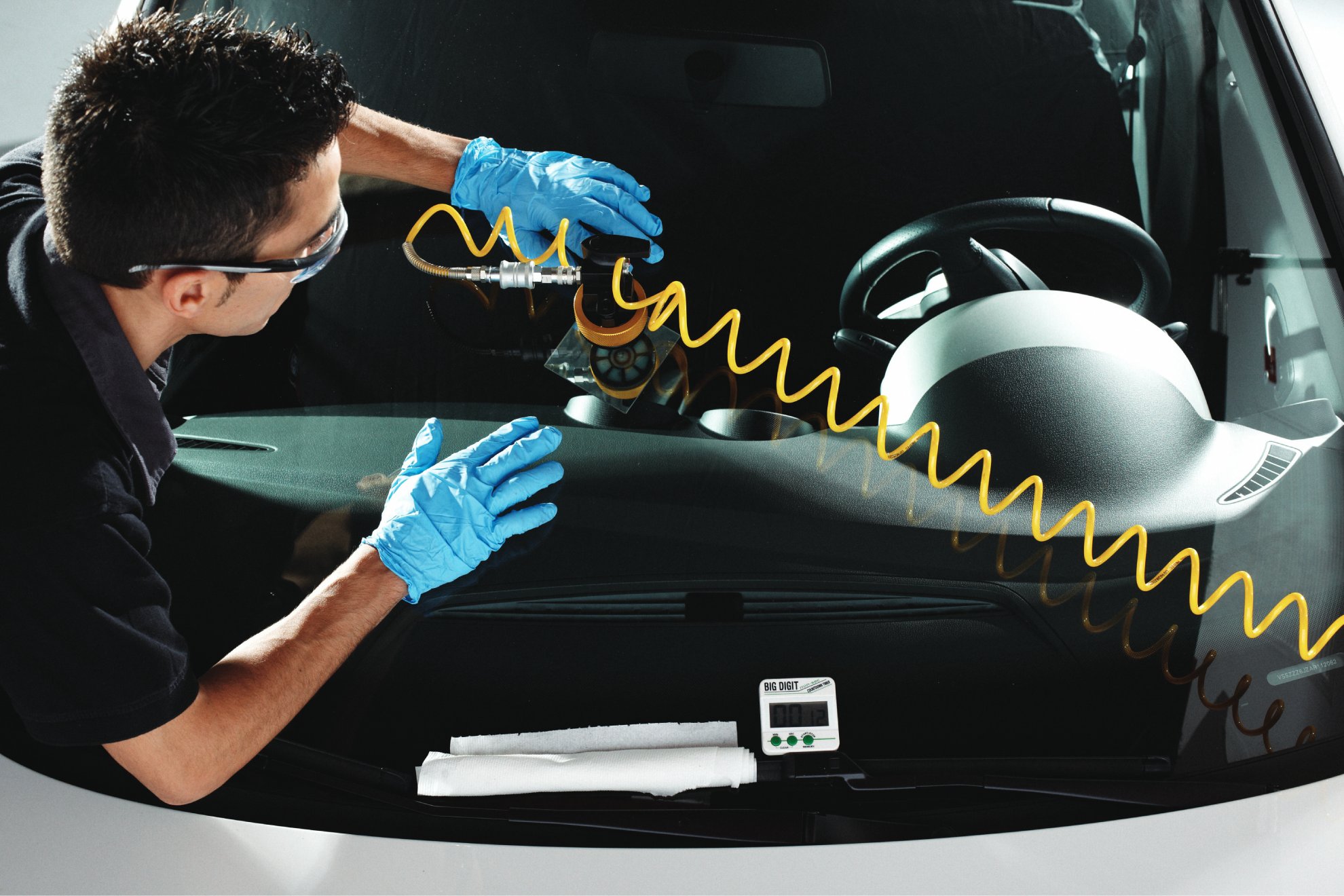
Very cold air conditioning can accelerate the appearance of cracks in automotive glass
Be careful with the air conditioning...There is a very common habit that doesn't help matters: when you get into a car that has been sitting in the sun for hours, you turn the air conditioning to maximum power—perhaps even directing the airflow straight at the windshield to avoid hitting your body with it. This causes such a sudden temperature change that the windshield takes a significant hit. Therefore, it is better to let the car's interior cool down by directing the airflow toward another part of the vehicle.
And that is without even considering the lifespan of the windshield, which is already under stress from the factory. The manufacturing process itself—cutting, molding, and laminating the glass—creates internal tension that varies from piece to piece. Additionally, the polyurethane adhesive that secures it to the body shrinks slightly as it dries, adding its own share of stress. To top it off, the windshield acts as the car's backbone, providing structural rigidity and absorbing some of the forces involved in cornering, braking, and accelerating. And as if that weren't enough, every bump, every road irregularity, and even the wind subject it to constant, minor jolts. Simply driving over a speed bump at 30 kilometers per hour generates up to 5G of acceleration on the glass...Under that kind of accumulated stress, anything would crack.
Given all these factors, the recommendation is simple: act quickly as soon as you notice an impact. Specialized repair shops can often fix the glass rather than replacing the entire windshield, provided the chip is away from the edge, small in diameter (roughly the size of a 2-euro coin), and outside the driver's field of vision.
Repairing instead of replacing is far more cost-effective, can be done without removing the windshield or affecting driver-assistance systems, and saves both materials and time. With an appointment, many shops can complete the process in just half an hour, compared to the hour and a half or more required to replace the entire windshield.
So, the next time a small stone chips your windshield, it is best to head to a repair shop right away—especially if you are about to go on vacation.


Nenhum comentário:
Postar um comentário