AUTONEWS
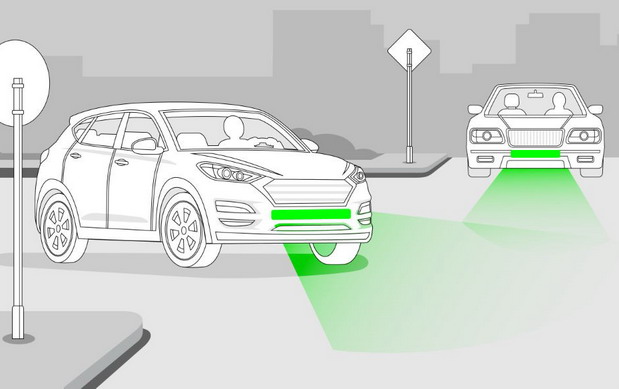
Interesting proposal for fewer collisions - green lights on the front of cars could save lives
Scientists recommend that brake lights be placed on the sides of vehicles as well.
Scientists from the Graz University of Technology have investigated how additional brake lights on the front of vehicles would affect traffic safety. It is said that this could prevent up to 17 percent of collisions at intersections.
While conventional brake lights only warn vehicles behind you, front brake lights also signal pedestrians and other vehicles that an oncoming vehicle is braking.
The scientists claim that these front brake lights would glow green instead of red and could be easily integrated into the vehicle design. They could also be retrofitted to existing vehicles relatively cheaply.
Scientists led by Ernst Tomasz from the Institute for Vehicle Safety reconstructed 200 real-life traffic accidents at Austrian intersections and then simulated them assuming that the vehicles involved were equipped with front brake lights.
Depending on the reaction time of the road users, between 7.5 and 17 percent of the crashes could have been prevented.
In as many as a quarter of cases, additional lights would have made it possible to reduce the impact speed and thus mitigate injuries. The key lies in the shortened reaction time, which can make the decisive difference between an accident and timely braking.
But the technology also has its limitations. According to a study by TU Graz, which was recently published in the journal Vehicles, in about a third of the reconstructed accidents, the front brake lights were not visible due to an unfavorable angle. The scientists recommend that brake lights also be installed on the sides of the vehicle.
Imagine you’re driving toward a busy intersection. A car approaching from the front is about to apply the brakes, but you have no way of knowing. By the time you realize it’s stopping, it’s too late, and a crash happens. Each year, numerous such collisions occur, but a simple change in our vehicles could dramatically reduce their number.
This simple idea is putting brake lights on the front of vehicles. This could be a game-changer in road safety. A recent study from Graz University of Technology in Austria suggests that these front-facing brake lights (FBLs) could help avoid up to 17% of intersection collisions and lessen injury severity in as many as 25% of cases.
It’s a low-cost, easy-to-implement solution with the potential to save thousands of lives, yet no car on the road today has it. So why haven’t we added this obvious safety feature before? Well, until now, the idea lacked strong real-world evidence. That’s exactly what the new study provides, by recreating real crashes, testing the idea in simulations, and determining just how helpful a front-facing brake light can be.
“The aim of this study is therefore a prospective evaluation of the safety performance of an FBL by means of a counterfactual simulation on the basis of real traffic accidents at junctions,” the study authors note.
Testing the power of FBLs...The researchers began by examining 200 actual vehicle accidents that took place at intersections in Austria. They used data from the Central Database for In-Depth Accident Study (CEDATU), which records detailed information about how crashes happen.
Using this data, the team reconstructed each crash. Basically, they created a timeline of events showing how the vehicles moved, when the drivers braked, and how the collision occurred. Next, they ran computer simulations of each crash scenario, but this time, they added a twist: they assumed that the cars approaching from secondary roads had green front-facing brake lights.
These lights would signal to other drivers, especially those coming from the side or in front, that a vehicle was slowing down. In the simulations, whenever these lights were visible, drivers were assumed to react more quickly. The researchers tested three possible reaction times: 0.5, 1.0, and 1.5 seconds. The faster the reaction, the better the outcome.
The results were surprising. Depending on the assumed reaction time, the simulations showed that 7.5% to 17% of the original accidents could have been completely avoided with front brake lights. In up to 25.5% of cases, the lights wouldn’t stop the crash entirely, but they would reduce the speed of impact, enough to lower the severity of injuries.
In one example, the average crash speed in minor-injury cases dropped from 44.8 km/h to 28.8 km/h when the driver reacted half a second faster. This drop can mean the difference between a few bruises and a life-threatening injury.
Car lights are, above all, essential for road safety—both for other vehicles and for pedestrians. Europe is seeking solutions to minimize the number of road fatalities—aiming for zero deaths by 2030, a goal that has proven difficult to achieve. For now, its primary tools are the driver-assistance systems that governments mandate for new cars.
Mercedes has become the first manufacturer in the world to offer a new color for the headlights and taillights of its autonomous vehicles. Currently, all vehicles use red brake lights, but that could change if Brussels takes seriously a study conducted by engineers at the Graz University of Technology.
Drivers know that proper lighting is crucial, especially for being seen by other road users and for communicating their intentions. A clear example is the turn signal; its use is required and encouraged, as no one can predict another driver's actions. It is the right way not only to drive safely but also to avoid misunderstandings.
Naturally, this also means that all lights must be in perfect working order, especially the brake lights. Researchers at the Austrian university determined that adding a fourth brake light could improve safety, after analyzing more than 200 real-world accidents in Austria.
The idea of a fourth brake light isn't new, but it is interesting...The study concludes that intersections are the sites with the highest incidence of collisions, showing that between 7.5% and 17% of crashes could have been avoided with a fourth brake light. This light would be installed at the front of the vehicle and would be green to increase visibility and improve reaction times. Researchers noted that the cost is very low and that the light could extend almost to the sides of the vehicle, making it visible to those approaching from the side as well.
In one-third of the reconstructed accidents, an unfavorable angle was the primary cause of the collision. The report emphasizes that if front-facing brake lights had been available to traffic on the main road, drivers on intersecting streets would have reacted more quickly, thereby mitigating the consequences—or even avoiding the collision altogether.


Nenhum comentário:
Postar um comentário