AUTONEWS

SKKU research team develops high-capacity battery material to drastically increase EV range
A joint research team—led by Professor Ki-Jae Kim from the Department of Energy Science and the Department of Future Energy Engineering
Sungkyunkwan University(SKKU), alongside Professor Jang Wook Choi's research team from Seoul National University—has developed a high-performance "hybrid polymer binder" for thick-film electrodes. This breakthrough significantly boosts the energy density of lithium-ion batteries while extending their lifespan. The study proposes a practical strategy to overcome chronic binder migration issues and performance degradation that occur during the conventional wet-manufacturing process when making electrodes thicker to increase battery capacity for electric vehicles (EVs) and smartphones.
Recently, the battery academia and industry have actively researched "high-loading electrode" technology. This involves stacking more nickel-rich layered cathode materials into thicker layers to increase EV driving ranges. However, the conventionally used PVDF (polyvinylidene fluoride) binder suffers from a critical drawback during the drying process of thick electrode manufacturing: the binder tends to float to the top, causing the electrode to crack or crumble easily. This severely weakens the mechanical strength and lithium-ion conductivity of the electrode, leading to a sharp decline in battery lifespan.
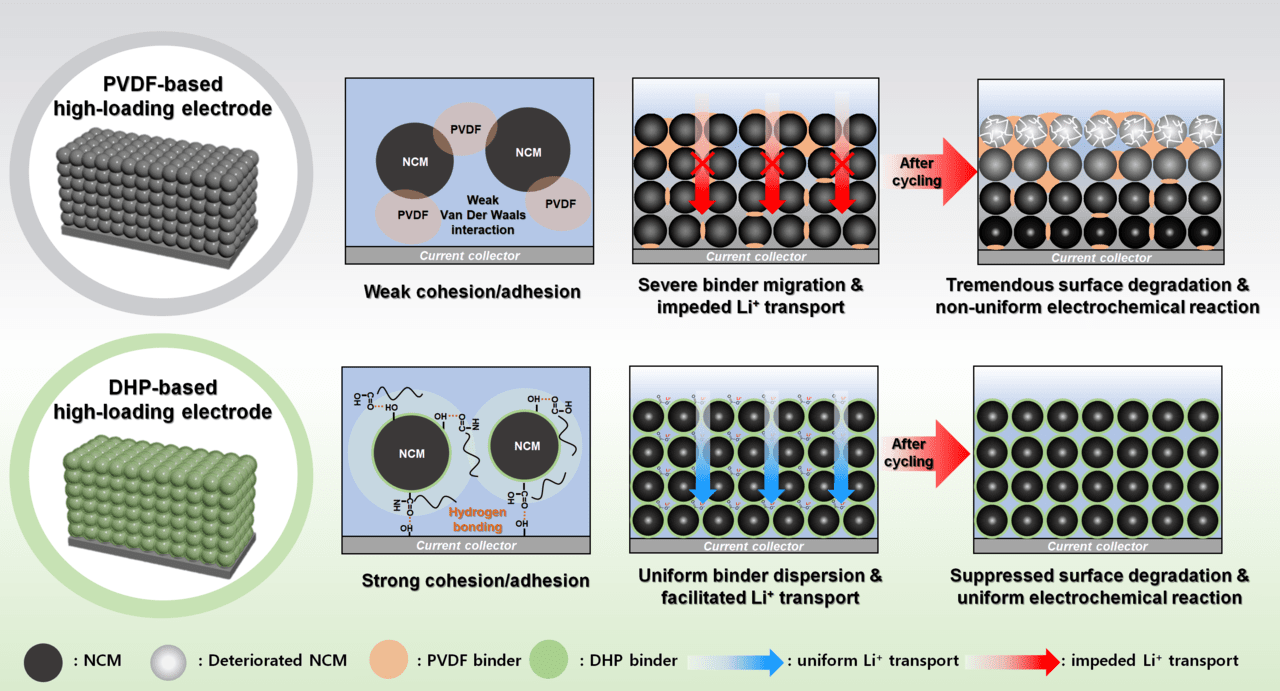
Structure of the DHP hybrid polymer binder and its principle for protecting the battery electrode(image above) Credit: SKKU
To tackle this challenge, Professor Ki-Jae Kim's joint research team blended two polymers with completely different properties: Spandex (SPDX), a highly elastic apparel fabric, and Poly(acrylic acid) (PAA). They applied this combination to the electrode as a novel "Dual-Acting Hybrid Polymer (DHP)" binder. Thanks to spandex's excellent elasticity and PAA’s superior molecular interaction with internal electrode components, this new binder maintains a robust structure that prevents cracking or crumbling, even when applied to exceptionally thick electrodes.
Experimental results showed that the electrode using the newly developed binder exhibited nearly twice the adhesive strength of conventional PVDF binders. Notably, the team identified a new operational mechanism during the initial charge/discharge cycles: the binder spontaneously forms a "Li-PAA interface" that accelerates lithium-ion migration. This enables faster and more uniform lithium-ion transport within the thick-film electrode, significantly enhancing its electrochemical performance.
Furthermore, the research team validated the new hybrid binder by fabricating large-capacity, commercial-grade pouch-type cells. The results were remarkable: while batteries with conventional binders suffered a sharp drop in capacity and failed after approximately 95 cycles, the batteries using the new hybrid binder stably maintained 86.8% of their initial capacity even after more than 200 charge/discharge cycles—effectively more than doubling the lifespan.

Chemical bonding mechanism and molecular interaction analysis of the DHP hybrid polymer binder--Park, B.K., Shim, Y.B., Won, J.U. et al. Wet-processed high-areal-capacity electrodes via transformative spandex–poly(acrylic acid) binder toward 450 Wh kg−1 lithium-ion batteries(image above) Nat Commun (2026).
This research carries immense industrial value because it allows manufacturers to produce high-capacity batteries using existing "wet manufacturing processes" without needing to alter production lines or invest in new equipment. It stands as an exemplary case of solving a practical industrial bottleneck by effectively harnessing the physical/chemical properties and ion-transport mechanisms of polymers.
"Previously, increasing electrode thickness and size was limited by binder and processing issues, which restricted overall battery performance. We overcame this hurdle by efficiently combining the advantages of spandex and poly(acrylic acid)," said Professor Ki-Jae Kim. "This binder technology is highly adaptable to the industry as it utilizes current wet production lines without adopting dry-processing technologies, which have recently attracted attention as next-generation battery manufacturing methods. We expect it to play a pivotal role in extending the driving range of next-generation electric vehicles."
This research was supported by the Ministry of Science and ICT and the National Research Foundation of Korea (NRF) through the projects: Development of Modular LEA (Lithium Electrode Assembly) Core Technology for Universal Utilization of Lithium Metal Anodes and Training Future Leading Talents to Respond to Industrial Demand for Breakthrough Next-Generation Secondary Batteries.
A major breakthrough in electric vehicle (EV) battery technology was achieved by a joint South Korean research team from Sungkyunkwan University (SKKU) and Seoul National University. They successfully developed a novel Dual-Acting Hybrid Polymer (DHP) binder that significantly boosts battery energy density and extends vehicle driving ranges.
What makes this innovation a potential industry game-changer is its seamless integration: it allows manufacturers to produce higher-capacity batteries using existing wet manufacturing lines without requiring any massive capital investment or retooling for dry-processing machinery.
The industrial bottleneck: thicker electrodes...To push EV driving ranges beyond the 400-mile mark, manufacturers need to increase the battery's energy density. The most direct way to do this is by making the electrode layers thicker, allowing them to hold more power-dense, nickel-rich active materials.
However, conventional wet-manufacturing methods hit a hard ceiling due to the standard industry glue, a polyvinylidene fluoride (PVDF) binder. During the slurry drying process for thick-film electrodes, the PVDF binder tends to migrate and float to the top. This uneven distribution causes the thick electrode to crack, crumble, and separate from the current collector, causing the battery's lifespan to plummet rapidly.
The innovation: spandex meets poly(acrylic acid)...To resolve this issue, the researchers combined two polymers with drastically opposing but complementary characteristics to create the DHP binder:
Spandex (SPDX): Provides extreme flexibility and elasticity, allowing the dense, thick electrode to absorb structural stresses without fracturing.
Poly(acrylic acid) (PAA): Offers powerful molecular bonding capabilities to securely hold the internal active materials and conductive agents together.
The combination yields nearly twice the adhesive strength of conventional PVDF binders. Furthermore, during the initial charge and discharge cycles, the binder spontaneously builds a specialized lithium-PAA (Li-PAA) interface layer. This layer acts as a high-speed transit highway, accelerating lithium-ion migration uniformly through the exceptionally thick electrode.
Promising performance results...When validated using commercial-grade, large-capacity pouch-type cells, the differences were stark:
Conventional Binders: Suffered a sharp, immediate drop in capacity, failing after roughly 95 cycles.
Why it matters for automakers...Most next-generation battery concepts (such as certain solid-state designs or dry-coating methods) require entirely new factories and massive capital expenditures (CapEx) to build specialized production environments. Because this hybrid polymer binder functions perfectly within traditional water- or solvent-based wet slurry systems, battery plants can deploy it immediately. This offers a fast, low-cost path toward mass-producing cheaper, longer-range EVs using factories that are already up and running.
If you are interested, we can look closer into the chemical mechanics of the Li-PAA interface, explore how it compares to other emerging binder alternatives like biomass-derived options, or look into the estimated timeline for commercial adoption in passenger vehicles.


Nenhum comentário:
Postar um comentário