AUTONEWS
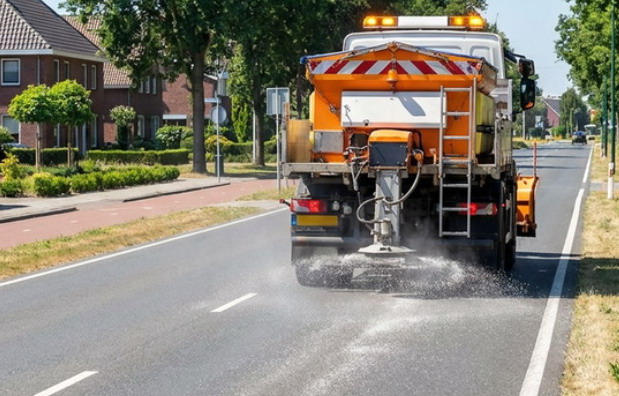
Dutch find way to keep roads cool in summer
People are amazed to see vehicles in a Dutch city sprinkle salt on the roads in the middle of summer, but there's a good reason for it.
Salt is used because it attracts moisture and helps cool the surface, which is one of the reasons why it's being done in the Dutch city of Hilversum. Due to high temperatures, which can heat the asphalt to more than 50 degrees Celsius, the city authorities have decided to sprinkle salt on the roads to prevent damage to the road surface, writes "Autonews".
The reason is that asphalt softens in extreme heat. This especially happens on sections that are exposed to the sun all day long, but also at intersections, roundabouts and other places where vehicles often brake, turn or start again. When heavy vehicles drive over the softened asphalt, the surface can deform, ruts form, and small stones in the asphalt begin to separate.
Salt is used because it attracts moisture and helps cool the surface. In Hilversum, they don't spread dry salt like they do in winter, but a wet salt solution. When it's spread on hot asphalt, the moisture gradually evaporates, cooling the road surface. This reduces the stickiness of the asphalt and the risk of additional damage caused by traffic.
"We do this to cool the roads," explains municipal spokesman Jeroen Oosterheert.
It's a wet salt solution. When we spread it on the asphalt, the moisture evaporates. This cools the asphalt, preventing it from damaging it.
According to him, this measure is necessary during heat waves, such as the one that hit Europe in June.
"In some places we measured, the temperature exceeded 50 degrees. "The heat softens the asphalt, and when heavy vehicles drive over it, ruts form," says Oosterheert. This eventually leads to cracking of the roadway. "And that's exactly what we're trying to prevent," he adds, according to Autonews.

Why salt and not sand or water? Oosterheert says he's not surprised that residents look at salt spreaders in the summer with bewilderment.
"When you think of salting the roads, you certainly don't think of it being done at 7:30 in the morning, on a nice, sunny day," he says.
Most people associate salt spreading with winter.
"And usually at night, just before the ice forms," he adds. "But salt actually helps keep the asphalt intact in the summer."
Salting roads on hot days is not entirely new and has already been used in other Dutch cities. However, since the salt solution containing chlorides can be harmful to the environment, some municipalities are giving up on this practice.
Similar measures are also used outside the Netherlands, but not necessarily with the use of salt. In the UK, local authorities also send vehicles that are normally used in winter onto the roads during heatwaves. For example, sand, stone or granite dust is often spread on softened asphalt to absorb the softened bitumen and prevent it from sticking to the tyres. The Road Surface Treatments Association in the UK says this is standard practice during extreme heat.
In other words, the problem is not unique to the Netherlands. Heat softens asphalt in other European countries too, but the solutions vary: in some Dutch municipalities salt solution is used, in the UK sand or stone dust is more common, while in some places roads are cooled with water.
The aim is the same everywhere – to reduce the stickiness and deformation of the road surface until the road temperature drops.
“You can use sand, for example,” Oosterheert says, citing one alternative, adding that you can also spray with water – this is done in some other municipalities, but it is a short-term solution. Salt takes a bit longer to work, as it takes at least a day for all the moisture to evaporate and disappears.


Nenhum comentário:
Postar um comentário