HUAWEI
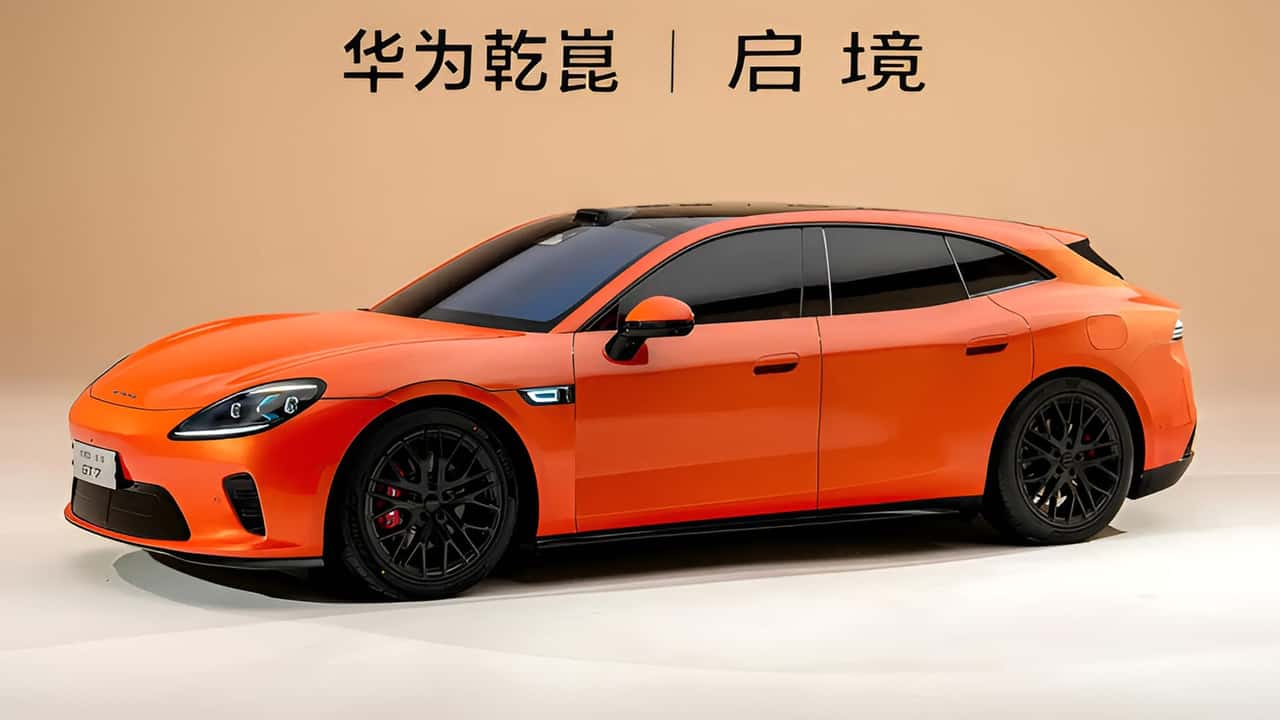
Huawei Aistaland GT7: Porsche Taycan and Panamera mix
The Aistaland brand (Chinese name: Qijing) was recently created in China, a joint project between the GAC automobile group and the technology giant Huawei. This project is not part of the HIMA alliance – the automotive technology alliance that Huawei previously launched with other local vehicle manufacturers. The first product of Aistaland is the striking electric shooting brake GT7, whose appearance is inspired by the station wagon version of the Porsche Taycan.
After the first images in March and the public premiere at the Beijing Auto Show in April, the interior and technical information have now been revealed, but the price has not yet been announced. The Aistaland GT7 is based on an 800-volt electric platform, has air suspension and wheels with a diameter of 19, 20 or 21 inches. The shooting brake is 5,050 mm long, 1,980 mm wide and 1,470 mm high.
More than just a new model, the GT7 marks the debut of the Qijing brand within the Huawei ecosystem and has already begun its journey with pre-orders, even before the full disclosure of price and versions. But what really stands out here is not just the format or the premium positioning, but the technological base.
The birth of the AISTALAND brand is the result of a collaboration between GAC Group and Huawei Qiankun. Positioned as a premium smart EV brand, it operates on a model where Huawei provides the full-stack intelligent solution while GAC handles vehicle R&D arces. The car debuts the new HUAWEI XMC Qiankun digital chassis engine, the next-gen Xiaoyi AI assistant, and a Kirin battery pack co-customized by CATL, Huawei Qiankun, and AISTALAND.
In other words, Huawei Qiankun has chosen the GT7 as the launchpad for its latest tech in autonomous driving, smart cabins, chassis control, and battery technology. This "priority on debut resources" gives AISTALAND a strong starting point for a new brand, but it also means the cost of trial and error is shared by both parties.

The GT7 adopts a set of three electric motors, something still rare even among high-performance models. This allows for much more precise control of torque and dynamic behavior, reinforced by a Huawei digital chassis capable of adjusting everything in milliseconds.
The electric base also follows the most advanced line in the Chinese market. The model uses an 800V architecture combined with a new generation battery supplied by CATL, with support for ultra-fast charging in the 6C standard. In practical terms, the promise is to recover about one kilometer of range per second under ideal conditions, a number that puts the GT7 among the fastest in this regard.
Another point that reinforces this technological profile of the model is the assisted driving system. The car features an 896-line LiDAR, indicating readiness for more advanced automation functions, already based on an architecture geared towards level 3 in specific scenarios. It's a significant leap compared to what is seen in most models currently available.
Inside, the logic remains the same. The GT7 should debut a new evolution of the HarmonyOS system, focusing on total integration between car, user, and services. The proposal goes beyond a traditional multimedia center and starts working with specialized intelligent assistants, capable of performing specific functions within the vehicle's ecosystem.
There is a three-spoke steering wheel, a narrow instrument panel, a 15.6-inch freestanding multimedia tablet and a double-height center console with a wireless charger. The seats are heated and ventilated with a massage function and a retractable footrest. Equipment includes a head-up display and a 21-speaker audio system. The station wagon can also project sound, including engine noise simulation.
The shooting brake format, in turn, helps position the model in a space that is still relatively unexplored outside of China, but which has been gaining strength there. At about five meters long and with a wheelbase of three meters, the GT7 clearly enters the large segment, combining a more sporty proposition with a high level of interior space.
In practice, this puts the model in an interesting competition. On the one hand, it speaks directly to cars like the Zeekr 001, which consolidated this type of body in the premium electric segment. On the other hand, the advancement in technology and software brings the GT7 closer to rivals like the Xiaomi SU7, which also bet on digital integration as their main differentiator.
This combination makes it clear that Huawei is not only participating in the automotive market, but trying to redefine part of the game. The GT7 emerges as a product conceived from the beginning based on digital architecture, with hardware and software evolving together, something that is becoming standard among new Chinese brands.
The 3,000 mm wheelbase shows that the Aistaland GT7 has a cousin in the similar electric station wagon Shangjie Z7T, a joint project of Huawei and SAIC (part of the HIMA alliance). The GT7's luggage capacity is 647 liters, and by folding the rear seats it increases to 1,606 liters. There is also an additional luggage compartment with a capacity of 215 liters in front.

The Aistaland GT7 will be offered with rear-wheel drive or all-wheel drive. The basic version uses an electric motor with a capacity of 250 kW (340 hp), while data on the 4×4 modification with three motors has not yet been released, except for the announcement that it will accelerate to “hundreds” in 2.98 seconds. According to Chinese media, the Aistaland GT7 will be available with a battery capacity of 86 or 103 kWh, or a maximum range of up to 900 km (CLTC).
by Autonews


Nenhum comentário:
Postar um comentário