MERCEDES-BENZ

Mercedes-Benz SLK celebrates 30 years
Thirty years after its premiere at the Turin Motor Show in April 1996, the Mercedes-Benz SLK (R 170) remains one of the most emotional models in the brand's history.
The compact sports car, whose name carries the description "Sportlich, Leicht, Kurz" (Sporty, Light, Short), continues to attract attention today with its innovative steel vario-roof construction, attractive design and driving pleasure.
The concept of lightweight construction using magnesium, among other materials, reduced the weight of the basic version of the SLK 200 to just 1,270 kilograms. In 2004, no fewer than 311,222 SLKs of the R 170 model series were built at the Bremen factory. Across three generations covering the R 170, R 171, and R 172 model series, this compact Mercedes-Benz convertible with an open top has sold over 710,000 units – since 2016 as the SLC. The first generation is already a recent classic and, as a result, is already in the second stage of its existence. The specialist magazine “Motor Klassik” commented in April 2019: “The first model of the SLK series (R 170) was a best-seller and had the characteristics of a classic.”
The roadster received its name during the design phase, when engineers referred to it as “SL kurz” (“compact”) in homage to the Mercedes-Benz SL. In fact, the R 170 model series, with a body length of 3,995 millimeters, was about 500 millimeters shorter than the SL Roadsters of the then-current R 129 model series.
The production version of the SLK was presented at the Turin International Motor Show on April 22, 1996. This sports car perfectly matched its time: the two-seater open car was then undergoing a strong revival. In Western Europe, the annual number of car registrations in this market segment increased from 11,300 in 1992 to 98,500 in 1995. The SLK contributed to the convertible boom in the 1990s and 2000s. For a time, this Mercedes-Benz was the best-selling car with a metal folding roof in Germany. The SLK was of great importance to the brand because it attracted a younger, lifestyle-oriented group of buyers. In retrospect, Jürgen Hubbert, a member of the Mercedes-Benz Board of Management at the time, said: “The SLK, CLK and M-Class models contributed greatly to a new image for Mercedes-Benz.”
A study that was also presented in Turin in April 1994 whetted the public's appetite for the roadster. It was based on the work of designer Michael Mauer and came very close to the later production model. Mauer's model, with its short front and rear overhangs coupled with a comparatively long wheelbase, highlighted many design details, from the hood with its electric domes to a striking detachable airflow edge at the rear. A second concept car presented in Paris in the autumn of 1994 not only showcased the vario roof but also a unique interior design. From 1996 onwards, the production SLK sports car attracted considerable attention due to its strikingly colorful and varied interior combined with refreshing exterior colors.
By the end of production in 2004, a total of 311,222 units had been built in the SLK 200, SLK 200 Kompressor, SLK 230 Kompressor, SLK 320 and SLK 32 AMG versions. The model won numerous international awards immediately after its launch, including the German "Goldenes Lenkrad", the Italian "L'automobile più bella del mondo" award and the American "Car of the Year" in 1997.
The roof that changes everything...One of the key technical attractions of the SLK is the electro-hydraulic vario-roof, which folds neatly into the boot in just 25 seconds, transforming the coupé into a roadster. The roof provides exceptional weather protection, reduces wind noise and passes through automatic car washes without damage, making the SLK a true all-season car.
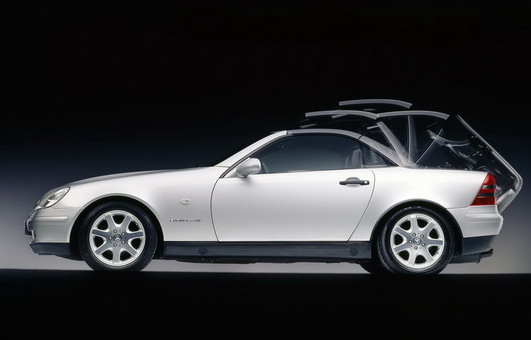
First generation: The Mercedes SLK R170 was the first generation of the compact roadster manufactured and marketed by Mercedes, from 1995 to 2004. It was designed from late 1991 under the direction of Bruno Sacco, with the final design being completed in early 1993 and approved by the board, with a German design patent registered on September 30, 1993. The production SLK was unveiled at the Turin Motor Show on April 22, 1996, emerging as a modern incarnation of the 1950s Mercedes-Benz 190SL, returning to four cylinders and with an identical wheelbase of 94 inches (2,400 mm). A facelift was introduced across all models in 2000, featuring an updated design and upgraded engines.
Second generation: The SLK R171 was presented at the 2004 Geneva Motor Show. It features greater use of high-strength steel and improvements in torsional rigidity and aerodynamic efficiency. The models feature a more compact and revised roof mechanism, which is operated in 22 seconds (previously 25 seconds), resulting in an increase in luggage capacity of 63 liters (2.2 cubic feet). The R171 also introduced the Airscarf system, which integrates a neck-level heating system into the car's headrests. The front design of the car was inspired by the noses of Formula 1 cars. It was facelifted in 2008 and featured new engines and minor changes to the exterior design.
Third generation: The SLK R172 was launched in 2011. It was available with a range of inline four-cylinder, V6 and V8 diesel and petrol engines, and introduced an electronic sunshade for the sunroof, called Magic Sky Control. A facelift was launched for vehicles produced from March 2016 onwards, to coincide with the 20th anniversary of the SLK Class. The model range was also renamed the SLC Class to align with Mercedes' new nomenclature and introduced new engines and a revised design. In 2020, Mercedes-Benz released a Final Edition to commemorate the end of the car's production.
Autonews


Nenhum comentário:
Postar um comentário