SKODA

Octavia Combi RS: 265 hp with 'common sense' to face the SUV craze
For years, the market has pushed us towards SUVs as if they were the only logical answer to everything. More height, a more adventurous image... more sales. However, models like the Skoda Octavia Combi RS continue to demonstrate that there is another way to understand the family car, especially when we are looking for a sporty touch. Here, the key is the reduced ground clearance, the greater length and a much more direct driving experience. Compared to a typical SUV, this Skoda has an advantage in terms of efficiency, dynamic handling and even that touch of discretion that many seek. Although, of course, this does not apply if you choose the Mamba Green color, which the brand offers at no extra cost.
To understand this model, we need to look back. Skoda has spent more than two decades refining the RS formula within the Octavia. From the first model, in the early 2000s, with 180 hp, to this generation, the idea has always been the same: a practical car with a touch of sportiness. Over the years, diesel versions (impossible today), plug-in hybrids, and various mechanical evolutions have emerged. But today, the cycle closes with a single gasoline option, more powerful than ever, but faithful to the original concept.

The exterior design evolved last year with subtle adjustments. The front gained more defined lines, the Matrix LED headlights gave it a more imposing look, and the 19-inch wheels perfectly filled the wheel arches. Up close, everything conveys sportiness without exaggeration (we insist: except for the color). There are no giant spoilers, exaggerated diffusers, or other artifices. It's a car that looks just like another family car... until you notice the exhaust outlets and its slightly lowered stance.
Its dimensions play a key role in its dual nature as a family car and a sports vehicle. It is long (4.7 meters), which translates into a spacious interior. It is also relatively low by current standards (1.45 m), which improves aerodynamics and stability. And in this balance between external size and use of internal space, we find one of the reasons why this car still makes so much sense compared to taller and less efficient alternatives.

Inside, Skoda's practical philosophy remains, albeit with a sportier touch. The star of the show is the 13-inch central screen, faster and easier to use than before. It is well integrated, avoiding that tablet look that seemed to have been carelessly placed there. The digital instrument panel provides good information and clear graphics. Everything is intuitive, which is much appreciated because, let's not forget, the Octavia RS is a car designed for everyday use.
The sports seats offer the perfect balance between comfort and support, allowing for long journeys without fatigue, keeping the body firm even on curves. In addition, their design combines technical fabrics with red details, a classic RS touch, giving it a distinct character without exaggeration.
Physical controls...In terms of ergonomics, it's very well done. There are physical buttons where they are needed, the steering wheel has very practical controls, and access to basic functions is quick. In other words, thankfully, they didn't rely exclusively on touch-sensitive controls, which ends up complicating things more than necessary.

But, although the front is impressive, it is in the rear seats that one of its greatest attractions emerges. There is ample leg and headroom, even for passengers over 1.80 meters tall, although the central transmission tunnel is somewhat bulky, which would compromise the comfort of a possible fifth passenger. And right after that is the other great attraction of this Skoda for families: the trunk. With 640 liters of cargo space in this station wagon version, it's among the best in its category. It easily accommodates the suitcases and bags that a family of four typically takes on summer vacation.
The 2.0 TSI engine is already a legend. Basically, it doesn't present problems, offers decent performance, and if even the factory tuning isn't enough, tuning companies can easily extract another hundred horsepower from the original engine. In the Octavia RS, after the restyling, it has 265 horsepower (20 more than before), but mainly 370 Nm of torque, which gives it a feeling of great flexibility from around 2,000 rpm. It has no problem overtaking and is refined even at low revs, below 1,500 rpm, where the transmission allows the engine to climb smoothly in constant driving, and all this without any mild hybrid system.
The excellent seven-speed DSG gearbox also contributes to the refined performance. In Comfort mode, it allows the clutch to slip a little more, but if you prefer, simply downshift using the paddles under the steering wheel, with a considerable jolt in the exhaust (which sounds more like a loudspeaker, as do other engine sounds accentuated by the resonator...) and you can already accelerate quite a bit. In Sport mode, the engine breathes more, but this is practically unnecessary – it already has plenty of power above 2,000 rpm, so why push it to the limit? Actually, I only have one comment about the mechanical setup: with winter tires, the Octavia RS struggles to transfer power, even on dry pavement. 265 hp is simply too much for the front wheel, and the VAQ limited-slip differential doesn't help either. On takeoff, it's very easy to become a "tire-burning beast," with skidding even with only a quarter of the throttle pressed.
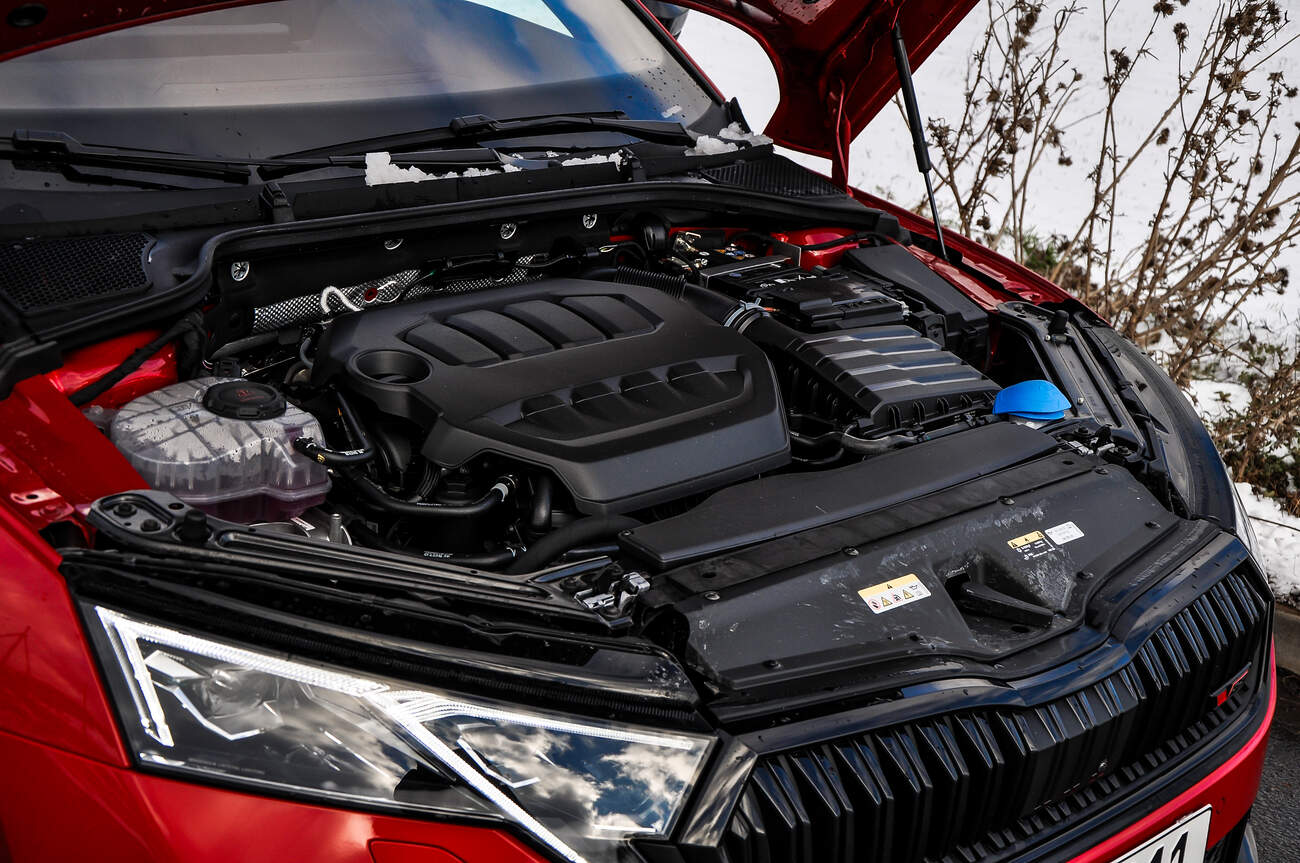
From 0 to 100 in 6.5 seconds... Under the hood, you'll find the already well-known 2.0 TSI engine from the Volkswagen Group, which produces 265 hp. It's a turbocharged four-cylinder engine that offers robust power from low revs and maintains a linear delivery to the limit, as demonstrated by the 0 to 100 km/h acceleration in 6.5 seconds (a typical number for an electric vehicle) and the top speed of 250 km/h (somewhat unusual for an electric vehicle). All the power is sent to the front axle through a seven-speed DSG automatic transmission. However, there is no hybridization of any kind, so you will have no option but to display the DGT C (yellow) emissions sticker on your windshield.
In terms of fuel consumption, the manufacturer announces 6.9 l/100 km in the WLTP cycle. But, of course, this is a car that encourages quick acceleration, so in real-world driving, it's easy to find figures between 7.5 and 8.5 l/100 km. That said, if you drive smoothly on the highway, you can get very close to the advertised figure; it all depends on your right foot, as always.

The chassis is another of its strong points. It features a system that simulates a limited-slip differential to improve traction in corners. In addition, there are several driving modes that adjust engine response, steering, and suspension. In Normal mode, the car is comfortable and easy to drive. In Sport mode, it becomes firmer, more direct, and responsive. The changes are noticeable, but don't expect a complete transformation in the car's personality.
The suspension surprised us with its balance. Even with the 19-inch wheels offered at no extra cost, it effectively filters out bumps and imperfections, providing a comfortable ride and easily handling small cracks or irregularities in the road surface. The steering is precise and quick, although with a slightly filtered feel. It inspires confidence at higher speeds, which is what really matters. And the brakes respond well, with sufficient power and good resistance under heavy use.
The standard equipment is quite comprehensive. Matrix LED headlights, adaptive cruise control, keyless entry and electrically operated tailgate are included. However, the list of optional extras can easily increase the price if you start adding items.

The Skoda Octavia Combi RS is priced at €47,600. It may seem high, but compared to rivals such as the Volkswagen Golf GTI or the Ford Focus ST, the balance between space, performance and price is much better. Therefore, perhaps its biggest rival is the Cupra Leon Sportstourer, which, for a very similar price, is offered as a plug-in hybrid (with the "Zero Emissions" label, although heavier) with 272 hp.
In the end, you're left with the feeling that this Skoda is a rarity, because it's fast and exciting, but also practical and sensible. There may be more radical or flashy options, but few combine daily usability with driving pleasure so well. And that, nowadays, when SUVs are everywhere, is a great achievement.
Autonews


Nenhum comentário:
Postar um comentário