PEUGEOT
The new 1.2-liter turbo gasoline engine from Peugeot — what does it bring and why is it important?
The death of combustion engines has been greatly exaggerated. Bombastic headlines about EVs taking over in X years have come and gone. It's true that electric cars continue to gain traction in many parts of the world, but in 2026, ICE vehicles still dominate. Even in the European Union, where EV adoption is rising strongly, they accounted for only 17.4 percent of total new car sales in 2025, according to the European Automobile Manufacturers' Association.
Even Stellantis is facing this reality, scaling back previously lofty ambitions to turn its many brands fully electric sooner rather than later. With that in mind, Peugeot is rolling out a new combustion engine designed to address past shortcomings. The problematic PureTech designation is gone, a serious source of concern for owners, replaced by the more straightforward Turbo 100.
Although it remains a 1.2-liter, three-cylinder engine, it addresses reliability concerns by switching to a timing chain instead of the dreaded wet belt, which ran immersed in oil. Peugeot says the engine is about 70 percent new, with updates to major components such as the cylinder block, turbocharger, and injection system.
The Turbo 100 operates on the Miller cycle to improve thermal efficiency, using a higher compression ratio. Engineers have also developed a new valve timing system to reduce internal friction, along with a variable-geometry turbocharger to enhance low-end response.
The three-cylinder unit produces 100 horsepower at 5,500 rpm and 151 pound-feet (205 Newton-meters) of torque from 1,750 rpm. While it won’t set pulses racing, Peugeot aims to reassure buyers that reliability issues have been resolved. Prototype engines logged 30,000 hours on test benches, while test vehicles accumulated more than three million kilometers (1.86 million miles). Some covered over 200,000 km (124,000 miles).
The 208 supermini is the first Peugeot model in Europe to receive the new engine this month, with the 2008 crossover set to follow in May.
Electric, hybrid or combustion, engines — whatever their power — are at the heart of PEUGEOT’s driving pleasure. PEUGEOT engineers have designed a new petrol engine, the Turbo 100, which elevates sensations and performance to the next level while offering optimised efficiency and reliability.
The Turbo 100 is a third‑generation engine which incorporates 70% new components by value. This includes key elements such as the timing chain, turbocharger, injection system, pistons, cylinder block, and more.
The Turbo 100 engine will be available on the PEUGEOT 208 from March 2026, followed by the PEUGEOT 2008, from May 2026.
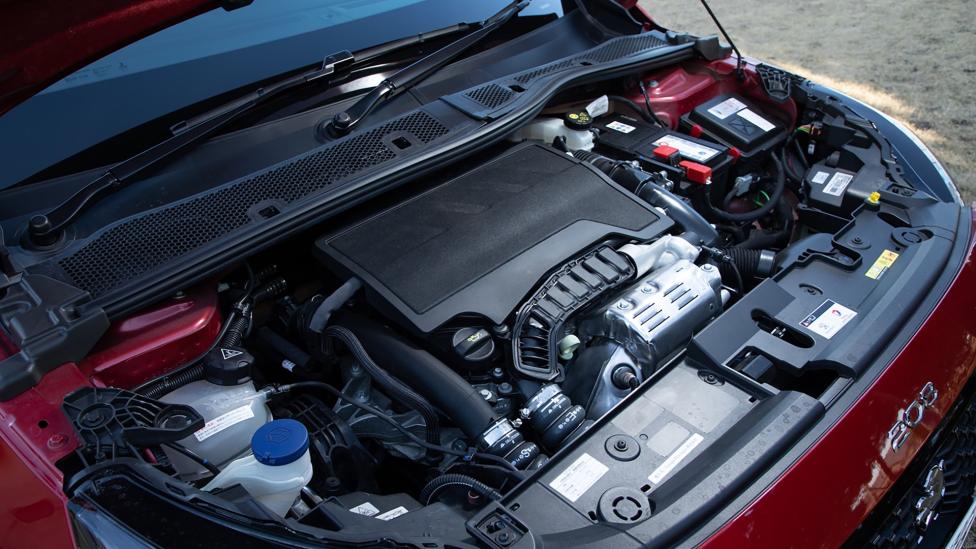
Guaranteed driving pleasure in all conditions...The Turbo 100 engine is a 3‑cylinder unit of 1,199 cm³ delivering a maximum output of 101 hp (74 kW) at 5,500 rpm and offering maximum torque of 205 Nm from 1,750 rpm.
The new variable‑geometry turbocharger optimises engine response at low revs, making urban driving and overtaking manoeuvres easier, and ensuring complete driving pleasure in all conditions.
Optimised efficiency...Fuel consumption and emissions control for the Turbo 100 engine are ensured by a new high‑pressure direct injection system (350 bar), the introduction of a valve timing system that reduces internal friction, as well as new piston heads and operation based on the Miller cycle with a high compression ratio, improving the thermal efficiency of combustion.
Enhanced reliability...For increased driving pleasure, the Turbo 100 engine is equipped with a timing chain, with superior durability. The engine block, pistons and rings are also new and designed to contribute to overall robustness and controlled oil consumption.
During its development, the Turbo 100 engine underwent particularly demanding endurance tests in extreme conditions, with more than 30,000 hours on test benches reproducing all driving situations. Prototype vehicles equipped with the Turbo 100 totalled more than 3 million kilometres, with several vehicles exceeding 200,000 kilometres — clear proof of the engine’s reliability.
For complete peace of mind, the PEUGEOT 208 and 2008 equipped with the Turbo 100 engine will, of course, benefit — like all models within the PEUGEOT brand — from the PEUGEOT CARE programme, offering a warranty of up to 8 years/160,000 km*.
Reduced maintenance...Models fitted with the new Turbo 100 engine will benefit from a reduced maintenance schedule, with a single service every 2 years/25,000 km (previously every 1 year/20,000 km), with an annual interim check.
Peugeot recently launched a significantly updated version of its 1.2-liter 3-cylinder turbo engine, now officially called the "Turbo 100" in some markets (replacing the old PureTech designation). This third generation was specifically designed to address the historical reliability issues of previous versions.
The new unit features approximately 70% new components:
Belt replacement with chain: The most critical change was the replacement of the controversial "wet belt" with a much more robust metal timing chain, eliminating the risk of premature degradation that clogged the lubrication system.
Miller cycle: The engine now operates on the Miller cycle, which improves thermal efficiency and reduces fuel consumption.
New turbo: Uses a variable geometry turbocharger, providing better response at low revs and more linear acceleration.
Injection system: New high-pressure direct injection (350 bar) for greater efficiency and emissions control.
The engine is available in different power configurations, often integrated into mild hybrid systems:
Turbo 100 (Pure Combustion/Hybrid): Delivers approximately 100 hp and 205 Nm of torque from 1,750 rpm.
Hybrid 136: A 136 hp and 230 Nm variant, coupled to a new 6-speed dual-clutch transmission (e-DCS6) that integrates a 48V electric motor.
Availability in models...This new powertrain is being gradually implemented in the Peugeot line:
Peugeot 208 and 2008: Expected debut in the first half of 2026 under the name Turbo 100.
Peugeot 3008 and 5008: Already using the 136 hp hybrid variants in European markets since 2023/2024.
Maintenance: Thanks to the timing chain, service intervals have been extended to every 2 years or 25,000 km.
Autonews


Nenhum comentário:
Postar um comentário