KIA MOTORS

Kia EV2 sets standards for noise and vibration reduction in B-segment electric vehicles
Kia has placed noise and vibration at the heart of the EV2’s development to provide European customers with a quiet and well-controlled cabin. Designed, developed and manufactured in Europe, the model brings a high level of acoustic silence to the compact electric vehicle segment.
In electric vehicles, the absence of combustion engine noise eliminates the “masking” effect typical of petrol and diesel vehicles. As a result, road, wind and high-frequency sounds are more noticeable and more important to the overall perceived quality.
“Electric vehicles change what customers notice first; without a petrol or diesel engine to mask background noise, small high-frequency sounds and vibrations immediately stand out,” said Pablo Martinez Masip, Vice President, Product, Brand and Customer Experience, Kia Europe. “The EV2 is quiet at higher speeds, controlled on rough roads and consistent every day, making the car feel refined from the first kilometre.”

Engineering for silence...Hyundai Motor Europe Technical Centre (HMETC) used advanced numerical simulations from the earliest stages of development, emphasizing noise immunity at high speeds. Testing noise and vibration reduction on a dynamometer provided accurate and repeatable measurements in a controlled environment. This allowed engineers to isolate specific frequencies and effectively apply targeted countermeasures. This method eliminates external variables such as changing weather conditions or changing road surfaces.
“We approached the development of noise and vibration for the EV2 as a system,” said Oliver Jung, Chief Engineer at Hyundai Motor Europe Technical Centre. “Early simulations helped us identify where road and wind noise could be disruptive to passengers in the cabin. In addition, dynamometer tests gave us repeatable data to validate each measure. Acoustic tyres, acoustic glass and an optimised acoustic package work together to ensure a calm and quiet cabin, even on motorways.”
To reduce road noise, the EV2 is equipped with acoustic tires designed to reduce tonal disturbances. The tires are complemented by specially developed pads and absorbers in the wheel arches, which reduce the perceived noise level. To reduce wind noise, acoustic door glass* and an acoustic windshield significantly reduce air turbulence noise at highway speeds. This contributes to a stable and calming environment in the cabin.
Although electric motors are quieter than internal combustion engines, components specific to electric vehicles, such as inverters and DC/DC converters, can generate high-frequency tones. The EV2 addresses this problem with a special acoustic package that includes an interior dashboard insulation concept, an absorber in the front of the trunk and an optimized underbody cover. Together, these elements reduce the transmission of high-frequency sounds and support a coherent acoustic profile.
Electric vehicle sound management...The EV2’s warning sound also contributes to safety and usability. Pedestrian warning sounds warn other road users without disturbing passengers. The Intelligent Speed Limiter (ISLA) warning sound is carefully tuned to provide clear instructions without becoming annoying over time.

The best of Kia...The Kia EV2 brings electric power to the B-SUV segment, making electric vehicles more affordable. Available with two battery capacities, 42.2 kWh and 61.0 kWh**, it offers a range of 317 and 453 km (WLTP in preparation)***. With 400-volt DC fast charging, 11 kW and 22 kW AC charging, and features such as EV route planning and two-way charging, the EV2 supports both urban and long-distance journeys, with easy handling.
The EV2 is Kia’s compact car for European households, offering plenty of legroom, flexible rear seating and up to 403 litres of luggage space. Equipped with three screens, live updates and advanced driver assistance systems, the EV2 demonstrates how engineering, development and validation can raise the acoustic standard in the compact electric vehicle class.
The 2026 Kia EV2 is designed to set a new benchmark for Noise, Vibration, and Harshness (NVH) refinement in the B-segment electric vehicle market, offering a cabin experience that is quiet, calm, and controlled. Positioned as a key player in the European compact EV segment, the EV2 incorporates advanced sound-deadening technologies and structural engineering to minimize cabin noise and vibration, often associated with higher-priced vehicles.
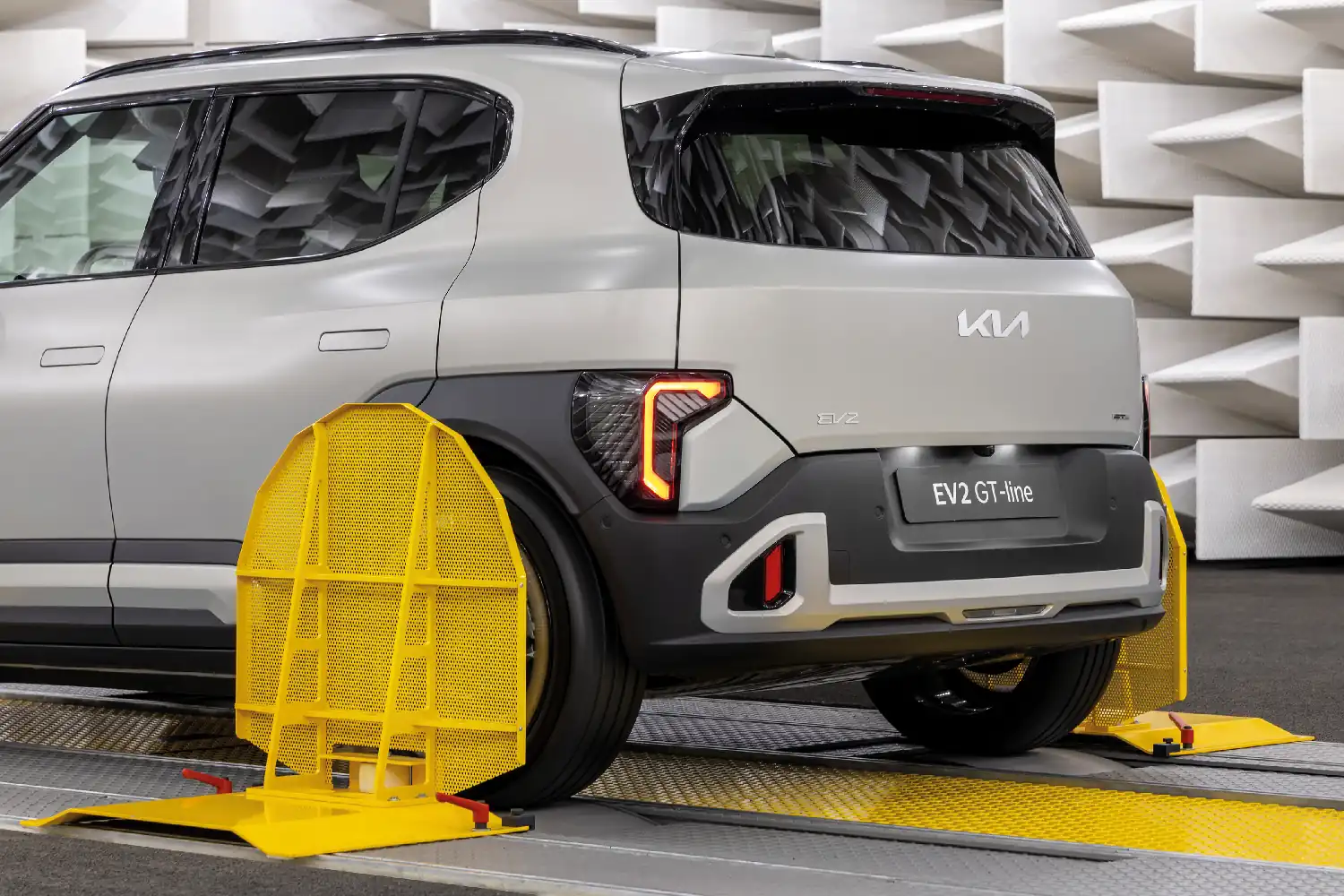
Key NVH reduction features...Kia has focused extensively on silencing the cabin, addressing the lack of engine masking noise by implementing the following solutions(below):
Acoustic materials: The EV2 uses acoustic laminated glass for both the windscreen and doors to significantly reduce wind noise.
Insulation & absorbers: A dedicated, comprehensive insulation system includes a dash inner insulation concept, a frunk sound absorber, and an optimized underbody cover to limit high-frequency sounds from the electric powertrain.
Vibration control: Specialized carpets and wheel-arch absorbers are used to damp vibration.
Suspension & tires: The rear coupled torsion beam axle (CTBA) features hydro bushings to reduce vibrations over bumps. The vehicle is also equipped with acoustic tires designed specifically to limit road noise.
Engineering for comfort...The EV2’s NVH strategy was handled as a system, utilizing digital simulations and dynamometer testing during development to identify and eliminate noise sources. This ensures that the cabin remains quiet and comfortable for passengers, even during high-speed highway driving.
Production and specifications...The EV2, built on a 400-volt architecture, is produced in Žilina, Slovakia, and features a 12.3-inch digital instrument cluster and a 5.3-inch climate control screen. The vehicle aims to make advanced EV comfort accessible in the compact SUV class.
Notes:
* Available for GT-Line only.
** The standard version with a 42.2 kWh battery is currently in production. The extended-range version (61.0 kWh) and the EV2 GT-line will be available in June 2026.
*** The official electric range of the EV2 is subject to final homologation.
Autonews


Nenhum comentário:
Postar um comentário