DODGE

2026 Dodge Charger Scat Pack: 3.0L Hurricane inline six engine 550hp
The new 2026 Dodge Charger Scat Pack two door marks a major turning point for Dodge performance cars. For decades, the Charger name was tied closely to large displacement V8 engines, tire smoke, and classic American muscle. Now the brand is stepping into a new era while still trying to keep that same aggressive spirit alive. Instead of the old HEMI V8, the latest Charger Scat Pack uses a powerful twin turbocharged 3.0 liter Hurricane inline six engine that Dodge calls the SIXPACK High Output.
This new engine produces 550 horsepower and 531 pound feet of torque. That is serious performance for a modern muscle coupe and it allows the Charger to remain competitive with high performance rivals from brands like BMW and Mercedes AMG. Power is delivered through an 8 speed automatic transmission, and for the first time in the history of the Charger Scat Pack, the car comes standard with all wheel drive.
The new platform also allows the driver to switch between all wheel drive and a rear wheel drive focused setup. Dodge engineered a front axle disconnect system that lets the Charger behave more like a traditional rear drive muscle car when the driver wants to have fun. That means burnouts, drifting, and aggressive launches are still very much part of the experience.
Performance numbers show that this is not just a modernized Charger but also a very fast one. The two door Scat Pack is expected to accelerate from 0 to 60 miles per hour in about 3.9 seconds, which is impressive for a large coupe. Quarter mile performance is estimated at around 12.2 seconds, and top speed is expected to reach about 177 miles per hour.
If you’ve read our previous coverage of the gas-powered Charger Scat Pack, then the new Charger R/T is going to look awfully familiar. Like the Scat Pack, the R/T is powered by a version of the Hurricane 3.0-liter twin-turbo I-6—rebranded by Dodge as the Sixpack—and mated to an eight-speed automatic. The biggest difference is power: The Charger R/T gets the standard-output version churning out 420 hp and 468 lb-ft of torque, versus the Scat Pack’s 550 hp.
Both models also come with a standard all-wheel-drive system featuring a mechanical limited-slip rear differential that biases power rearward wherever possible for more of a traditional muscle car feel. For those in the snow belt, it’s useful knowing that Normal mode features up to a 40/60 front/rear power split, Snow/Wet a fixed 50/50 split, and Sport an up to 30/70 front/rear split, with the ability to also switch into a full rear-wheel-drive mode. Dodge says the Charger R/T should accelerate to 60 mph in 4.6 seconds (about a half second behind the Scat Pack) and that it’s EPA-rated at 17/26/20 mpg city/highway/combined (1 mpg better in each category than the Scat Pack).

Developing a new engine from the ground up is an extremely intricate and expensive task, but relying on old designs for new engines can only take efficiency so far. Sometimes, going back to the drawing board can produce something that's far better tailored for the needs of today. That's part of the reason why Stellantis went to all the work to create an entirely new inline-6 gas engine.
Say hello to the Hurricane. Built in part to help phase out larger engines as Stellantis strives for increasing efficiency, the Hurricane is said to offer V8 performance at a two-cylinder bargain. When it comes to market, this dual-overhead-cam engine will be offered in both efficient standard-output (SO) form, as well as a performance-oriented high-output (HO) variant.
The two engines share 96 common parts, including the block, exhaust camshaft and spark plugs, but each variant has dozens of unique pieces meant to get the most out of what each variant offers. That said, the more efficient version won't exactly be a slouch, as Stellantis claims it'll be capable of putting out more than 400 horsepower and 450 pound-feet of torque. The high-output Hurricane, on the other hand, will be able to deliver upwards of 500 horsepower and 475 lb-ft. Both should have a nice, flat torque curve that dials up nearly all its available twist by 2,350 rpm.
While Dodge is quick to hammer home the Charger’s muscle car credentials both to us and to you in its marketing campaigns, there’s clearly some sensitivity over the fact that the Charger is not, in the traditional American sense, as muscle car like as it was before thanks to the lack of a V-8 and its standard all-wheel drive.
But that might be the gas-powered 2026 Charger’s greatest strength.
Putting aside the emotional questions around the V-8 (it’s worth noting that the bulk of previous Chargers and Challengers sold were powered by a V-6, and we wouldn’t bet against a V-8 appearing at some point), the Charger R/T is a compelling option for shoppers who can afford its high-for-the-segment starting price.
This Sixpack came packing the high-output version of the 3.0-liter twin-turbo inline-six pushing 550 hp, and thanks in part to the car’s all-wheel-drive system, the new two-door Charger had no issue laying down the engine’s 531 lb-ft of torque. With launch control helping eliminate any turbo lag, the car was able to charge to 60 mph from a standstill in 4.0 seconds and barrel through the quarter mile in 12.3 seconds at 114.7 mph.
How does that compare to the previous-generation Charger? Or in this case, the two-door Challenger Scat Pack? The most recent edition that went through our battery of instrumented tests was the 2023 Dodge Challenger Shakedown R/T Scat Pack Widebody, which featured a 6.4-liter V-8 developing 485 hp and 475 lb-ft of torque.
With less output, the RWD coupe still managed the same 0–60-mph time of 4.0 seconds, though it took slightly longer to complete the quarter mile (12.5 seconds at 112.1 mph). Notably, the last-generation Challenger weighed in at 4,340 pounds, while this Charger tipped the scales at a far heftier 4,876 pounds.
Now it’s time to address the Dark Horse in the room, the Ford Mustang Dark Horse, which develops 500 hp and 418 lb-ft of torque from its 5.0-liter V-8 engine. It’s also a lot lighter than the Charger or Challenger coupes, weighing in at 4,028 pounds. A 10-speed-automatic-equipped Dark Horse we tested needed just 3.7 seconds to hit 60 mph and galloped through the quarter mile in 12.0 seconds at 118.4 mph. As a comparably priced drag racer, the Dodge Charger leaves something to be desired relative to its rival from the Blue Oval.
Thanks to its standard all-wheel drive and resultant all-weather capability, ample power, large back seat, available sedan configuration, and massive trunk, it’s a new-era performer with few holes in its game. Bring the kids and bring on the snow, because this might be the first modern muscle car that can do it all, no matter the season.
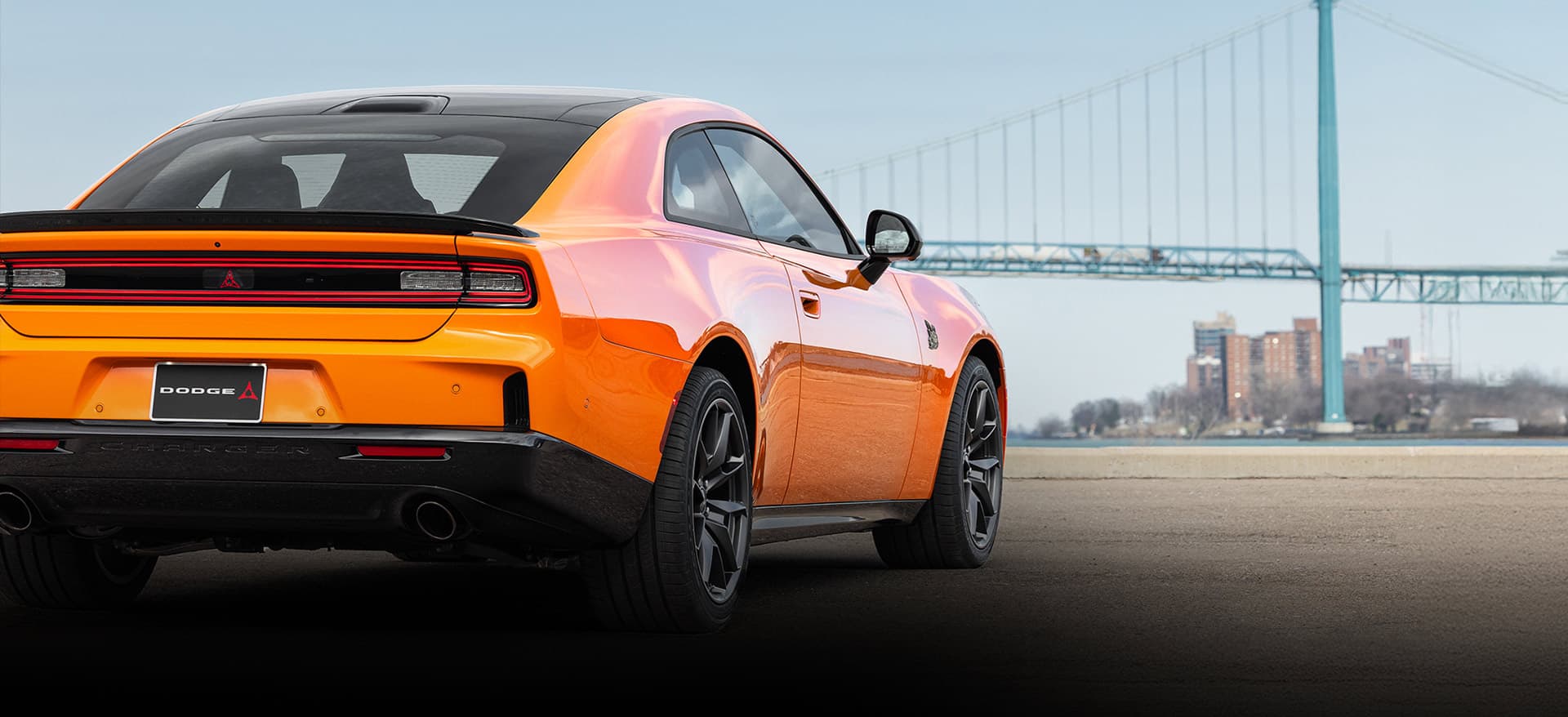
The design of the new Charger also helps it stand out. The coupe returns with a bold wide body stance, muscular fenders, and a modern interpretation of classic Dodge styling cues. Unlike the previous generation sedan, this new Charger is built as a liftback coupe, which gives it a practical cargo area while still keeping the sporty profile.
Inside the cabin, the car blends muscle car attitude with modern technology. Drivers are greeted by a large digital gauge display and a 12.3 inch central touchscreen running the latest Uconnect system. Premium materials, optional performance seats, and an available 18 speaker Alpine sound system add a level of refinement that older Chargers never had.
The two door Charger Scat Pack with the SIXPACK engine shows how Dodge is trying to balance tradition with innovation. It keeps the aggressive personality that muscle car fans expect while introducing a new generation of turbocharged power and modern performance technology.
For enthusiasts who were worried about the future of American muscle, this new Charger proves that the story is far from over.
by Autonews


Nenhum comentário:
Postar um comentário