AUTONEWS
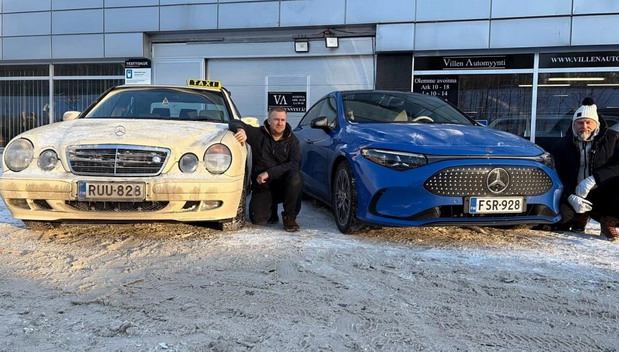
Unexpected outcome of the duel: Mercedes diesel with 2.2 million kilometers traveled against the modern electric CLA
Finns are like the Balkans. They are less enthusiastic about electric cars than Norwegians, Swedes or even Danes, and when asked about durability in arctic conditions, most answer that they trust petrol and diesel cars more. The test between the old diesel and the new electric Mercedes was a surprise.
As confirmation of the durability of old-fashioned vehicles, we will recall the famous story of a car dealer from Finland named Vile Raisanen, who owns a 24-year-old Mercedes E-Class W210 diesel that has traveled 2.2 million kilometers and is still in very good condition.
A Finnish YouTuber specializing in electric vehicles, named Harri Salo, thought it would be a good idea to compare this old Mercedes diesel with the German brand's latest electric model, the CLA Electric, to see who could cover a long distance faster in winter conditions and how far behind, reports Finnish newspaper Ilta-Sanomat.
The challenge was to drive the two cars between Vantaa, a city in the far south of Finland, and Saariselka, a northern settlement far above the Arctic Circle. The distance between the two points is more than 1,070 kilometers. And most of the journey takes place on slower country roads.
Vile, who does not like electric cars and who says he will never drive one, agreed to lend his legendary Mercedes for this little competition.
"Of course I accepted the challenge if I could humiliate an electric car," said Vile, who has his shop in the same building as Tesla. The starting assumption was clear: the diesel would dominate because it had a longer range and didn’t need frequent charging, while the electric car would be slowed down by winter conditions and the need to recharge its batteries.
The competition was evenly matched until Keminma, when the team with the old diesel took the wrong turn towards Tornio instead of Rovaniemi, adding 13 kilometers of wandering. The problem arose because the crew was used to modern navigation systems. The old Mercedes worked flawlessly, except that the engine in the Arctic conditions did not reach normal operating temperature until Oulu. The oil warning light came on because Vile had poured too much oil before the start, and when the engine finally warmed up, the system detected it.
The Mercedes CLA Electric didn’t just last – it won! Harri Salo arrived first after 14 hours of driving, half an hour ahead of his diesel competitor. The electric car had three charges that lasted a total of 50 minutes, which means an average of 17 minutes per stop, although Salo says that it could have been done with two. Consumption was only 18 kWh per 100 kilometers traveled despite the harsh winter conditions.
"Electric cars no longer slow down the journey, but people. Biological breaks set the pace," Salo concluded. For comparison, the same route with a Tesla Model 3 in 2019 took 16 hours, which means that charging technology has advanced significantly.
Despite the defeat, Vile emphasizes economic reality. His Mercedes was purchased in 2018 for 280 euros, while the new CLA Electric costs 49,000 euros, which is 175 times more expensive. Also, a new battery for an electric car costs 42,000 euros. And he is largely right, because in 15 or 20 years, no one will want to pay that much for a new battery.
The electric car won in speed, but the diesel holds the advantage in durability and price. Vile once again underlined the insane price of a new battery for an electric model, while his almost quarter-century-old diesel, with a mileage that would allow it to circle the Earth 55 times, is still working reliably.
However, the owner of the diesel Mercedes W210 says he is not disappointed with the result, but emphasizes that today's electric Mercedes will certainly not last 2.2 million kilometers, and in 24 years no one will see it on the roads.
Comparing a historic Mercedes diesel with 2.2 million km to a new electric Mercedes CLA involves contrasting the proven durability of older technology with the efficiency and cutting-edge technology of a new era. The diesel model represents mechanical longevity, while the electric offers lower operating and maintenance costs, but with long-term logistical and battery challenges.
Autonews responds(autonews1@yahoo.com): Mercedes E-Class W210 diesel with 2.2 million km--vs--Mercedes CLA electric (below):
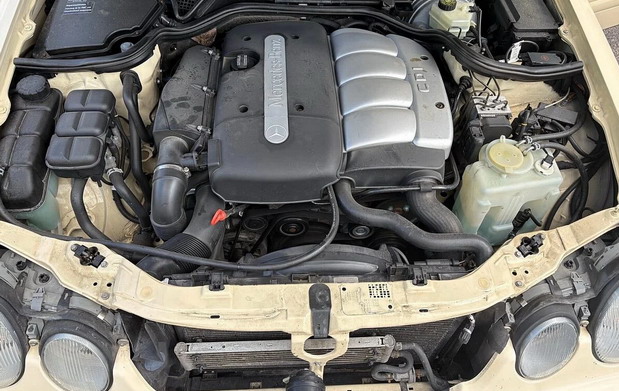
High-Mileage Mercedes Diesel (210D)...Older Mercedes-Benz diesel vehicles, such as the Mercedes-Benz 240D and 200D (W115/W123 series), became legendary for their extreme robustness and ability to achieve millions of kilometers.
Proven Durability: A Greek taxi driver covered more than 4.6 million kilometers with his 240D, a testament to the diesel engineering of the time, which was simpler and less dependent on complex electronics.
Simple mechanics: These engines (like the four-cylinder W115) had few electronic components, which facilitated maintenance and preventive repairs, such as replacing connecting rod bearings and decarbonization.
Rigorous maintenance: The secret to this longevity was extremely meticulous maintenance, including frequent oil changes (every 10,000 km) and regular replacement of filters and other wear parts.
Modest performance: They had very low performance (the 200D offered only 55 hp), which encouraged smoother and less aggressive driving, indirectly contributing to mechanical longevity.
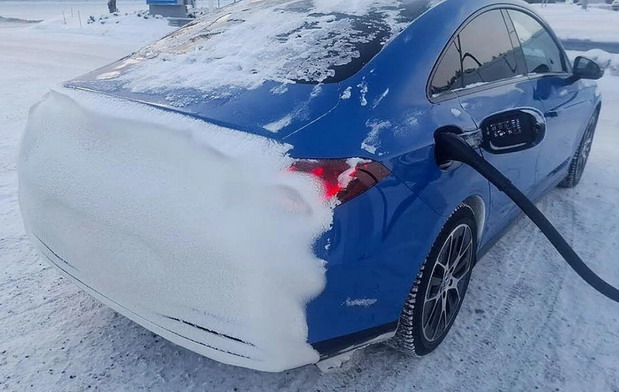
Mercedes CLA Electric (New Generation)...The new Mercedes-Benz CLA electric (based on the MMA platform, to be launched in 2026) represents the vanguard of the brand's electric technology, focusing on efficiency, range and advanced software.
Efficiency and autonomy: Promises an impressive range of up to 792 km (CLA 250+ version) and very low consumption (around 12.5 kWh/100 km), thanks to a drag coefficient of 0.21 and an 800V architecture that allows for fast charging (300 km in 10 minutes).
Advanced technology: Features an advanced operating system (MB.OS), screens that cover the entire width of the dashboard, and an AI voice assistant, providing a modern and connected driving experience.
Reduced maintenance: Electric motors have significantly fewer moving parts (around 90% fewer components than a diesel engine), resulting in lower scheduled maintenance costs (no oil or fuel filter changes).
Long-term challenges: The main uncertainty lies in the durability and cost of long-term battery replacement (after 8-10 years) and the complexity of the electronics, which can be expensive to repair outside of dealerships. The logistics of charging on long journeys is still a challenge in many places.
The old Mercedes diesel is a monument to the mechanical durability of the past, achieved with simplicity and diligent maintenance. The electric CLA is a technological leap with promises of efficiency and lower operating costs, but its long-term durability depends on battery longevity and electronic complexity.
by Autonews


Nenhum comentário:
Postar um comentário