AUTONEWS

Car manufacturers support appeal to Brussels for fairer competition
The association of manufacturers for the automotive industry (AFIA) supported the appeal addressed to the European Commission to strengthen fair competition and preserve European innovation and value chains.
In a statement, the association, as a member of the board of CLEPA – European Association of Automotive Suppliers, announced that it is joining the open letter sent to the President of the European Commission, Ursula von der Leyen, “which defends the urgent need to create measures that help strengthen fair competition and preserve the capacity for innovation and European value chains”.
According to CLEPA, which sent the letter in December 2025, car suppliers, who are “responsible for 75% of the total value of a vehicle”, are “a strategic pillar of European industrial prosperity”.
However, it warns that they face “unprecedented frictions, in a global context marked by distorting subsidies, price dumping, state-supported overcapacity and unilateral tariffs that leave European producers at a structural disadvantage and facing unfair competition.”
The letter also says that, in 2025, “imports of automotive components from China reached 8.2 billion euros” and that the trade balance went from a surplus five years ago of almost 7 billion euros to a deficit of 700 million euros.
Citing a recent study by Roland Berger, it also warns of the risk of job losses in Europe by 2030 if timely measures are not taken.
“Importing the cheapest technology today empties our capacity for innovation tomorrow. If we allow our value chains to deteriorate, we will lose factories, but also our strategic autonomy. We risk exchanging European technological sovereignty for permanent dependence on lower-cost, less regulated regions,” warns CLEPA.
AFIA also emphasizes that Europe must remain open to international trade and cooperation, but recalls that "trade is only sustainable when it is based on equivalent rules for all and on effectively fair competition."
Quoted in the same statement, the president of AFIA and member of the CLEPA board, José Couto, highlights that "the transition to low-emission mobility and digitalization requires investment, scale and predictability."
"If Europe wants to lead the transformation, it must guarantee fair competition conditions and frameworks that keep value, innovation and employment anchored in the European space. Supporting the CLEPA proposal is choosing industrial sovereignty, strengthening the resilience of value chains and protecting Europe's technological capacity," he adds.
The association also reaffirms its willingness to collaborate with European decision-makers and partners in building "a credible and ambitious framework that aligns competitiveness, innovation and climate transition, ensuring that the transformation of mobility creates value and quality jobs in Europe."
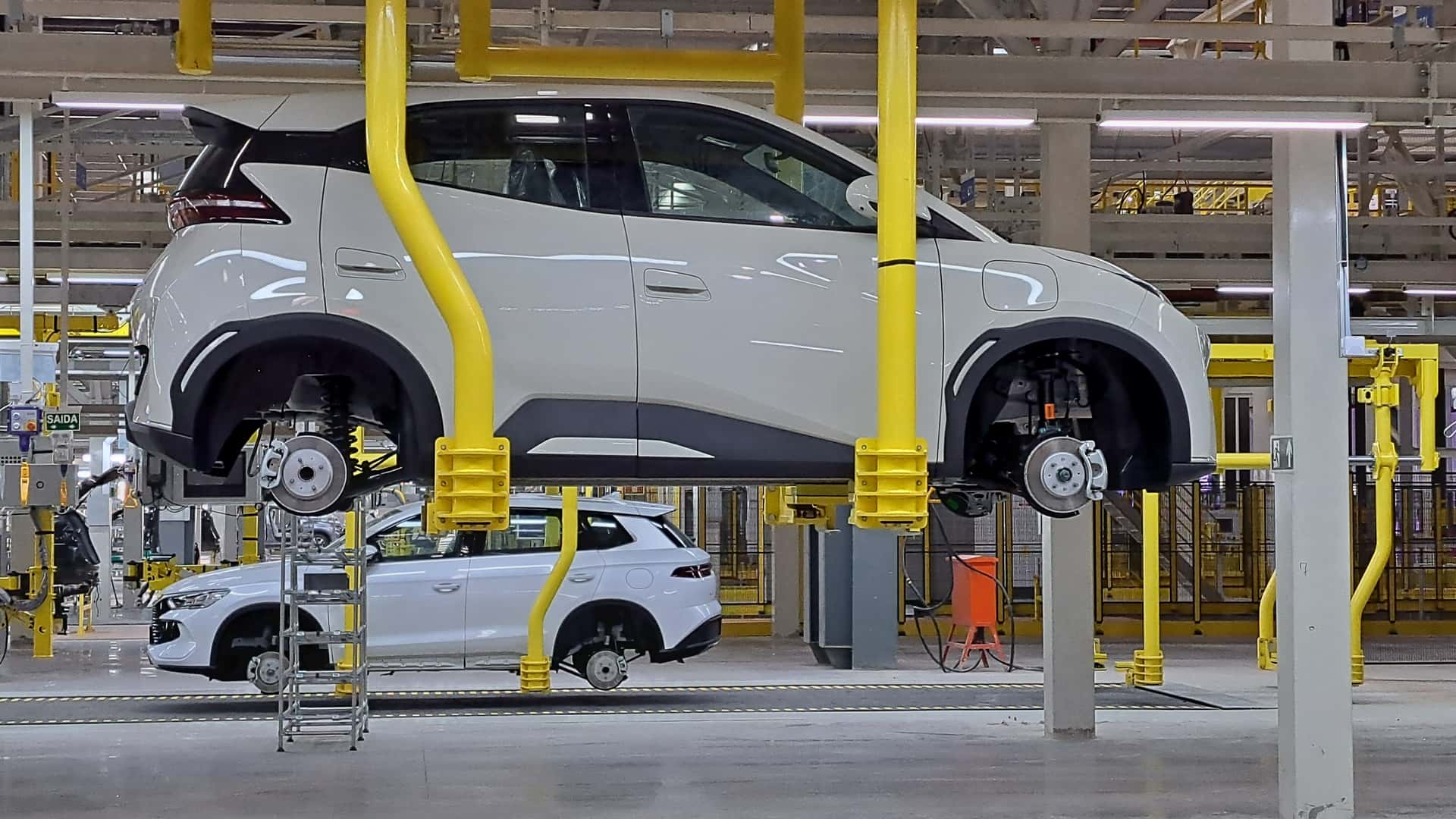
In Brazil, the Chinese CKD and SKD electrified production system reigns supreme without any resistance from the government...The apparent tranquility demonstrated by the president of Anfavea, Igor Calvet, during the press conference announcing the January automotive industry balance sheet on Friday, the 6th, is likely to turn into a new concern. No request for the renewal of import quotas for CKD and SKD electrified kits was addressed to the government before the deadline, January 31st, when the US$463 million agreed upon in August expired. However, according to reporting by Autocar, executives from companies originating in China are preparing new visits to government representatives to try to extend the benefit in some way.
There are two fronts: the first is the establishment of new quotas, perhaps smaller, for a longer period. The argument is that CKD and SKD kits are important in the transition from imports to local production, as there is a timeframe for the machines to be fully operational in the new factories. The import tax rate today is 10% to 30%, depending on the technology. Since February 1st, it applies to all imported kits, as quotas have been eliminated.
The next Gecex meeting is scheduled for February 12th, and although some executives linked to Anfavea fear it will not be on the agenda. The plan is for it to be reconsidered by the MDIC committee after Carnival, in an extraordinary meeting, according to sources who spoke to the press.
A mechanism for new entrants...In parallel, Chinese companies are working on creating a transition system for new entrants, linked to Mover, the Green Mobility and Innovation Program. Those who commit to producing in Brazil will receive an import quota for CKD and SKD kits for a short period while they structure their production unit.
This is nothing new: it was established in the past with the Inovar Auto program, which granted import tax or IPI (Industrialized Products Tax) discounts to companies that committed to local production.
However, the government suffered two defaults: first from Asia Motors, during the FHC (Fernando Henrique Cardoso) administration, and then from JAC Motors, represented by the SHC Group, owned by Sérgio Habib, which even announced a factory in Camaçari, Bahia, that never materialized. They never fulfilled their promises. They imported units with tax discounts and left the debt in the hands of the Federal Revenue Service.
This history may hinder the advancement of this system within the government, although it is viewed favorably, even by established automakers here, who could use the benefit in electrified vehicle projects.
Resistance within the government...Industrialization through CKD and SKD kits is not well received within the MDIC (Ministry of Development, Industry and Foreign Trade), according to the report. The prevailing view among high-ranking officials is that the more industrialization, the better, and that creating quotas for kits that only require assembly in factories goes in the opposite direction.
According to NewCAR, which heard from a well-connected source within the ministry, Camex's position is against the creation of new quotas, but pressure may come from above, from other ministries and the Presidency of the Republic. There is also resistance from the Finance Ministry due to the tax revenue loss that these imports would generate.
Anfavea's position will remain the same. President Calvet stated during a press conference on Friday, the 6th, that he is unaware of any request to the government, but will oppose any that is made, tomorrow or in two or three months: “We defend industrialization. We want to generate jobs throughout the chain, something that will not be done with the importation of CKD or SKD kits.”
by Autonews


Nenhum comentário:
Postar um comentário