AUTONEWS
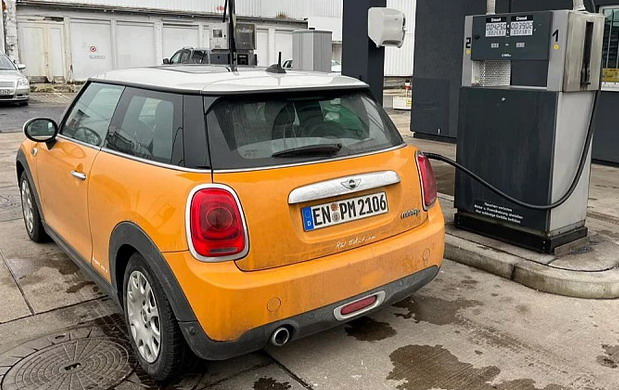
Can a Mini cover a million kilometers with a fragile three-cylinder diesel engine?
That a car can cover a million kilometers today is a real sensation, both because of the way they are built and because of the much higher maintenance costs, especially for diesels. German Peter Kirkhoff has made sure to restore the glory of diesels, with only three cylinders in the block.
Of all the cars that cover a million kilometers today, there is no known case so far that involved a car with a fragile three-cylinder engine.
However, German Peter Kirkhoff will soon become the first owner in the world of an unusual model that will soon enter (again) the record books. His car is a MINI Cooper D, with a 1.5-liter diesel engine under the hood, reports the German publication Auto Bild.
German journalists remind you that the same Peter Kirkhoff covered a million kilometers in 2013 with a Skoda Fabia 1.9 TDI. At the time, it took the German 13 years behind the wheel of a Czech car, manufactured in 2000, to reach one million kilometers. His statistics at the time showed that he was present in the car for the equivalent of 700 days to reach this mileage. He also documented his diesel fuel consumption and then reached an overall average of 3.68 liters/100 km over the million kilometers. The proven 1.9 TDI engine, as well as the manual transmission in the record-breaking Fabia, survived in their original form.
The devil did not give him peace, so a year after the record with the Fabia, Peter bought a new diesel car. It was a Mini Cooper D from the F56 series, manufactured in 2014 and delivered in the summer of that year. From the very beginning, Peter set himself the goal of "throwing" this car to one million kilometers and began to document everything from the beginning on the Facebook page "Project one M".
Unlike the Skoda, under the hood of the yellow Mini is an engine with only three cylinders, a concept known for its physical imbalance, which requires very carefully calculated counterweight mechanisms to counteract this physical effect. Usually, the effect can only be mitigated in certain limited ranges of crankshaft speeds, otherwise it is impossible to completely eliminate vibrations.
This engine in the Mini is the original BMW B37 engine, with 1,496 cubic centimeters. In the Cooper D, it develops only 95 hp and 220 Nm. But the car it has to move weighs only about 1,200 kg, so it does not have a large load.
A year after buying the Mini, it has already covered 100,000 kilometers. Peter then made sure that every milestone on its odometer was marked by a beautiful journey.
Since 2014, the car has covered between 80,000 and 90,000 km per year. His job means he travels frequently around Germany and the surrounding countries, but the car has also taken him on longer trips. In total, he has visited 25 countries outside Germany with it.
The German has documented every refueling - how many liters he has put in the tank, how many kilometers he has driven since the last refueling. All these entered numbers have allowed him to generate statistics over time with consumption and cost data.
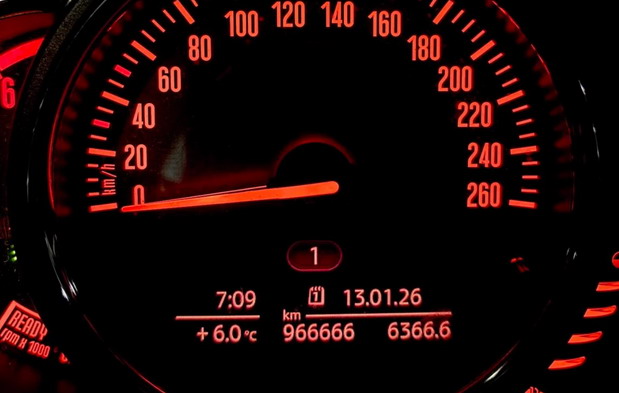
The odometer reached 966,666 km on January 13, 2026, and to cover this distance, the car has consumed more than 28,500 liters of diesel, which equals an effective average consumption of 2.95 liters/100 km!
So we are not talking about the lowest, but about an overall average consumption of less than three liters per 100 kilometers driven, measured by refueling at the pump, not by the car's computer! And the figure is about 15 percent better than the official factory consumption of this Mini.
The fuel costs for this distance were €38,235 as of January 8, 2026, or €3.96/100 km. This is an extremely low cost, which even an electric Mini would not be able to achieve today, even if it were powered only by electricity from a cheap household tariff. Although, if Peter were to set records with an electric car, with his meticulous approach to planning and driving efficiency, he would probably organize everything in such a way as to achieve even lower costs.
The German says that he filled up at gas stations a total of 690 times. On average, he filled up every 1,396 km, which also means an absolutely extraordinary range, especially since the tank has a small capacity of only 44 liters. But, with a consumption of 2.95 liters/100 km, it is no wonder, because this means that he needed an average of 29.5 liters of diesel to cover 1,000 km.
The car’s initial purchase price was €30,350, and if we add the fuel costs of €38,235, we arrive at a figure of €68,585. In addition, insurance during this period meant a cost of €5,110, and an additional €1,704 went to annual taxes. The total amount reaches €75,400.
Peter says that maintaining the car so far has meant 25 service visits, for which he paid €22,594. What is impressive here is not so much the amount, but the small number of service visits. Even if we assume that the oil was changed at each visit, that means an oil change approximately every 35-38 thousand km!
It sounds unrealistic, but hardly any other engine would last a million kilometers with such infrequent oil changes. But this is exactly the case we sometimes talk about as a scenario in which such a long oil change interval can work - long-distance driving, with few engine warm-up and cool-down cycles and of course a lot of open-top driving.
The service costs of 22,594 euros bring the total cost to 97,994 euros. In addition, other operating costs totaled 5,496 euros, and the final amount reaches 103,490 euros. That means total operating costs of 10.70 euros/100 km or 0.107 euros/km! So, less than 11 euro cents per kilometer driven has so far cost this German to own and operate this popular car despite the mini diesel engine with only three cylinders in the block.
After all, these facts prove that a car that covers long distances can be more rational in terms of costs than a car whose owner mainly exploits it in city driving and gets rid of it after only a few years of ownership and a few tens of thousands of kilometers.


Nenhum comentário:
Postar um comentário