AUTONEWS
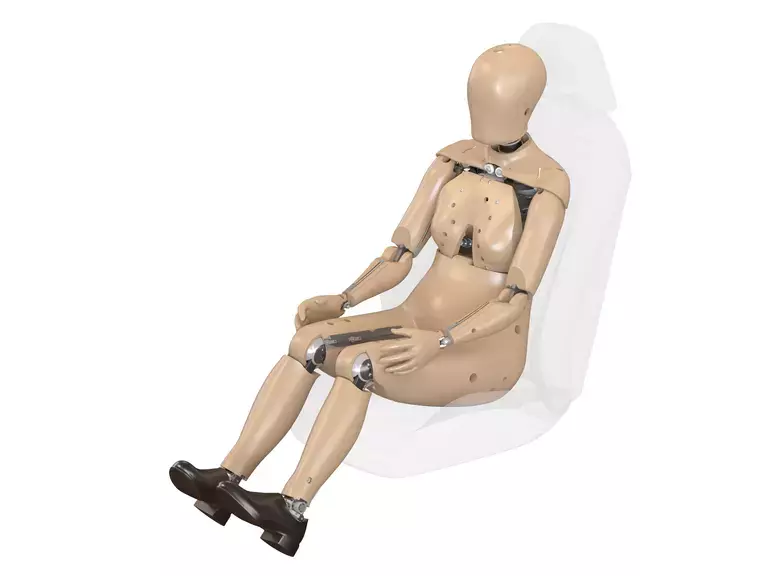
Long live equality! Here is the first female crash-test dummy!
Gender equality has arrived in the safety of transport vehicle users, whose protection in the event of an accident is developed with the use of crash-test dummies, mannequins full of sensors that, until now, exclusively displayed the shapes and other characteristics of men. Now, this science has (finally) received the dummy that the automotive industry has long demanded, with the shapes and dimensions of a woman, in addition to taking into account the characteristics of the female body, a gender that is 73% more likely to suffer serious injuries in a frontal collision, when compared to a man, with women also having a 17% greater chance of dying than their partner.
Today, it's becoming well known that the current staple of female crash test dummies are not representative of the unique physiology of women. We desperately need to consider the risks that are characteristic for women and design test dummies around that criterion.
Armed with this awareness and knowledge, what are our next steps? Research and development is certainly important in discovering new ways to protect women in automobiles, but regulation is key to getting the industry on-board and consistent. That regulation also needs the correct tools to do this evaluation. We need test devices that are not adaptations of a male device. We also need a more sophisticated ATD for assessing whole-body trauma in a variety of occupant restraint environments.
Taking a first step is always critical, and that gateway should be a test device already available today - the THOR-5F advanced female frontal impact dummy. She’s designed from actual female anthropometry data, which means she has a female form, not that of her male counterpart. Her technology is the most advanced ever produced, derived from the THOR architecture of advanced human mechanics. Plus, she has 150 sensor channels that are designed to help address those parts of the body where women have increased vulnerability to injury.
Evening out the odds for female protection in automotive crashes mean that the death of up to 1,342 mothers, daughters, spouses, and loved ones could be prevented in one year alone. Using National Safety Council (NSC) estimates, these preventable tragedies translate to an economic cost of over $2 billion in 2018.[1] The non-economic costs are immeasurable.
Developed by the American company Sierra Engineering, the first crash-test dummy, the Sierra Sam, emerged in 1949. At the time, it had a very small number of sensors designed to measure the forces applied to US Air Force pilots by the ejection systems of warplane seats. In 1968, General Motors commissioned a more advanced version of the Sierra Sam with an increased number of sensors, with the intention of determining the forces applied to different parts of the driver's and passengers' bodies, as well as finding ways to mitigate injuries and save lives, thanks to the data collected by the dummies. Today, the most modern and sophisticated models are equipped with more than 200 sensors and require an investment of over $1 million.
The first "female dummy" was developed and manufactured by the American company Humanetics, with the US Secretary of Transportation, Sean Duffy, making a point of actively participating in the presentation of the mannequin intended to save women's lives, despite having a male name, being called Thor 5F. According to the manufacturer, the new mannequin is not limited to being a smaller and lighter version of a normal model, having been designed differently from head to toe to represent female occupants, who are very different in terms of chest, thorax and pelvis.
THOR-5F...Our Test device for Human Occupant Restraint, or THOR, is offered in a female 5th percentile format, building on the same advanced technology used in the male 50th dummy. Like the male version, THOR-5F incorporates significantly expanded instrumentation along with major advancements in sensing technology, infidelity, and user handling. However, THOR-5F is designed with skeleton, flesh, surface geometry and landmarks in compliance with the UMTRI AMVO 5F female standard.
Our THOR series represents the future of crash-technology—our most sophisticated ATDs for assessing whole-body trauma in a variety of occupant restraint environments. They are available for use today, and THOR-50M is currently being validated by NHTSA and Euro NCAP for certified use in frontal impact tests. We expect validation of THOR-5F to follow. Humanetics is actively involved in addressing the test procedures, replacement parts and other refinements needed to ensure regulatory adoption.
Humanetics explains that the Thor 5F (5th percentile and female, as opposed to the Thor 50M which represents an adult with the 50th percentile and male) has significant anatomical differences, reflecting the muscle distribution and mass of women, as well as specific joint characteristics. Vehicle manufacturers can now adapt their safety systems for both men and women, from seatbelt pretensioners and load limiters to deformable areas of the chassis, in order to reduce the decelerations that bodies undergo in the event of a collision, with the aim of saving the lives of women who represent approximately 50% of drivers, depending on the market.
Mundoquatrorodas


Nenhum comentário:
Postar um comentário