AUTONEWS
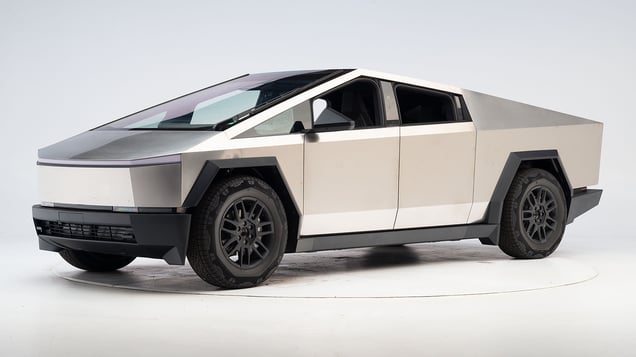
IIHS: Tesla Cybertruck passes crash test in the US
The Insurance Institute for Highway Safety (IIHS) issued its last safety ratings of the year late Monday night for 20 new cars, including 16 that earned awards. Among the highest rated are four all-electric SUVs, trucks and sedans.
The most noticeable of the EV award-winers is the Tesla Cybertruck. It earned IIHS’ Top Safety Pick+ designation for units of the all-electric pickup truck built after April 2025. The Cybertruck earned the top grade of “Good” for all crash tests and its headlights. Its seat belt reminder was graded “Marginal” and its LATCH car seat system was “Acceptable.”
The Cybertruck, known for its polarizing futuristic looks, features a bright, continuous singular front headlight that runs across the front. Cybertruck sales have slowed for the heavy 6,600-pound pickup that Tesla CEO Elon Musk has touted for years. The base version all-wheel drive version starts at about $79,990 with 325-mile range and 11,000-pound towing capacity.
The Tesla Cybertruck, an all-electric pickup, was introduced in the 2024 model year. Beginning with 2025 models built after April 2025, changes were made to the front underbody structure and footwell to improve occupant safety in driver-side small overlap front crashes. (Information about when a specific vehicle was manufactured is on the certification label typically affixed to the car on the driver door or adjacent B-pillar.) Driver-side small overlap frontal ratings are assigned by the Institute based on a test of a 2025 Cybertruck conducted by Tesla.
The electric pickup truck that divided opinions has earned the highest safety rating from the American Institute for Highway Safety (IIHS), Top Safety Pick+. This is the highest recognition awarded by the organization, which immediately led many to question whether this would be sufficient for the more stringent European criteria.
The IIHS is making its testing criteria increasingly rigorous, therefore this award carries special weight. The Cybertruck received it thanks to versions produced after April of this year, which underwent significant structural improvements, according to Autonews.
The redesigned undercarriage and legroom resulted in the best possible ratings in frontal collisions with little overlap, on both the driver's and passenger's sides. It also received a good rating in the moderate overlap frontal collision test, with only an acceptable rating related to rear passenger chest protection.
Side impacts, tested according to new standards that take into account heavier and taller vehicles, also presented no problems. And it achieved a good overall rating in that regard. Some safety enhancements, collision avoidance systems, and reliable child seat supports make it clear why the IIHS gave it the green light.
While safety awards always sound impressive, the differences between the American and European approaches are stark. In the US, testing focuses almost exclusively on protecting vehicle occupants and is tailored for the large pickup trucks and SUVs that dominate the roads.
Europe pays much more attention to pedestrian and cyclist protection. Euro NCAP and UNECE standards analyze in detail how a vehicle interacts with its surrounding environment, especially in urban settings. Deformable fronts, softer materials, and surfaces that absorb impact energy are key elements.
And that's where the Cybertruck encounters its biggest problem. Straight lines, flat stainless steel panels, and an extremely rigid body conflict with European standards for the protection of vulnerable road users. In a collision between a vehicle and a pedestrian, this design simply doesn't leave enough space for controlled energy absorption, resulting in serious injuries for pedestrians and cyclists.
Doubts about the future of the Cybertruck in Europe were further confirmed by Tesla's management. According to the German newspaper Handelsblatt, the director of Tesla's factory in Grünheide, André Thierig, stated that he does not expect the Cybertruck to circulate in large numbers on European roads.
There is allegedly only one registered unit in Germany, and even that one with a special permit and some modifications. Tesla made it clear that such cases should not be interpreted as an announcement of the wider arrival of the model to the European market.
The Cybertruck has undoubtedly proven that it can protect its passengers very well. What it has not yet proven, and probably will not prove without a fundamental change in design, is its ability to meet European exterior safety requirements.
Autonews


Nenhum comentário:
Postar um comentário