PEUGEOT
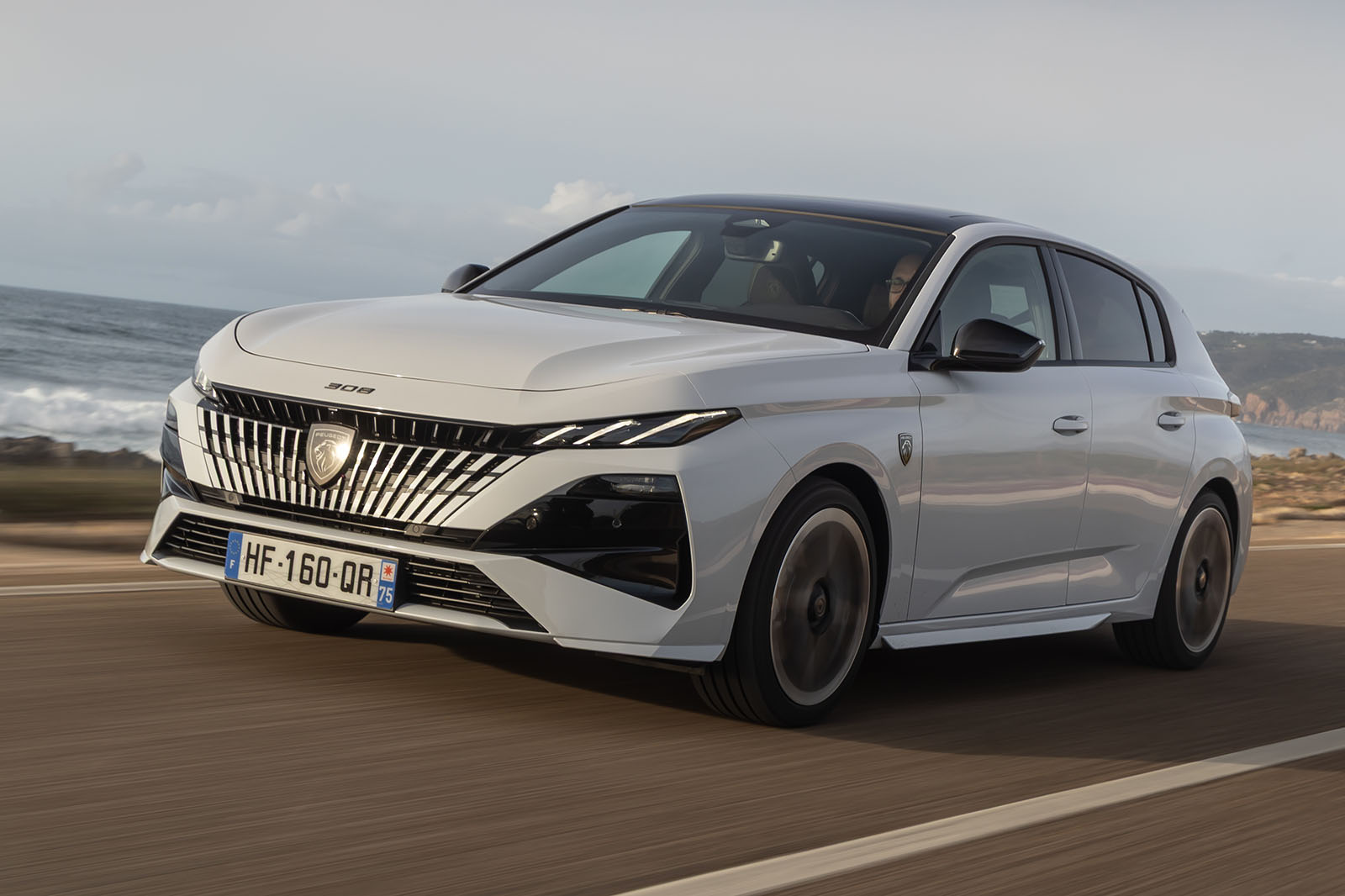
Peugeot 308 review
When this generation of 308 arrived in the UK in 2022, we found that it had gained a good dose of ride and handling sophistication. Paired with the effortless style that Peugeot has become quite good at in recent years, it made sense that it would prove popular as a sleeker and more dynamic alternative to the high-rise family car
Now the 308 is getting a mid-life update, with upgraded hybrid powertrains and tweaked looks. There's also a fully electric 308, dubbed the Peugeot e-308, which we've covered in a separate review.
It has become a habit of Peugeot’s to confine itself to the more compact end of the family hatchback market: perhaps since the svelte 306 took over from the blocky-looking 309 in 1993 and, by offering something a little more petite than the norm, showed that smaller could be better in all sorts of ways.
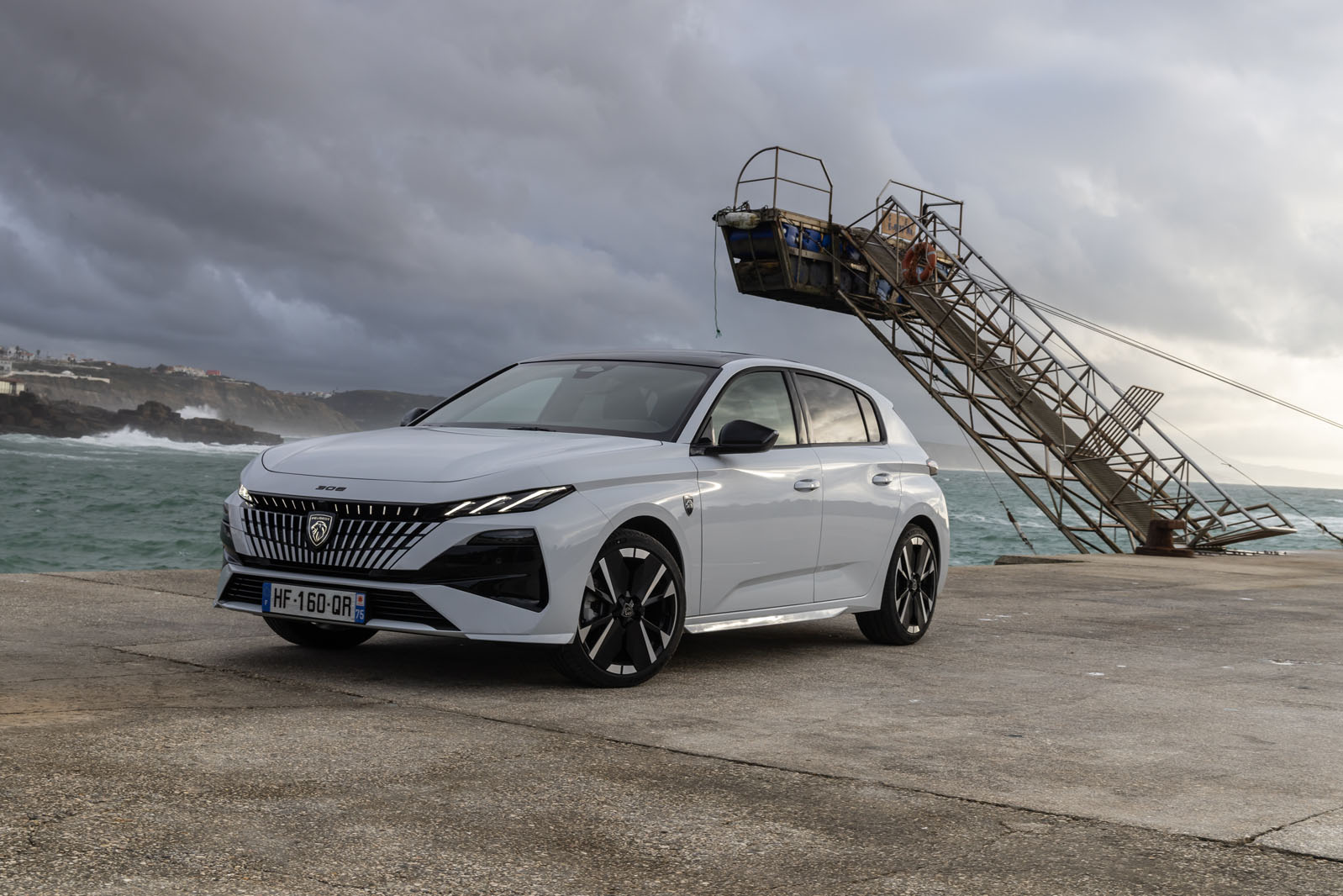
The new 308 isn’t quite that small. Having had 55mm added to its wheelbase compared with the second-generation 308. In fact, the hatchback is now 4365mm long, so it’s more than 100mm longer than the car it replaces, as well as wider and slightly taller. If anything, however, slightly lower, wider overall proportions for the car give it a notably more sporting stance than any previous 308 had. Peugeot valiantly continues to offer an 'SW' estate version alongside the hatchback, with a longer wheelbase and rear overhang.

Those who compare it with rivals, meanwhile, will note that it’s still marginally shorter at the kerb than a Ford Focus, Seat Leon and Toyota Corolla, as well as the segment’s practicality-centred offerings (Skoda Octavia, Honda Civic et al).
Mechanically, the 308 is a very similar package to a lot of the other Stellantis offerings such as the Vauxhall Astra and DS N°4, the EMP2 v3 architecture giving it a range of ICE, hybrid and electric power options.
The entry-level version uses a 1.2-litre turbocharged three-cylinder petrol engine. Pre-facelift, this came paired with an automatic gearbox. Later it was joined by a hybrid option, which replaces the eight-speed torque-converter transmission with a six-speed dual-clutcher that encompasses a small electric motor. With the facelift, the pure-petrol version has been dropped and the hybrid has become the default option.
/i.s3.glbimg.com/v1/AUTH_cf9d035bf26b4646b105bd958f32089d/internal_photos/bs/2025/U/T/SlLc8GS32IwcWzRlNkFw/peugeot-e308sw-2508styp-280-fr.jpg)
The plug-in hybrids have gone through a similar evolution. Originally there were two variations (177bhp and 222bhp) of the same system, featuring a 1.6-litre four-cylinder petrol engine and a 90bhp electric motor within an eight-speed torque-converter. After the 2025 update, the gearbox is a seven-speed dual-clutcher with a more powerful 123bhp electric motor for a total of 192bhp. The battery capacity has increased from 9.9kWh to 14.6kWh, boosting the electric-only range from 40 miles to 53 miles – more competitive than before, if still significantly down on the Volkswagen Golf eHybrid’s 88 miles.
The 1.5-litre diesel sticks with its eight-speed torque-converter and no electrification. Peugeot’s people freely admit this will be a niche choice, but it's one they are happy to fill as fewer and fewer rivals do.
Suspension is via class-typical MacPherson struts with a torsion-beam axle at the rear, irrespective of which engine you opt for.
For 2025, the 308 has been treated to a mid-cycle update. As well as the shuffling of the powertrain line-up, this is mainly a styling exercise. Peugeot has leapt enthusiastically on the bandwagon of bold front lighting signatures, with a light bar and a light-up lion emblem. What used to be the main headlight clusters are now only used for the daytime running lights, with the brand-typical ‘three-claw’ pattern, while the main beams are contained in simpler units beneath.
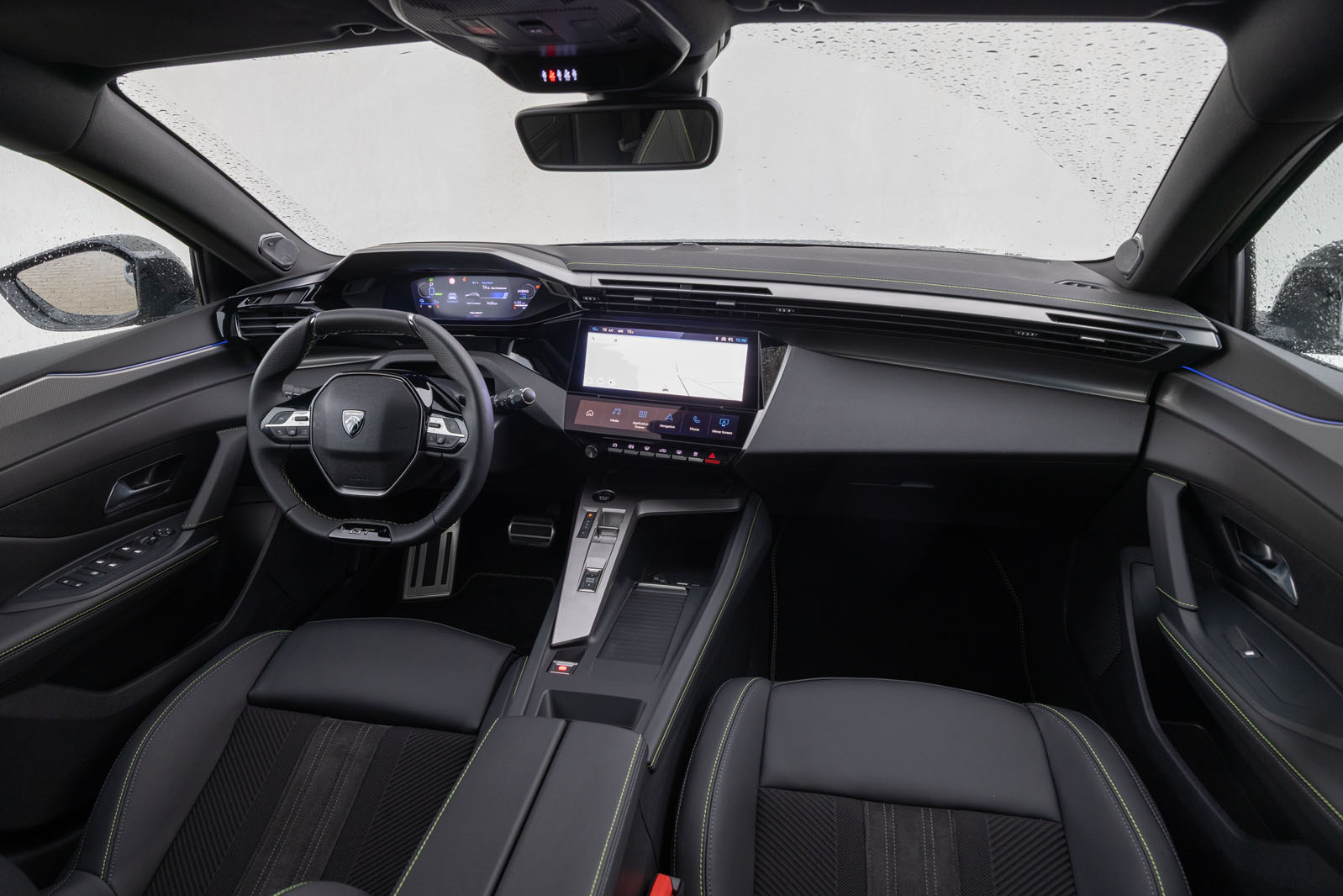
Peugeot’s i-Cockpit control regime has been with us for more than a decade now. Consisting of a lowish-set downsized steering wheel and a high-placed set of instruments, it was, and remains, Peugeot’s us-against-the-world attempt at redefining a normal control layout.
Peugeot has a slightly surprising philosophy when it comes to physical controls. There is a row of piano-key-style buttons for a few very basic functions whichever version you pick. Allure-trim additionally gets a panel with some rotary controls for the climate control and a home button for the infotainment.
Much time-honoured convention has been sacrificed on this ergonomic altar over the years. When the previous Peugeot 308 came out in 2013, it did do so with speedometer and rev-counter clocks whose normal positions (revs on the left, speed on the right) had been switched around, and with the rev counter graded in an anti-clockwise direction so as to be more readable in the new i-Cockpit era. That never really felt like intuitive thinking to us, but the orientation of instruments survives into the new 308, albeit on the car’s all-digital dashboard, which comes as standard.
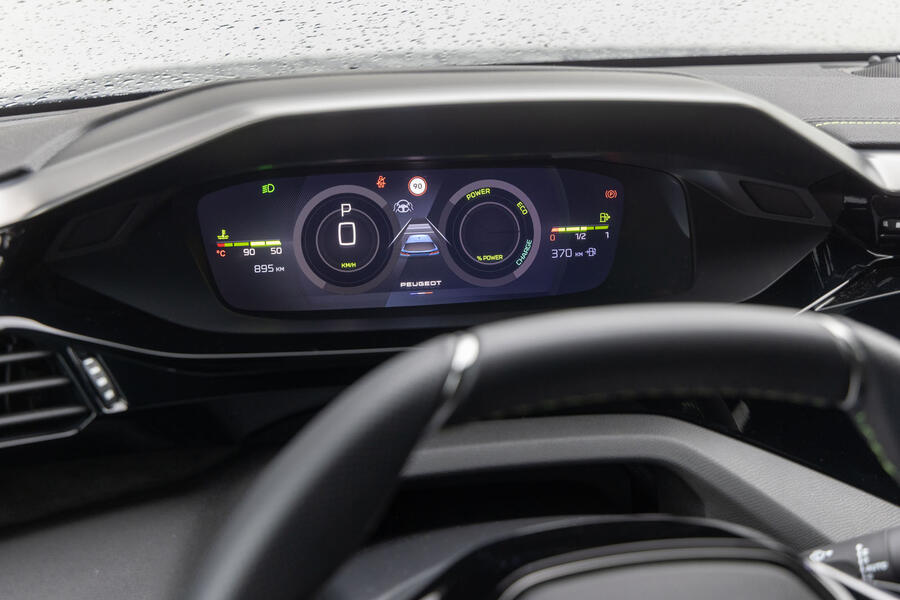
Even after up to a decade of getting used to it, the balance of testers reported that they still found the 308’s layout unintuitive; that the car’s handling seemed to benefit little from being translated through a smaller-diameter steering wheel; and that they didn’t enjoy an unencumbered view of the instruments in any case. With all of that said, it works better in the 308, with its lowish driving position, than in the smaller 208.
Be that as it may, though, if Peugeot’s designers could have been talked out of their ergonomic coup, it would have surely happened by now. And elsewhere, the 308 strikes quite a convincing semi-premium vibe. The car’s cabin is one of smart, boldly drawn geometric lines, moderately expensive-looking metallised trim finishes and appealing decorative textiles.
Now, the 308 definitely holds its own on ambient cabin appeal. It offers abundant oddment storage for the front seats also, thanks not least to Peugeot finally making the 308’s fuse box a part of its right-hand-drive conversion, meaning UK 308 owners get a full-size glove compartment.
The car’s front seats offer good support and reasonable comfort, although taller drivers might want a little more headrest adjustment range and lumbar support. Second-row accommodation remains quite lean by class standards – good enough for younger children but certainly not for taller adults, with both head room and knee room in pretty short supply. The estate provides a useful improvement in this area, thanks to its 6cm longer wheelbase.
Boot space is subject to quite a sizable loading lip in the hatch, and maximum loading space is 412 litres in most versions (314 litres in the plug-in hybrid). The estate adds around 150 litres in both cases.
This sounds very alluring indeed, because every 308 press car we’ve ever laid our hands on has been a more upmarket GT trim, which replaces this panel with what Peugeot calls i-Toggles. In effect, this is a smaller touchscreen with five user-configurable shortcuts. It’s a nice idea, but you're relatively limited in what you can actually make them do.
The rest of the system is now looking rather fussy compared with the best rivals’. It isn’t as responsive as some; it’s quite prescriptive about which functions can be accessed while you are driving; and it will warn you if you’ve been looking at it for too long, rather than at the road ahead. That might sound like a good safety feature, but a less distracting system overall would be a much better one.
Most 308s in the UK will be powered by Stellantis’s long-running and widely used 1.2-litre three-cylinder turbo petrol engine.
Despite how familiar it is, its character can be rather different depending on which car it’s in. In some applications, like the Vauxhall Corsa or Jeep Avenger, it’s rattly and rough; in others, it’s fairly unobtrusive.
Thankfully, the 308 belongs to the latter category. When we road tested the unhybridised version, we found it commendably refined, fairly free-revving and with a useful amount of accessible torque. It posted a respectable 9.5sec 0-60mph time.
Somewhat surprisingly given the presence of a 28bhp electric motor, the hybridised version isn’t quite the improvement you’d expect. The Volkswagen Group's 1.5 eTSI hybrid powertrain is both more refined and more flexible at low revs and tends to be a bit more responsive. Stellantis’s triple counters with a much greater fervour to explore the upper reaches of the tachometer. While we’ve not run the numbers on a hybridised 308, the factory claims it is 0.9sec faster to 62mph.
Where the dual-clutch and torque-converter gearboxes are kindred spirits is in their preference for low revs. Left to their own devices, both can be slow to kick down, overly keen to shift up and a little too given to ‘hunting’ for another ratio when it should simply be hauling on.
The 308 PHEV used to be quite short on electric grunt and had to rely on the petrol engine rather too much, even when there was plenty of juice in the battery. The updated version is much better in that respect, and the engine and electric motor will combine to give it a relatively muscular but relaxed turn of pace.
Remarkably, at 123bhp, it doesn’t have much less electric power than the fully electric e-308. The gearbox is no improvement, however. The dual-clutcher can be quite clunky at low speeds, even in electric mode.
Our time in the car was relatively limited, so we can’t say for sure yet how the system behaves with a depleted battery. Braking performance, like acceleration, is good for a fairly lightweight car. Pedal feel is fine, even in the electrified versions, and stability is good, our 308 stopping from 70mph in less than 45 metres.
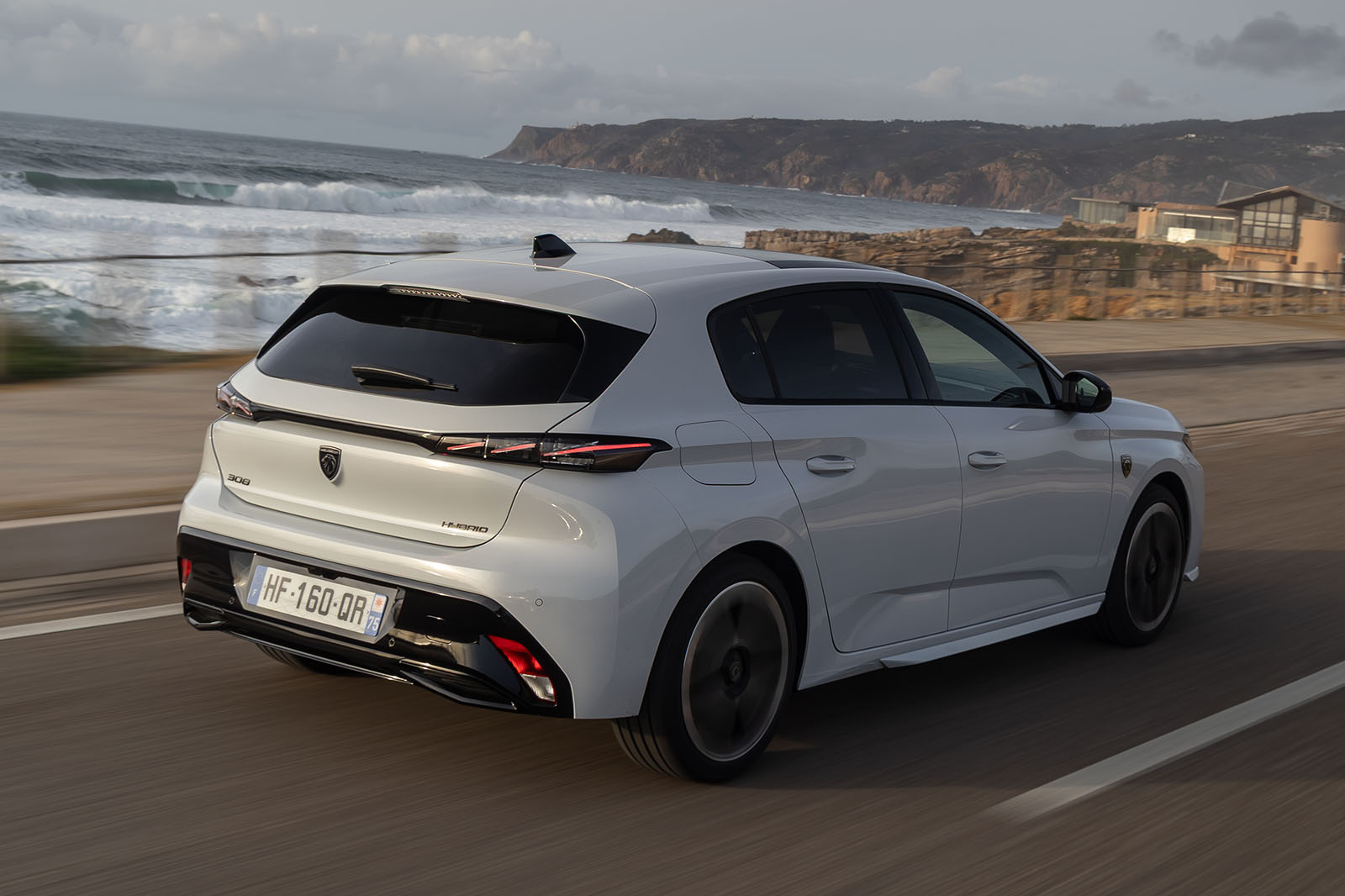
VERDICT: The 308 is probably the strongest product in Peugeot’s line-up, combining plenty of design style inside and out with the sort of dynamic mojo with which Peugeot made its modern reputation in the 1980s and 1990s.
The lighting signature introduced with the 2025 facelift is perhaps a little fussy, but the 308 remains a classy, elegant hatchback or estate.
Meanwhile, the interior has a richness of materials and design that makes the Golf look rather plain. The simpler versions ride and handle with a distinguishing fluidity, and an elastic energy that’s endearing.
The 308 isn’t quite complete enough as a product to top its class overall, though. It’s not the most practical hatchback, the user interface on the posher trims are rather fussy and the hybrid powertrains can be a little clunky at low speeds.
Autonews



Nenhum comentário:
Postar um comentário