AUTONEWS
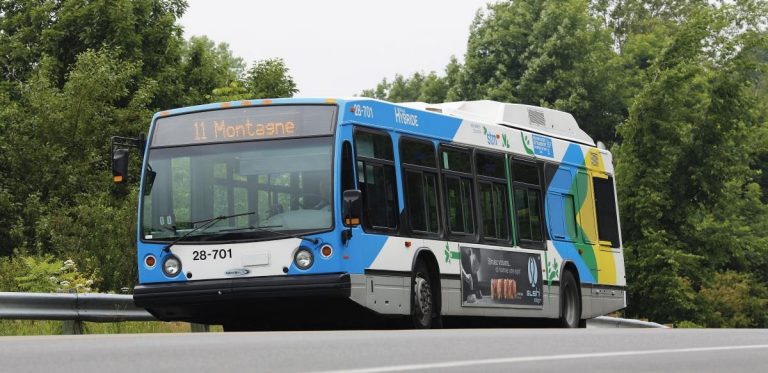
Montreal's electric buses use more energy in winter but are still more cost-effective than diesel
The Société de transport de Montréal (STM), the city's urban transit authority, plans to make its network completely electric by 2040 by adding 140 electric buses to its fleet annually to meet this target. It's an ambitious goal, made more challenging by the extreme swings in the city's weather every year.
The city's cold winters make serious demands on battery electric buses (BEBs). Keeping temperatures comfortable for passengers, accounting for stop-and-go city traffic and managing icy roads are important factors the agency must consider when forecasting its energy consumption as it transitions away from gas-powered vehicles.
A new Concordia-led study provides empirical evidence on how cold weather affects BEB performance while offering data-driven insights into how Montreal and other cities can keep the buses running efficiently year-round.
The research, published in Transportation Research Part D: Transport and Environment, is based on more than 66,000 data points supplied by the STM from 40 electric buses operating across 56 routes in Montreal. The real-world operational data allowed the team to assess how factors like temperature, traffic and driving patterns influence energy use, regenerative braking and operating costs.
"Most studies on electric buses have focused on temperate regions, but cold weather introduces unique challenges," says primary author Xuelin Tian, who completed her Ph.D. at Concordia this year. Tian is now a postdoctoral fellow at Université Laval in Quebec City.
A paper on this topic led by Concordia researchers was recently published in the journal Transportation Research Part D: Transport and Environment. In it, they describe a new framework to analyze the effectiveness and emission-reduction potential of electrifying transit policies. It includes estimates of upgrading infrastructure costs, operating costs, maintenance costs, carbon pricing and societal costs associated with air pollution in four Canadian cities. The researchers find that the electrification of bus fleets can lead to significant reductions not only in total greenhouse-gas emissions but also in maintenance and societal health-related costs.
An estimated 22 per cent of Canada’s greenhouse-gas emissions comes from the transportation sector. Decreasing its overall reliance on polluting fossil fuels is therefore critical to achieving the Paris Accords targets.
“When combined with other efforts to decarbonize energy systems, our research shows that from 2019 to 2030, cumulative GHG emissions of bus fleets in Toronto, Montreal, Edmonton and Halifax were reduced by 18.7 per cent, 30.1 per cent, 21.3 per cent and 34.6 per cent respectively,” says the study’s primary author Xuelin Tian. Tian is a PhD student in the Department of Building, Civil and Environmental Engineering at the Gina Cody School of Engineering and Computer Science.
Owen Waygood from Montreal’s École Polytechnique contributed to this paper, along with Concordia PhD students Zhikun Chen and He Peng. Associate professor Chunjiang An is the corresponding author.

"We already had a relationship with the STM. Thanks to our previous research, we were able to partner with them for an in-depth analysis of their operational data."
Lower costs despite winter demands...Unsurprisingly, the study found energy consumption was highest during the winter months, while efficiency was highest during the summer. Energy use peaked at 1.7 kilowatt hours per kilometer (kWh/km) in winter. That figure was roughly 26% higher than in summer, when smoother traffic flow and lower heating and other energy demands helped reduce consumption to 1.4 kWh/km. Spring and autumn fell in between these seasonal extremes.
The researchers also studied regenerative braking, the system that captures energy during deceleration and feeds it back into the battery. Montreal's BEBs recovered an average 45.8% of their braking energy—a figure that rises to more than 50% in the summer.
They performed worst in February, when only 32% of braking energy was recovered. This outcome was due to lowered battery efficiency and icy roads, which forced drivers to rely on traditional friction brakes. Regenerative brakes worked best when the buses were moving at moderate speeds, between 30 to 50 kilometers per hour.
Overall, however, the researchers found that electric buses are far more economical than diesel or hybrid vehicles. Operating costs for electric buses averaged 40 to 60% lower than their diesel counterparts, potentially saving the agency up to $3,500 a day for comparable routes.
"These results can provide improvements in operation planning by optimizing charging strategies, adjusting route lengths and balancing fleet usage," Tian says.
"Aside from helping the STM improve efficiency for their service, our study provides the kind of evidence-based results that can inform future pilot programs in other cities."
Provided by Concordia University



Nenhum comentário:
Postar um comentário