MAZDA
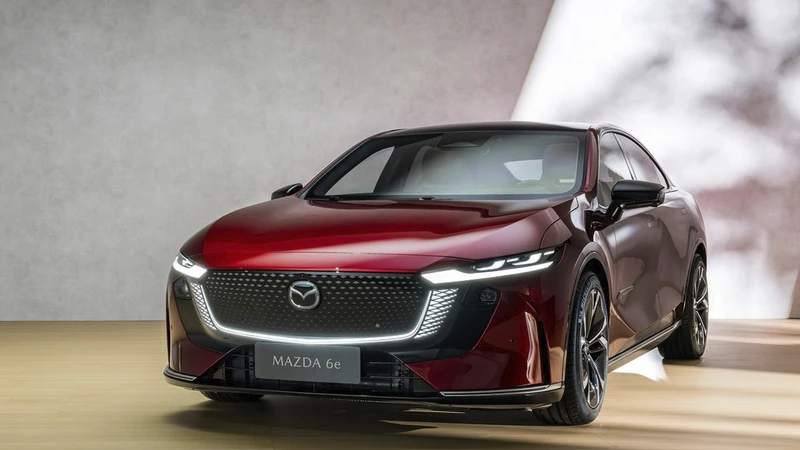
Mazda 6e: Why is he (probably) the best Japanese electric car?
The new Mazda 6e electric sedan, now available on the Portuguese market, is surprisingly interesting and competitive, positioning it (most likely) as the best Japanese electric car. However, it's curious that this achievement was achieved with the help of a Chinese manufacturer and one model in particular, the Deepal L07.
This isn't Mazda's first electric vehicle launch, but its first foray into this technology was far from remarkable. With the MX-30, the crossover based on the CX-30 and using a small battery (35.5 kWh gross), Mazda entered the electric vehicle world modestly. So much so that this model was met with a somewhat lukewarm reception, to the point that it was only produced between 2020 and 2024.
At 4,395 meters long, the MX-30's battery not only limited it to a "short" 200 km of range, but also limited it to charging at a maximum power of 50 kW, making charging the small battery slow. And this in an SUV that originally sold (in 2020) for R$35,000, before discounts were introduced to help move production. Now, Mazda's new electric sedan doesn't suffer from these drawbacks...The new Mazda 6e is substantially longer (4,921 m), wider (1,890 m instead of 1,795 m), and has a more generous wheelbase (2,895 m instead of 2,655 m), with the advantage of more powerful motors (245 or 258 hp instead of 145 hp) and larger battery capacities (68.8 or 80 kWh gross). Even so, these significant differences only translate into a small price jump of €5,000 between the Japanese automaker's two electric cars.
Mazda's new electric car is available in four trim levels, priced from €40,048 for the Takumi trim level to €44,498 for the Long Range Takumi Plus. Interestingly, Mazda combines the higher power with the "shorter" battery, which is a different approach than usual. The 245 hp motor powers the 6e Long Range with an 80 kWh (gross) battery, while the 258 hp motor powers the 68.8 kWh battery. The difference in power doesn't offset the battery's additional weight, so the more powerful Mazda is also the slower one (another strange decision, to say the least), claiming a 0-100 km/h time of 7.8 seconds, compared to 7.6 seconds for the less powerful and more affordable version.
Equipped with LFP batteries, the 6e is always limited to a top speed of 175 km/h, but with 68.8 kWh and 245 hp, it can travel 479 km between charges, while with 80 kWh and 258 hp, it has a range of 552 km. While not the best values on the market, they are very respectable, especially considering the sedan's affordable price and size. Still, when choosing between one range and the other, it's worth keeping in mind that the 68.8 kWh battery charges at 165 kW (DC), while the 80 kWh battery charges at 90 kW, which is yet another incomprehensible strategy that clashes with the competition.
All-New Mazda6e Scores Five Stars in Euro NCAP Safety Tests...Mazda’s latest all-electric offering, the Mazda6e, has earned a top five-star rating in the latest Euro NCAP safety tests, reaffirming the brand’s focus on safety and innovation. The sleek five-door hatchback impressed with an exceptional 93% score for both Adult and Child Occupant protection, alongside 74% for Vulnerable Road Users and 77% for Safety Assist systems.
Autonews




Nenhum comentário:
Postar um comentário