FIAT
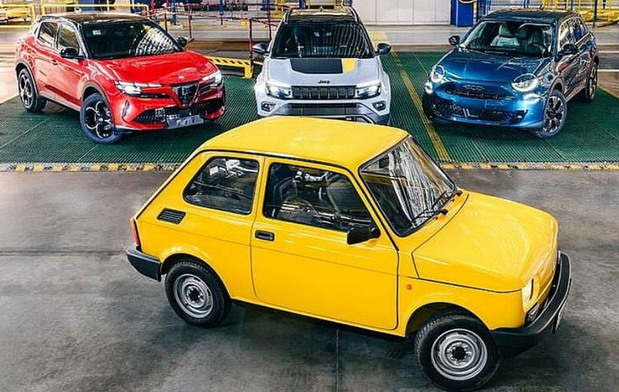
25 years ago we said goodbye to the legendary Peglica
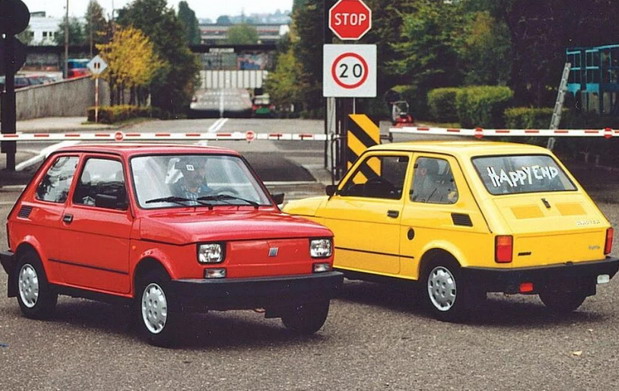
25 years ago, the last Fiat 126 "Happy End" in yellow left the production line at the Polish factory Fiat Auto Poland in Bielsko-Biała. What did one of the last and longest-lasting rear-engined small cars mean to Europe?
When it was presented at the Turin fair in 1972, the Fiat 126 had the thankless task of inheriting the legendary 500 model. While the "Nuova 500" was rounded and emotional, the Fiat 126 was angular and unusual, just to satisfy the trend of the 70s, according to Autonews.
The Fiat 126 is a city car designed by the young designer Sergio Sartorelli and produced by the Italian manufacturer Fiat. It was presented in October 1972 at the Turin Motor Show as a replacement for the Fiat 500. It was produced for many years, notably between 1973 and 2000.
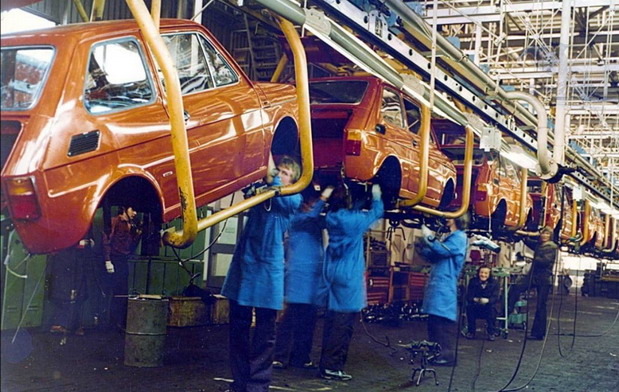
Sales in Western Europe ended in 1991, with production and sales continuing in the Polish market until 2000, having begun in 1973. The version produced in Poland was manufactured by Fabryka Samochodów Małolitrażowych and was known as the Polski Fiat 126p. In Italy, the car was produced at the Cassino and Termini Imerese factories until the 1980s. 4.6 million units of the model were produced.
The original version had a 594 cc engine and a 4-speed gearbox. In late 1977 the engine capacity was increased from 594 cc to 652 cc.
Dante Giacosa, creator of the 500 and Topolino, later stated that Fiat only wanted to increase production costs minimally, famously remarking, "It seemed impossible to give the look a shape that didn't evoke sad memories of the 500."
And so Fiat designer Sergio Sartorelli designed a slightly larger, but completely new body. An angular design in the style of the early 1970s, with the positive side effect of providing space for four people.
The new body retained the familiar wheelbase of 1.87 meters, but the length was slightly increased to 3.05 meters. The biggest advantage was the ability to accommodate four people. This also eliminated the need to develop an expensive new platform, and the craftsmen rubbed their hands because the rear-mounted drive concept remained more or less the same.
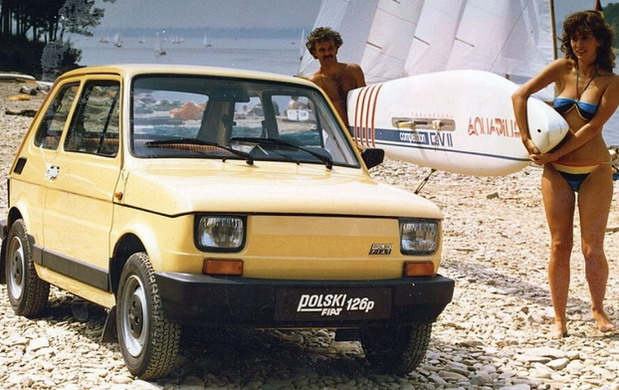
The roaring 594 cc, 23 hp two-cylinder engine enabled a top speed of 105 km/h. Practicality was improved by moving the fuel tank under the rear seat, which increased luggage space from 30 to 100 liters.
In January 1974, a folding roof was also available for the 126 model. Initially, the Fiat 126 cost 795,000 lire in Italy, and buyers jumped at the chance: By 1980, 1.35 million vehicles had rolled off the assembly line.
But some 2,000 kilometers away from Italy, the Fiat 126 will become a symbol of the whole nation and go much further than Europe. In Poland, the car was produced under license between 1973 and 2000 by the "Fabryka Samochodów Małolitrażowych" (FSM) (translated: Factory for Small Volume Vehicles, Small Car Factory) in Bielsko-Biała under the name Polski-Fiat 126p.
Nicknamed "Maluch" (meaning "small" or "dwarf"), the Fiat 126 became a symbol of mobility for an entire nation. Despite its price tag of 70,000 zlotys (about 20 monthly salaries), demand was so high that a second factory was opened in Tychy in 1975.
Initially, the Polski Fiat was almost identical to the basic Italian model: differences included a raised chassis, a modified rear grille and front turn signal lenses, which were transparent white in Italy and orange in other markets. To distinguish it from the original Italian car, the letter "p" was added to the name.

During the 1980s, the model was continuously improved with plastic bumpers, new lights, a better instrument panel and improved brakes. The 1983 650E had a higher compression ratio and a revised cylinder head, which reduced fuel consumption by five percent. In 1987, the 126 BIS went into production with a water-cooled 704 cc engine with 26 hp. This allowed for a large tailgate and a 100-litre boot, although the engine suffered from thermal problems. However, the top speed was 116 km/h, and the 126 accelerated to 100 km/h in "only" 33 seconds, instead of 47.
The Fiat 126 won the hearts of drivers all over the world. Between 1985 and 1989, for example, over 23,000 Maluchas were exported to China, where they were used as taxis in many Chinese cities. In the city of Wenzhou alone, there were 5,000 such taxis. But that was not the end of its overseas travels. In Australia, it found a small market between 1989 and 1992 under the name FSM Niki. At the time, it was the most affordable car in Australia. For one Holden V8, you could buy five Nikis.
The Fiat 126p was also successful in Cuba, where it was one of the best-selling cars of its time, and it is estimated that around 10,000 units exist today. Its nickname there was "Polqi" or "Polaquito" (little Pole).
Fiat marketed the 126 in Germany with many special models and above all with its price. Thus, in 1986, the Fiat 126 cost exactly 7,790 DM, which made it 2,000 DM cheaper than the cheapest Panda. The brochure even said: "If you travel with four people, the price drops to almost zero: less than five pfennigs per person!"
Even in the former Yugoslavia, drivers called it "Peglica" because of the 126PGL designation.
Between 1991 and 1995, a convertible version was also produced, which was exported to Western Europe under the name POP.
When the last yellow "Happy End" rolled off the production line at noon on September 22, 2000, the era of the small car that powered millions of drivers came to an end. Of the 4.7 million units produced, Polish factories made the largest contribution to this impressive figure.
Autonews


Nenhum comentário:
Postar um comentário