AUTONEWS
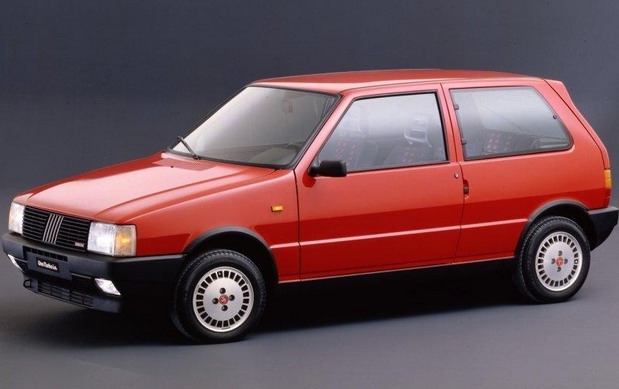
The 1980s were truly something special in the world of cars. Namely, most manufacturers offered the market uncompromising sports models in the city and compact class that, for affordable money, could compete with much more expensive sports coupe models with their small mass and powerful engines.
Some of the most important protagonists of that era came from France - the superbly maneuverable Peugeot 205 GTI 1.6/1.9 (1984–1994) with 105 to 130 hp and the bullet-fast Renault 5 GT Turbo with 115 hp (1985–1991). Of course, the Germans also had their famous representatives - the iconic VW Golf 1.8 GTI 16V "Dvojka" (1986–1992) with 139 hp, the Opel Kadett GSI 16V (1987–1991) with 115 to 150 hp and the Ford Fiesta XR2 (1981–1989) with a naturally aspirated 1.6 liter engine from 96 to 110 hp.
Japan was represented by Honda Civic models with incredibly durable 1.6 liter naturally aspirated engines that "revolved endlessly", as well as, for example, the Suzuki Swift GTI powered by a 1.3 liter naturally aspirated 4-cylinder, an incredibly agile and fast city car to drive.
The colors of Italy were then represented by the Lancia Delta HF Turbo (1983–1986) with a 1.6-liter turbo engine of 105 hp and the Fiat Ritmo 105 TC with 105 hp from a 1.6-liter naturally aspirated engine, but this is the story of another urban Italian with a small mass and a powerful engine - the Fiat Uno Turbo i.e.
Four decades have passed since Fiat introduced the first generation that would forever change the perception of compact cars, and the Uno Turbo i.e. became an icon of the 1980s and 1990s, combining the practicality of a city car with adrenaline-pumping sports performance.
The small Uno with the addition of Turbo "i.e." (electronic fuel injection) was introduced in 1985 as the "top gun" model in the range and achieved 105 hp. At the same time, the Fiat Uno Turbo i.e. and the first Fiat model with a turbocharger, and the technology itself, without exaggeration, comes from Ferrari's experiences from that time with turbo engines in Formula 1, according to Jutarnji.hr.
The 1.3-liter 69 hp engine itself had already been installed in the Ritmo and Uno 70 SX, and for this occasion it was refined with Bosch electronic multi-point injection (hence the designation Iniezione elettronica, or i.e.), as well as Magneti Marelli electronic ignition and an IHI water-cooled turbocharger.
As a result of this cutting-edge technology, the Fiat Uno Turbo i.e. achieved 105 hp at 6500 rpm. and 150 Nm at 3200 rpm. These figures, especially today, are not impressive, but with a weight of only 845 kilograms, the Fiat Uno Turbo i.e. achieved 100 km/h from a standstill in around eight seconds and could reach 200 km/h.
The braking system is capable of handling the muscle of the fastest Uno, with 240 mm self-ventilated discs at the front and 227 mm at the rear. In the Antiskid version, introduced in 1987, there was a kind of rudimentary ABS that worked on the front wheels, but with questionable performance, so most owners decided to deactivate it.
The characteristic "cube" design, sporty body decorations and Turbo badges made it a favorite of all drivers across Europe. To make it as light as possible, for example, the tailgate was made of fiberglass, it received front fog lights and a small spoiler at the end of the roof, as well as characteristic 13-inch Cromodorine alloy wheels decorated with the Abarth scorpion on the hubcaps with 175/60 tires.
The Uno Turbo cabin was sporty with seats in red and black tones, and the "rich" Veglia-Borletti instrument panel also attracts attention, which also includes a turbo pressure gauge and oil pressure and temperature indicators and coolant temperature.
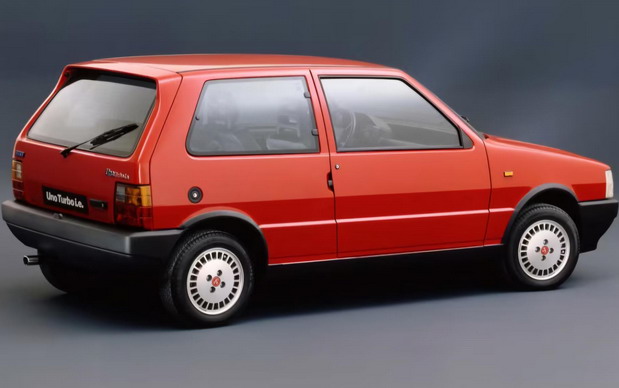
The speedometer scale ended at 240 km/h, and the four-spoke steering wheel was sporty, on which the red inscription "Uno Turbo" stood out. Optionally, from 1986 the model could be ordered with a (spectacular for the 1980s) digital instrument panel. Its agility, speed, superb handling, precise steering and the characteristic sound of the turbo engine won over fans of sports models in no time.
Today, 40 years later, the Fiat Uno Turbo i.e. remains a legend among collectors and car enthusiasts. Restored examples are becoming more valuable, and nostalgia for this car continues to grow, so the prices of "surviving" neat examples are also rising - today up to 20,000 euros.
Four years later, a redesigned model arrived, better in terms of performance and more modern, but still without the aura of the first, initial generation.
Photo: Fiat/Stellantis

/i.s3.glbimg.com/v1/AUTH_cf9d035bf26b4646b105bd958f32089d/internal_photos/bs/2025/r/i/sKfqKSQNWEjuGKmjmkIw/mercedes-benz-cla-250-1-frente-diagonal.jpg)


Nenhum comentário:
Postar um comentário